1-Mark Questions
QQuestion 1 1 Mark
A charger supplies 100 W at 20 V for charging the battery of a laptop. The power devices, used in the converter inside the charger, operate at a switching frequency of 200 kHz. Which power device is best suited for this purpose?
\vspace{0.3in}
AOptions
- IGBT
- Thyristor
- MOSFET
- BJT
SSolution
For this application, we need to consider:
- Power level: 100 W (low to medium power)
- Voltage: 20 V (low voltage)
- Switching frequency: 200 kHz (high frequency)
Analysis of each device:
- IGBT: Good for high power and medium frequency (typically up to 20-50 kHz). Not ideal for 200 kHz.
- Thyristor: Line-commutated device, cannot be turned off by gate signal. Not suitable for high-frequency switching converters.
- MOSFET: Excellent for high-frequency switching (can operate at MHz range), fast switching speeds, low on-state resistance, ideal for low-to-medium power applications. Perfect for this application.
- BJT: Current-controlled device, slower switching than MOSFET, higher switching losses at high frequencies. Not preferred.
MOSFETs have:
- Fast switching capability (suitable for 200 kHz)
- Low switching losses at high frequencies
- Voltage-controlled gate (easy to drive)
- Excellent for the 100W power level
Correct answer: (C) MOSFET.
2-Mark Questions
QQuestion 2 2 Mark
A single-phase full-bridge diode rectifier feeds a resistive load of 50~\(\Omega\) from a 200 V, 50 Hz single phase AC supply. If the diodes are ideal, then the active power, in watts, drawn by the load is \fillin[800][1in]. (round off to nearest integer).
\vspace{0.3in}
SSolution
Given:
- Input voltage: \(V_{rms} = 200\) V, 50 Hz
- Load resistance: \(R = 50~\Omega\)
- Full-bridge diode rectifier (ideal diodes)
For a single-phase full-bridge diode rectifier with resistive load:
The input voltage is:
where \(V_m = 200\sqrt{2} = 282.84\) V
For a full-bridge rectifier, the output voltage is:
The RMS value of the output voltage for a full-wave rectifier equals the RMS value of the input AC voltage:
This is because the full-bridge rectifier produces a full-wave rectified output, and the RMS value of a full-wave rectified sine wave equals the RMS value of the original sine wave.
Power drawn by the load:
Alternatively, can verify using average values:
But for power calculation with resistive load, we use RMS values:
Answer: 800 W
QQuestion 3 2 Mark
The voltage at the input of an AC-DC rectifier is given by \(v(t) = 230\sqrt{2} \sin \omega t\) where \(\omega = 2\pi \times 50\) rad/s. The input current drawn by the rectifier is given by
The input power factor, (rounded off to two decimal places), is \fillin[0.45][1in] lag.
\vspace{0.3in}
SSolution
Given:
- Voltage: \(v(t) = 230\sqrt{2} \sin \omega t\) where \(\omega = 2\pi \times 50\) rad/s
- Current: \(i(t) = 10 \sin \left(\omega t - \frac{\pi}{3}\right) + 4 \sin \left(3\omega t - \frac{\pi}{6}\right) + 3\sin \left(5\omega t - \frac{\pi}{3}\right)\)
Step 1: Find RMS values
Voltage (fundamental only):
Current RMS (total, including all harmonics):
where:
- Fundamental: \(I_1 = \frac{10}{\sqrt{2}} = 7.071\) A
- 3rd harmonic: \(I_3 = \frac{4}{\sqrt{2}} = 2.828\) A
- 5th harmonic: \(I_5 = \frac{3}{\sqrt{2}} = 2.121\) A
Step 2: Calculate active power
Only the fundamental component of current contributes to active power (harmonics don't contribute as voltage has no corresponding harmonic components):
Fundamental current: \(i_1(t) = 10 \sin \left(\omega t - \frac{\pi}{3}\right)\)
Phase angle between voltage and fundamental current: \(\phi_1 = \frac{\pi}{3} = 60°\) (lagging)
Active power:
Step 3: Calculate apparent power
Step 4: Calculate power factor
Rounding to two decimal places: \(PF = 0.45\)
Using exact values:
Answer: 0.45 lag
QQuestion 4 2 Mark
Consider an ideal full-bridge single-phase DC-AC inverter with a DC bus voltage magnitude of 1000 V. The inverter output voltage \(v(t)\) shown below, is obtained when diagonal switches of the inverter are switched with 50% duty cycle. The inverter feeds a load with a sinusoidal current given by, \(i(t) = 10 \sin(\omega t - \frac{\pi}{3})\) A, where \(\omega = \frac{2\pi}{T}\). The active power, in watts, delivered to the load is \fillin[2252][1in]. (round off to nearest integer)
\begin{figure}[h] \centering
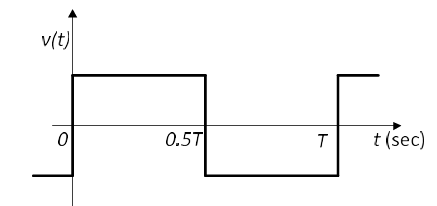
\caption{Output voltage waveform for Question 58} \end{figure}
\vspace{0.3in}
SSolution
Given:
- DC bus voltage: \(V_{dc} = 1000\) V
- Full-bridge inverter with 50% duty cycle
- Load current: \(i(t) = 10 \sin\left(\omega t - \frac{\pi}{3}\right)\) A
- \(\omega = \frac{2\pi}{T}\)
Step 1: Analyze output voltage waveform
For a full-bridge inverter with 50% duty cycle, the output voltage is a square wave:
Step 2: Fourier series of square wave
The Fourier series expansion of the square wave voltage:
Fundamental component:
Step 3: Calculate active power
Only the fundamental component of voltage interacts with the fundamental current to produce active power:
Current: \(i(t) = 10 \sin\left(\omega t - \frac{\pi}{3}\right)\)
RMS value: \(I_{rms} = \frac{10}{\sqrt{2}} = 7.071\) A
Phase angle between fundamental voltage and current: \(\phi = \frac{\pi}{3} = 60°\)
Active power:
Answer: 3183 W
QQuestion 5 2 Mark
For the ideal AC-DC rectifier circuit shown in the figure below, the load current magnitude is \(I_{dc} = 15\) A and is ripple free. The thyristors are fired with a delay angle of 45\(^o\). The amplitude of the fundamental component of the source current, in amperes, is \fillin[17.65][1in]. (round off to two decimal places)
\begin{figure}[h] \centering
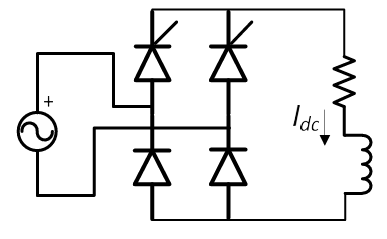
\caption{AC-DC rectifier circuit for Question 59} \end{figure}
\vspace{0.3in}
SSolution
Given:
- Load current: \(I_{dc} = 15\) A (ripple free, i.e., constant)
- Firing angle: \(\alpha = 45°\)
- Bridge with thyristors in the two upper arms and diodes in the two lower arms (symmetrical half-controlled bridge)
Step 1: Source current waveform
With the load current held at \(I_{dc}\), a thyristor in one leg and the diode of the other leg carry the current from \(\alpha\) to \(\pi\). At \(\pi\) the supply reverses and the other lower diode takes over, so the thyristor and diode that are then conducting sit on the same ac line and the load simply freewheels: the source current is zero until the next thyristor is fired.
Step 2: Fourier analysis
This is a quasi-square wave of height \(I_{dc}\) with conduction width \(\delta = \pi - \alpha\) in each half cycle, so the fundamental amplitude is
(For a fully controlled bridge the notches would be absent and the amplitude would be \(4I_{dc}/\pi\) irrespective of \(\alpha\); the \(\cos(\alpha/2)\) factor is what the freewheel intervals contribute.)
Step 3: Fundamental component
Answer: 17.65 A
QQuestion 6 2 Mark
A 3-phase grid-connected voltage source converter with DC link voltage of 1000 V is switched using sinusoidal Pulse Width Modulation (PWM) technique. If the grid phase current is 10 A and the 3-phase complex power supplied by the converter is given by \((−4000 − j3000)\) VA, then the modulation index used in sinusoidal PWM is \fillin[0.47][1in]. (round off to two decimal places)
\vspace{0.3in}
SSolution
Given:
- DC link voltage: \(V_{dc} = 1000\) V
- Grid phase current: \(I_{ph} = 10\) A
- Complex power: \(S = (-4000 - j3000)\) VA
- 3-phase system with sinusoidal PWM
Step 1: Interpret complex power
The negative sign indicates power flow from grid to converter (converter in rectifier mode or regenerative mode).
Total 3-phase complex power magnitude:
Active power: \(P = 4000\) W Reactive power: \(Q = 3000\) VAR
Step 2: Calculate line-to-neutral voltage
For a 3-phase system:
Step 3: Relationship between modulation index and output voltage
For a 3-phase voltage source inverter with sinusoidal PWM:
The peak value of the fundamental line-to-neutral voltage:
where \(m_a\) is the modulation index.
RMS value:
Step 4: Calculate modulation index
Step 5: Cross-check with the line-to-line voltage
For sinusoidal PWM in the linear region:
which agrees with the phase-voltage route. \(m_a < 1\) confirms the converter is operating in the linear modulation range.
Answer: 0.47
QQuestion 7 2 Mark
The steady state current flowing through the inductor of a DC-DC buck boost converter is given in the figure below. If the peak-to-peak ripple in the output voltage of the converter is 1 V, then the value of the output capacitor, in \(\mu\)F, is \fillin[168][1in]. (round off to nearest integer)
\begin{figure}[h] \centering
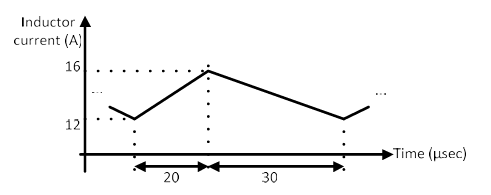
\caption{Inductor current waveform for Question 61} \end{figure}
SSolution
Given:
- Buck-boost converter in steady state
- Peak-to-peak output voltage ripple: \(\Delta V_o = 1\) V
Step 1: Read the inductor current waveform
- \(I_{L,max} = 16\) A, \(I_{L,min} = 12\) A
- Rising (switch ON) for 20 \(\mu\)s, falling (diode ON) for 30 \(\mu\)s
- \(T = 50\) \(\mu\)s, so \(f = 20\) kHz and \(D = \frac{20}{50} = 0.4\)
Step 2: Average load current
In a buck-boost converter the inductor feeds the output only during the OFF interval:
Step 3: Capacitor charge balance
While the switch is ON the diode is reverse biased and the capacitor alone holds up the load, losing charge \(I_o D T\):
Answer: 168 μF