0-Mark Questions
QQuestion 1 0 Mark
A six-pulse thyristor bridge rectifier is connected to a balanced three-phase, 50 Hz AC source. Assuming that the DC output current of the rectifier is constant, the lowest harmonic component in the AC input current is
AOptions
- 100 Hz
- 150 Hz
- 250 Hz
- 300 Hz
SSolution
For a six-pulse (three-phase) thyristor bridge rectifier:
The AC input current contains harmonics at:
where \(q = 6\) (pulse number), \(n = 1, 2, 3, ...\)
Harmonic orders: \(h = 5, 7, 11, 13, 17, 19, ...\)
Frequencies: \(f_h = h \times f_0\)
Lowest harmonic: \(h = 5\)
The characteristic harmonics are \(6k \pm 1\) where \(k = 1, 2, 3, ...\), i.e. orders 5, 7, 11, 13, ...
Triplen harmonics are absent from the line currents of a balanced three-phase bridge and the even harmonics are absent by half-wave symmetry, so nothing exists at 100 Hz, 150 Hz or 300 Hz.
The lowest harmonic component is therefore the 5th, at 250 Hz.
Correct answer: C
QQuestion 2 0 Mark
Given, \(V_{gs}\) is the gate-source voltage, \(V_{ds}\) is the drain source voltage, and \(V_{th}\) is the threshold voltage of an enhancement type NMOS transistor, the conditions for transistor to be biased in saturation are
AOptions
- \(V_{gs} < V_{th}\); \(V_{ds} \geq V_{gs} - V_{th}\) \(V_{gs} > V_{th}\); \(V_{ds} \geq V_{gs} - V_{th}\)
- \(V_{gs} > V_{th}\); \(V_{ds} \leq V_{gs} - V_{th}\)
- \(V_{gs} < V_{th}\); \(V_{ds} \leq V_{gs} - V_{th}\)
SSolution
For an enhancement type NMOS transistor to operate in saturation region:
Condition 1: The transistor must be ON
Condition 2: The channel must be pinched off at the drain end
where \(V_{ov}\) is the overdrive voltage.
These conditions ensure:
- Channel is formed (\(V_{gs} > V_{th}\))
- Drain current is relatively independent of \(V_{ds}\) (saturation)
Correct answer: B
QQuestion 3 0 Mark
The output voltage of a single-phase full bridge voltage source inverter is controlled by unipolar PWM with one pulse per half cycle. For the fundamental rms component of output voltage to be 75% of DC voltage, the required pulse width in degrees (rounded off to one decimal place) is \_\_\_\_\_\_\_\_.
SSolution
For a single-phase full bridge inverter with unipolar PWM:
The fundamental component (RMS) of output voltage is:
where \(\alpha\) is the pulse width in radians.
Given: \(V_{1,rms} = 0.75 V_{dc}\)
QQuestion 4 0 Mark
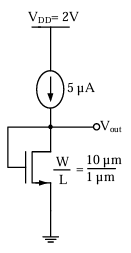
The enhancement type MOSFET in the circuit below operates according to the square law. \(\mu_n C_{ox} = 100\) \(\mu\)A/V\(^2\), the threshold voltage (\(V_T\)) is 500 mV. Neglect channel length modulation. The output voltage \(V_{out}\) is
AOptions
- 100 mV
- 500 mV
- 600 mV
- 2 V
SSolution
Given: \(\mu_n C_{ox} = 100\) \(\mu\)A/V\(^2\), \(V_T = 0.5\) V, \(\frac{W}{L} = 10\), \(I_D = 5\) \(\mu\)A
For saturation region:
The gate is tied to the drain, so the device is diode-connected: \(V_{GS} = V_{DS} = V_{out}\). Then \(V_{DS} > V_{GS} - V_T\) automatically, so the transistor is in saturation, and the 5 \(\mu\)A source fixes the drain current.
Correct answer: C
QQuestion 5 0 Mark
A DC-DC buck converter operates in continuous conduction mode. It has 48 V input voltage, and it feeds a resistive load of 24 \(\Omega\). The switching frequency of the converter is 250 Hz. If switch-on duration is 1 ms, the load power is
AOptions
- 12 W
- 24 W
- 48 W
SSolution
Given: \(V_{in} = 48\) V, \(R_L = 24\) \(\Omega\), \(f = 250\) Hz, \(t_{on} = 1\) ms
Time period: \(T = \frac{1}{250} = 4\) ms
Duty ratio: \(D = \frac{t_{on}}{T} = \frac{1}{4} = 0.25\)
For a buck converter:
Load power:
Correct answer: A
QQuestion 6 0 Mark
In a DC-DC boost converter, the duty ratio is controlled to regulate the output voltage at 48 V. The input DC voltage is 24 V. The output power is 120 W. The switching frequency is 50 kHz. Assume ideal components and a very large output filter capacitor. The converter operates at the boundary between continuous and discontinuous conduction modes. The value of the boost inductor (in \(\mu\)H) is \_\_\_\_\_\_\_\_.
SSolution
Given: \(V_{out} = 48\) V, \(V_{in} = 24\) V, \(P_{out} = 120\) W, \(f = 50\) kHz
Duty ratio:
Output current:
Input current:
At boundary of CCM and DCM:
The minimum inductor current reaches zero. The average inductor current equals input current:
Peak-to-peak ripple: \(\Delta I_L = 2 I_{L,avg} = 10\) A (at boundary)
Change in inductor current during ON time:
where \(T = \frac{1}{f} = \frac{1}{50 \times 10^3} = 20\) \(\mu\)s
QQuestion 7 0 Mark
A fully-controlled three-phase bridge converter is working from a 415 V, 50 Hz AC supply. It is supplying constant current of 100 A at 400 V to a DC load. Assume large inductive smoothing and neglect overlap. The rms value of the AC line current in amperes (rounded off to two decimal places) is \_\_\_\_\_\_\_\_.
SSolution
Given: \(V_{L} = 415\) V, \(f = 50\) Hz, \(I_{dc} = 100\) A, \(V_{dc} = 400\) V
For a three-phase fully-controlled bridge converter with highly inductive load, the line current waveform is quasi-square wave.
Each line conducts for 120° (or \(\frac{2\pi}{3}\) radians) per half cycle.
The RMS line current is:
QQuestion 8 0 Mark
A single-phase fully-controlled thyristor converter is used to obtain an average voltage of 180 V with 10 A constant current to feed a DC load. It is fed from single-phase AC supply of 230 V, 50 Hz. Neglect the source impedance. The power factor (rounded off to two decimal places) of AC mains is \_\_\_\_\_\_\_\_.
SSolution
Given: \(V_{dc} = 180\) V, \(I_{dc} = 10\) A, \(V_s = 230\) V, \(f = 50\) Hz
DC output power:
For ideal converter: \(P_{ac} = P_{dc} = 1800\) W
Average output voltage for single-phase fully-controlled converter:
where \(V_m = \sqrt{2} \times 230 = 325.27\) V
RMS line current:
For rectangular current waveform (highly inductive load), each thyristor conducts for 180°:
Apparent power:
Power factor:
The same figure follows from the standard expression, in which \(\frac{2\sqrt{2}}{\pi}\) is the distortion factor of the rectangular line current and \(\cos\alpha\) is the displacement factor: