1-Mark Questions
QQuestion 1 1 Mark
Q45 (Set-1): BJT in saturation mode, which statement TRUE about CB and BE junctions?
\subsection*{Set-2 Questions}
AOptions
- CB forward, BE reverse biased
- CB reverse, BE forward biased
- Both CB and BE forward biased
- Both CB and BE reverse biased
SSolution
BJT operating modes:
Active: BE forward, CB reverse
Saturation: Both BE and CB forward biased
Cutoff: Both junctions reverse biased
Inverted active: BE reverse, CB forward
In saturation, transistor acts as closed switch with both junctions forward biased.
Answer: C
QQuestion 2 1 Mark
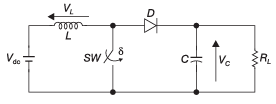
Q20 (Set-2): Self-commutating switch at duty cycle \(\delta\) controls load voltage. Under steady-state, average voltage across \(L\) and \(C\) respectively are
AOptions
- \(V_L = 0\) and \(V_C = \frac{V_{dc}}{1-\delta}\)
- \(V_L = \frac{\delta^2V_{dc}}{1-\delta}\) and \(V_C = \frac{V_{dc}}{1-\delta}\)
- \(V_L = 0\) and \(V_C = \frac{V_{dc}}{1-\delta}\)
- Different values
SSolution
Boost converter analysis:
Circuit represents boost (step-up) converter.
Inductor voltage:
In steady-state, average voltage across inductor:
Output voltage:
Answer: A
2-Mark Questions
QQuestion 3 2 Mark
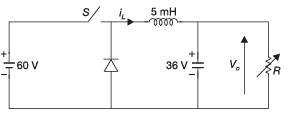
Q22 (Set-1): Buck converter feeding variable resistive load. Switching frequency 100 kHz, duty ratio 0.6, \(V_O = 36\) V, \(L = 5\) mH. All components ideal, ripple-free output. Value of \(R\) (in \(\Omega\)) for inductor current just continuous is
SSolution
Inductor ripple current:
For buck converter: \(V_O = DV_S\)
For continuous conduction:
At boundary: \(I_{L,min} = 0\)
Average current: \(I_{L,avg} = \frac{\Delta I_L}{2} = 0.0144\) A
Answer: 2480-2520 \(\Omega\)
QQuestion 4 2 Mark
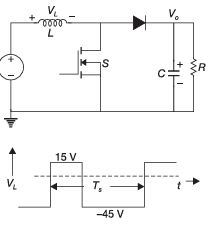
Q23 (Set-1): Switching converter with inductor voltage waveform shown. \(V_L = +15\) V during ON, \(V_L = -45\) V during OFF. Duty cycle is
SSolution
Steady-state inductor voltage:
Average voltage across inductor in steady-state:
Duty cycle:
Answer: 0.75
QQuestion 5 2 Mark
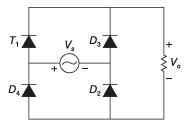
Q24 (Set-1): Rectifier with thyristor \(T_1\), delay angle 30° from positive zero crossing of \(V_s = 100\sin(100\pi t)\) V. Average voltage across \(R\) (in V) under steady-state is
SSolution
Circuit operation:
The bridge contains one thyristor \(T_1\) and three diodes. In the positive half cycle \(T_1\) and \(D_2\) conduct, but only from the firing instant \(\alpha = 30°\) onwards. In the negative half cycle the two diodes \(D_3\) and \(D_4\) conduct without any control, so the complete half cycle appears across \(R\).
Average output voltage:
Answer: 61.53 V (range: 61 to 62)
QQuestion 6 2 Mark
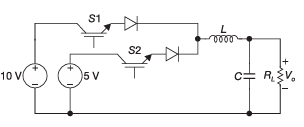
Q19 (Set-2): Circuit with switches \(S_1\) and \(S_2\) controlled alternately. \(S_1\) on 0.2 ms, \(S_2\) on 0.3 ms in 0.5 ms period. Continuous inductor current, negligible capacitor ripple. Output voltage \(V_o\) (in V) is
SSolution
Average output voltage:
Two sources: \(V_1 = 10\) V, \(V_2 = 5\) V
Answer: 7 V
QQuestion 7 2 Mark
Q21 (Set-2): Single-phase full-bridge VSI, 50 Hz output, unipolar PWM with 50 kHz switching, modulation index 0.7. For \(V_{in} = 100\) V DC, \(L = 9.55\) mH, \(C = 63.66\) \(\mu\)F, \(R = 5\) \(\Omega\). Amplitude of fundamental output voltage \(V_o\) (in V) is
SSolution
Inverter fundamental:
For a full-bridge inverter with sinusoidal (unipolar) PWM in the linear range, the peak of the 50 Hz component at the bridge terminals is
Output filter at 50 Hz:
The 50 kHz switching harmonics are filtered out; only the 50 Hz component reaches the load. With \(R\) in parallel with \(C\),
Fundamental output amplitude:
Answer: 62.76 V (range: 60 to 64)
QQuestion 8 2 Mark
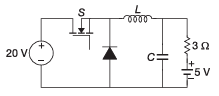
Q35 (Set-2): Chopper circuit with duty ratio 0.4. Input 20 V, battery 5 V, resistance 3 \(\Omega\). Charging current (in A) of 5 V battery under steady-state is
SSolution
Given: - Duty ratio: \(d = 0.4\) - Input: \(V_i = 20\) V - Battery: \(E = 5\) V - Resistance: \(R = 3\) \(\Omega\)
Average output voltage:
Charging current:
Answer: 1 A