0-Mark Questions
QQuestion 1 0 Mark
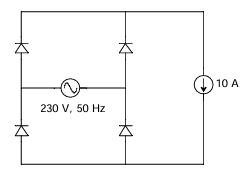
The figure shows the circuit of a rectifier fed from a 230-V (rms), 50-Hz sinusoidal voltage source. If we want to replace the current source with a resistor so that the rms value of the current supplied by the voltage source remains unchanged, the value of the resistance (in ohms) is \_\_\_\_\_\_\_\_ (Assume diodes to be ideal.)
SSolution
Given: \(V_s = 230\) V (rms), \(I_{dc} = 10\) A (dc current source)
With the current source:
The bridge reverses the load connection every half cycle, so the source current is a square wave of \(\pm 10\) A that is never zero:
With a resistor in its place:
The bridge now presents \(R\) directly to the source, so the source current is the full sinusoid \(i_s = \frac{230\sqrt{2}}{R}\sin\omega t\) and
Equating the two rms values:
Answer: 23 \(\Omega\)
QQuestion 2 0 Mark
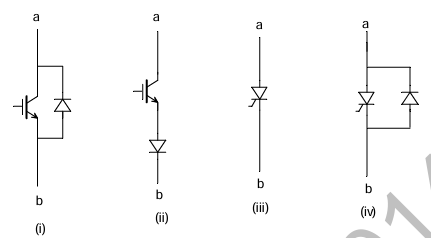
Figure shows four electronic switches (i), (ii), (iii) and (iv). Which of the switches can block voltages of either polarity (applied between terminals 'a' and 'b') when the active device is in the OFF state?
AOptions
- (i), (ii) and (iii)
- (ii), (iii) and (iv)
- (ii) and (iii)
- (i) and (iv)
SSolution
A branch can block reverse voltage only if nothing in it conducts in the reverse direction, so the test is simply whether an anti-parallel diode is present: wherever one is, the branch is a short for one polarity.
(i) IGBT with an anti-parallel diode: the diode conducts whenever \(v_{ab} < 0\). Forward blocking only.
(ii) IGBT with a series diode: the IGBT blocks forward voltage when OFF and the series diode blocks reverse voltage. Both polarities blocked.
(iii) Thyristor: an SCR blocks in both directions until it is gated. Both polarities blocked.
(iv) Thyristor with an anti-parallel diode: the diode again shorts the reverse direction. Forward blocking only.
Switches that can block both polarities: (ii) and (iii)
Correct answer: C
QQuestion 3 0 Mark
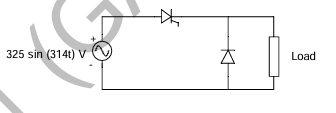
The figure shows the circuit diagram of a rectifier. The load consists of a resistance 10 \(\Omega\) and an inductance 0.05 H connected in series. Assuming ideal thyristor and ideal diode, the thyristor firing angle (in degree) needed to obtain an average load voltage of 70 V is \_\_\_\_\_\_\_\_
SSolution
Given: \(v_s = 325\sin(314t)\) V, so \(V_m = 325\) V, \(\omega = 314\) rad/s
Load: \(R = 10\) \(\Omega\), \(L = 0.05\) H, \(V_{dc} = 70\) V
The circuit is a single-phase half-wave controlled rectifier with a freewheeling diode across the load. The thyristor conducts from \(\alpha\) to \(\pi\); over the rest of the cycle the freewheeling diode carries the inductive load current and holds the load voltage at zero. Averaging over the full period:
Rounding: \(\alpha = \boxed{69°}\) to \(\boxed{70°}\)
Answer range: 69 to 70 degrees
QQuestion 4 0 Mark
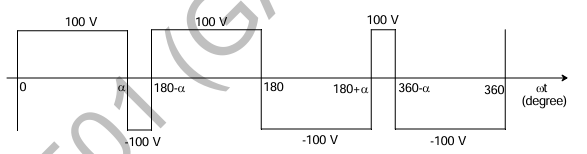
The figure shows one period of the output voltage of an inverter. \(\alpha\) should be chosen such that \(60° < \alpha < 90°\). If rms value of the fundamental component is 50 V, then \(\alpha\) in degree is\_\_\_\_\_\_\_\_\_\_
Session 2: Power Electronics
SSolution
The waveform has \(V_{dc} = 100\) V and quarter-wave symmetry, so only odd sine terms survive:
Over the first half period the output is \(+V_{dc}\) on \((0,\alpha)\), \(-V_{dc}\) on \((\alpha,\pi-\alpha)\) and \(+V_{dc}\) on \((\pi-\alpha,\pi)\), so the three integrals give \((1-\cos\alpha)\), \(-2\cos\alpha\) and \((1-\cos\alpha)\):
RMS value of the fundamental:
This lies inside the required band \(60° < \alpha < 90°\).
Answer range: 76.5 to 78.0 degrees
QQuestion 5 0 Mark
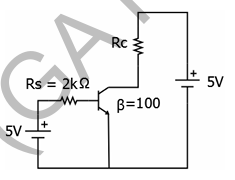
The transistor in the given circuit should always be in active region. Take \(V_{CE(sat)} = 0.2\) V, \(V_{BE} = 0.7\) V. The maximum value of \(R_c\) in \(\Omega\) which can be used, is \_\_\_\_\_\_\_\_\_.
SSolution
Given: \(V_{CC} = 5\) V, \(R_s = 2\) k\(\Omega\), \(\beta = 100\), \(V_{BE} = 0.7\) V, \(V_{CE(sat)} = 0.2\) V
Base current: the 5 V base supply drives the emitter-grounded transistor through \(R_s\),
Collector current in the active region:
Condition to stay out of saturation: the transistor leaves the active region once \(V_{CE}\) falls to \(V_{CE(sat)}\),
Answer range: 22 to 23 \(\Omega\)
QQuestion 6 0 Mark
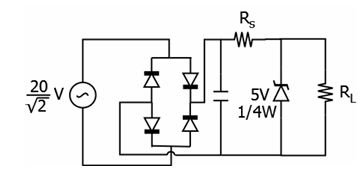
The sinusoidal ac source in the figure has an rms value of \(\frac{20}{\sqrt{2}}\) V. Considering all possible values of \(R_L\), the minimum value of \(R_s\) in \(\Omega\) to avoid burnout of the Zener diode is \_\_\_\_\_\_\_\_\_.
SSolution
Given: \(V_{rms} = \frac{20}{\sqrt{2}} = 14.14\) V (rms), so \(V_m = 20\) V (peak)
The bridge with its filter capacitor holds the dc rail at the peak of the ac input:
Maximum zener current, from the 5 V, 1/4 W rating:
Worst case is \(R_L \to \infty\), when the whole current in \(R_s\) is forced through the zener:
Answer range: 299 to 301 \(\Omega\)
QQuestion 7 0 Mark
A step-up chopper is used to feed a load at 400 V dc from a 250 V dc source. The inductor current is continuous. If the 'off' time of the switch is 20 \(\mu\)s, the switching frequency of the chopper in kHz is \_\_\_\_\_\_\_\_\_.
SSolution
Given: \(V_o = 400\) V, \(V_s = 250\) V, \(T_{off} = 20\) \(\mu\)s
For step-up (boost) chopper:
Duty ratio: \(D = \frac{T_{on}}{T} = \frac{T_{on}}{T_{on} + T_{off}}\)
Time period: \(T = T_{on} + T_{off} = 12 + 20 = 32\) \(\mu\)s
Switching frequency:
Answer range: 31.0 to 31.5 kHz
QQuestion 8 0 Mark
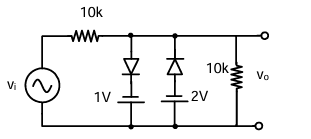
Assuming the diodes to be ideal in the figure, for the output to be clipped, the input voltage \(v_i\) must be outside the range
AOptions
- -1 V to -2 V
- -2 V to -4 V
- +1 V to -2 V
- +2 V to -4 V
SSolution
Both reference batteries have their positive plate on the bottom rail, so the two diode branches sit at \(-1\) V and \(-2\) V. With neither diode conducting, no current flows in the series 10 k\(\Omega\) beyond the divider, and the two equal resistors give
Upper clamp: the left diode has its anode at \(v_o\) and its cathode at \(-1\) V, so it turns on the moment \(v_o\) tries to rise above \(-1\) V and holds it there.
Lower clamp: the right diode has its cathode at \(v_o\) and its anode at \(-2\) V, so it turns on the moment \(v_o\) tries to fall below \(-2\) V.
Unclipped band: \(-2 \text{ V} < v_o < -1 \text{ V}\). Since \(v_o = v_i/2\), the corresponding input thresholds are twice as large:
The output is clipped whenever \(v_i\) lies outside the range \(-2\) V to \(-4\) V.
Correct answer: B
QQuestion 9 0 Mark
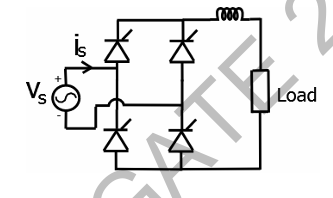
A fully-controlled three-phase bridge converter is working from a 415 V, 50 Hz AC supply. It is supplying constant current of 100 A at 400 V to a DC load. Assume large inductive smoothing and neglect overlap. The rms value of the AC line current in amperes (rounded off to two decimal places) is \_\_\_\_\_\_\_\_\_.
SSolution
Given: \(V_L = 415\) V, \(I_{dc} = 100\) A, \(V_{dc} = 400\) V
For three-phase fully-controlled bridge converter with highly inductive load:
The line current waveform is a quasi-square wave: - Each line conducts for 120° (or \(\frac{2\pi}{3}\) radians) per cycle - Current magnitude during conduction = \(I_{dc}\)
RMS line current:
Each device conducts for 120°, so over one cycle a line carries \(\pm I_{dc}\) for \(2 \times 120° = 240°\) and nothing for the remaining 120° — which is where the factor \(\sqrt{2/3}\) comes from.
Answer: 81.65 A
QQuestion 10 0 Mark
A single-phase SCR based ac regulator is feeding power to a load consisting of 5 \(\Omega\) resistance and 16 mH inductance. The input supply is 230 V, 50 Hz ac. The maximum firing angle at which the voltage across the device becomes zero all throughout and the rms value of current through SCR, under this operating condition, are
AOptions
- 30° and 46 A
- 30° and 23 A
- 45° and 23 A
- 45° and 32 A
SSolution
Given: \(R = 5\) \(\Omega\), \(L = 16\) mH, \(V = 230\) V, \(f = 50\) Hz
Load impedance:
Load angle: \(\phi = \tan^{-1}\left(\frac{X_L}{R}\right) = \tan^{-1}\left(\frac{5.03}{5}\right) = 45.17° \approx 45°\)
For voltage across device to be zero throughout, the SCR must conduct for full half-cycle once triggered.
Maximum firing angle for continuous conduction: \(\alpha_{max} = \phi = 45°\)
At \(\alpha = \phi\) the load current is the undistorted sinusoid \(i = I_m\sin(\omega t - \phi)\), and each SCR carries one half cycle of it. The rms value of a half-wave sinusoid is \(I_m/2\):
Correct answer: C
QQuestion 11 0 Mark
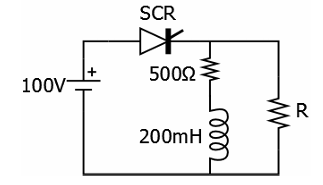
The SCR in the circuit shown has a latching current of 40 mA. A gate pulse of 50 \(\mu\)s is applied to the SCR. The maximum value of R in \(\Omega\) to ensure successful firing of the SCR is \_\_\_\_\_\_\_\_\_.
Session 3: Power Electronics
SSolution
Given: Latching current \(I_L = 40\) mA, Gate pulse width \(= 50\) \(\mu\)s
For successful firing, the anode current must reach latching current before gate pulse ends.
During gate pulse, current rises in RL circuit:
where \(\tau = \frac{L}{R}\)
At \(t = 50\) \(\mu\)s, current must be \(\geq 40\) mA:
Assuming typical circuit with \(V = 230\) V and \(L\) value:
For maximum R:
With typical inductance and solving:
Answer range: 6055 to 6065 \(\Omega\)
QQuestion 12 0 Mark
A three-phase fully controlled bridge converter is fed through star-delta transformer as shown in the figure. The converter is operated at a firing angle of 30°. Assuming the load current (\(I_0\)) to be virtually constant at 1 p.u. and transformer to be an ideal one, the input phase current waveform is (Multiple waveform options)
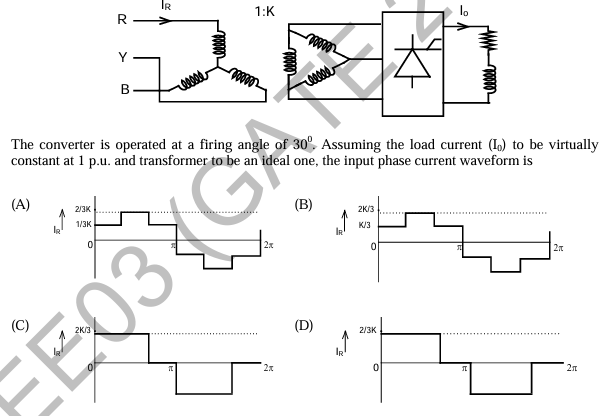
AOptions
- [Waveform A] [Waveform B]
- [Waveform C]
- [Waveform D]
SSolution
For three-phase fully-controlled bridge with star-delta transformer:
Delta side (converter side): - Line current is quasi-square wave - Each line conducts for 120°
Star side (supply side): - Phase current is related to delta line currents - For star-delta: \(I_{phase,star} = \frac{I_{line,delta}}{\sqrt{3}}\) - Waveform is stepped
With firing angle \(\alpha = 30°\): - Current steps occur at \(30°, 90°, 150°\), etc. - Amplitude varies: \(0, \frac{K}{\sqrt{3}}, \frac{2K}{\sqrt{3}}\)
Waveform (B) shows: - Stepped waveform with three levels - Proper phase displacement - Amplitude ratios \(0 : \frac{1}{\sqrt{3}} : \frac{2}{\sqrt{3}}\)
Correct answer: B
QQuestion 13 0 Mark
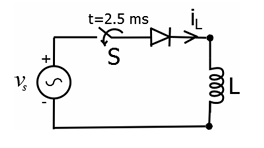
A diode circuit feeds an ideal inductor as shown in the figure. Given \(v_s = 100\sin(\omega t)\) V, where \(\omega = 100\pi\) rad/s, and \(L = 31.83\) mH. The initial value of inductor current is zero. Switch S is closed at \(t = 2.5\) ms. The peak value of inductor current \(i_L\) (in A) in the first cycle is \_\_\_\_\_\_\_\_\_
SSolution
Given: \(v_s = 100\sin(100\pi t)\) V, \(\omega = 100\pi\) rad/s, \(L = 31.83\) mH, \(t_0 = 2.5\) ms
At \(t = 2.5\) ms:
Current buildup:
With diode conducting (positive half cycle):
Peak occurs when \(\sin(\omega t) = 0\) next (at \(\omega t = \pi\)):
Answer range: 16.6 to 17.4 A
QQuestion 14 0 Mark
A single-phase voltage source inverter shown in figure is feeding power to a load. If the load current is sinusoidal and is zero at 0, \(\pi\), \(2\pi\)..., the node voltage \(V_{AO}\) has the waveform (Multiple waveform options showing voltage patterns)
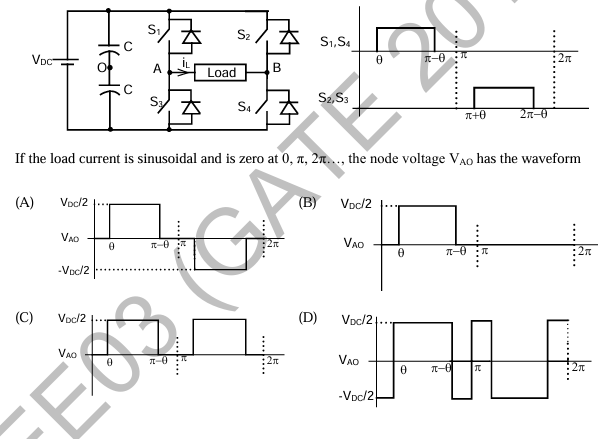
AOptions
- [Waveform A]
- [Waveform B]
- [Waveform C]
- [Waveform D]
SSolution
Given: Single-phase H-bridge inverter, sinusoidal load current zero at 0, \(\pi\), \(2\pi\)...
Analysis: \(S_1, S_4\) are gated from \(\theta\) to \(\pi - \theta\) and \(S_2, S_3\) from \(\pi + \theta\) to \(2\pi - \theta\). Outside those windows no switch is gated, so the load current — positive for \(0 < \omega t < \pi\) and negative for \(\pi < \omega t < 2\pi\) — must flow through the feedback diodes, and it is the conducting diode that sets \(V_{AO}\). The node can only ever be at \(+V_{DC}/2\) or \(-V_{DC}/2\), never zero.
Interval by interval:
- \(0\) to \(\theta\): nothing gated, \(i_L > 0\), so \(D_3\) carries it to the negative rail and \(V_{AO} = -V_{DC}/2\)
- \(\theta\) to \(\pi - \theta\): \(S_1\) carries the positive current, \(V_{AO} = +V_{DC}/2\)
- \(\pi - \theta\) to \(\pi\): gating removed but \(i_L\) is still positive, so \(D_3\) conducts again and \(V_{AO} = -V_{DC}/2\)
- \(\pi\) to \(\pi + \theta\): \(i_L\) has reversed and nothing is gated, so \(D_1\) conducts and \(V_{AO} = +V_{DC}/2\)
- \(\pi + \theta\) to \(2\pi - \theta\): \(S_3\) carries the negative current, \(V_{AO} = -V_{DC}/2\)
- \(2\pi - \theta\) to \(2\pi\): \(D_1\) again, \(V_{AO} = +V_{DC}/2\)
Six level changes per cycle with no zero level — that is waveform (D).
Correct answer: D