2-Mark Questions
QQuestion 1 2 Mark
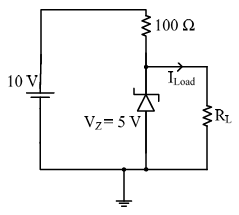
In the circuit shown below, the knee current of the ideal Zener diode is 10 mA. To maintain 5 V across \(R_L\), the minimum value of \(R_L\) in \(\Omega\) and the minimum power rating of the Zener diode in mW respectively are
AOptions
- 125 and 125
- 125 and 250
- 250 and 125
- 250 and 250
SSolution
Given:
- Source voltage: \(V_s = 10\) V
- Series resistance: \(R_s = 100\) \(\Omega\)
- Zener voltage: \(V_Z = 5\) V (to be held across \(R_L\))
- Knee current: \(I_{Z,min} = 10\) mA
Total current through the series resistor:
While the zener regulates it holds 5 V, so the drop across \(R_s\) is fixed and \(I_s\) is the same for every load:
Minimum \(R_L\):
The load can take the largest share of \(I_s\) when the zener is left with just its knee current:
Minimum power rating of Zener:
Maximum Zener current occurs when \(R_L\) is maximum (open circuit):
Correct answer: B (125 \(\Omega\) and 250 mW)
QQuestion 2 2 Mark
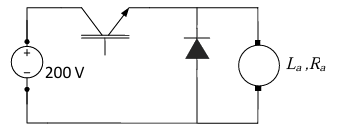
The separately excited dc motor in the figure below has a rated armature current of 20 A and a rated armature voltage of 150 V. An ideal chopper switching at 5 kHz is used to control the armature voltage. If \(L_a = 0.1\) mH, \(R_a = 1\) \(\Omega\), neglecting armature reaction, the duty ratio of the chopper to obtain 50% of the rated torque at the rated speed and the rated field current is
AOptions
- 0.4
- 0.5
- 0.6
- 0.7
SSolution
Given:
- Rated: \(I_{a,rated} = 20\) A, \(V_{a,rated} = 150\) V
- Source: \(V_s = 200\) V
- \(R_a = 1\) \(\Omega\), \(L_a = 0.1\) mH
- Required: 50% rated torque at rated speed and rated field
At rated conditions:
Back EMF:
At 50% rated torque:
Since \(T \propto \phi I_a\) and field is at rated value:
At rated speed, back EMF remains same (since \(E_b \propto \phi N\)):
Required armature voltage:
Duty ratio:
Correct answer: D
QQuestion 3 2 Mark
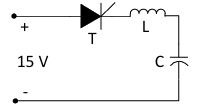
Thyristor T in the figure below is initially off and is triggered with a single pulse of width 10 \(\mu\)s. It is given that \(L = \frac{100}{\pi}\) \(\mu\)H and \(C = \frac{100}{\pi}\) \(\mu\)F. Assuming latching and holding currents of the thyristor are both zero and the initial charge on C is zero, T conducts for
AOptions
- 10 \(\mu\)s
- 50 \(\mu\)s
- 100 \(\mu\)s
- 200 \(\mu\)s
SSolution
This is an LC resonant circuit. When the thyristor is triggered, the capacitor charges through the inductor.
Natural frequency:
Period of oscillation:
The thyristor conducts for half cycle (until current tries to reverse):
Correct answer: C