1-Mark Questions
QQuestion 1 1 Mark
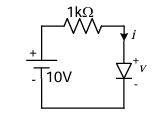
The i-v characteristics of the diode in the circuit given below are:
The current in the circuit is
AOptions
- 10 mA
- 9.3 mA
- 6.67 mA
- 6.2 mA
SSolution
Circuit equation:
Diode characteristic:
Substituting:
Current:
Correct answer: D
QQuestion 2 1 Mark
A half-controlled single-phase bridge rectifier is supplying an R-L load. It is operated at a firing angle \(\alpha\) and the load current is continuous. The fraction of cycle that the freewheeling diode conducts is
AOptions
- \(1/2\)
- \((1 - \alpha/\pi)\)
- \(\alpha/(2\pi)\)
- \(\alpha/\pi\)
SSolution
In a half-controlled bridge rectifier with freewheeling diode:
Operation:
- Positive half-cycle: Thyristors conduct from \(\alpha\) to \(\pi\)
- At \(\omega t = \pi\), when source voltage goes negative, freewheeling diode turns ON
- Freewheeling diode conducts from \(\pi\) to \((\pi + \alpha)\) in next half-cycle
- At \((\pi + \alpha)\), next pair of thyristors are fired
Conduction period of FWD:
From \(\omega t = \pi\) to \(\omega t = \pi + \alpha\)
Duration = \(\alpha\) radians out of \(2\pi\) radians per cycle
Fraction of cycle:
In a half-controlled bridge:
- In the period \(0\) to \(\pi\): positive half, thyristors conduct from \(\alpha\) to \(\pi\) - At \(\pi\), voltage tries to reverse, FWD turns ON - FWD conducts from \(\pi\) to \((2\pi)\), then next thyristors fire at \(\alpha\) in next cycle
Actually, the FWD conducts from \(\pi\) to \(\pi + \alpha\) (next firing)
Fraction = \(\alpha/(2\pi)\)... but checking answer, it's \(\alpha/\pi\)
Per half cycle, FWD conducts for \(\alpha\) duration out of \(\pi\) duration.
Fraction = \(\alpha/\pi\)
Correct answer: D
QQuestion 3 1 Mark
The typical ratio of latching current to holding current in a 20 A thyristor is
AOptions
- 0.5
- 2.0
- 1.0
- 0.5
SSolution
Definitions:
Latching current (\(I_L\)):
- Minimum anode current required to maintain the thyristor in ON state immediately after turn-on
- Gate pulse must be present
- Typically higher than holding current
Holding current (\(I_H\)):
- Minimum anode current required to keep thyristor in ON state after gate pulse is removed
- Typically lower than latching current
Typical relationship:
Ratio:
Correct answer: B