Question : Given a system of equations
\(x + 2y + 2z = b_1\)
\(5x + y + 3z = b_2\)
What of the following is true regarding its solutions
The system has a unique solution for any given \(b_1\) and \(b_2\)
The system will have infinitely many solutions for any given \(b_1\) and \(b_2\)
Whether or not a solution exists depends on the given \(b_1\) and \(b_2\)
The systems would have no solution for any values of \(b_1\) and \(b_2\)
Solution:
The system of equations is a non-homogeneous system \(A\mathbf{X} = \mathbf{B}\), where the coefficient matrix \(A\) and the augmented matrix \([A|\mathbf{B}]\) are: \[A = \begin{bmatrix} 1 & 2 & 2 \\ 5 & 1 & 3 \end{bmatrix}, \quad [A|\mathbf{B}] = \begin{bmatrix} 1 & 2 & 2 & b_1 \\ 5 & 1 & 3 & b_2 \end{bmatrix}\] The number of variables is \(n=3\).
We perform Gaussian elimination on the augmented matrix to find the rank. \[[A|\mathbf{B}] \xrightarrow{R_2 \to R_2 - 5R_1} \begin{bmatrix} 1 & 2 & 2 & b_1 \\ 0 & -9 & -7 & b_2 - 5b_1 \end{bmatrix}\]
From the row-echelon form:
The rank of the coefficient matrix \(A\) is \(\mathbf{\text{Rank}(A) = 2}\).
The rank of the augmented matrix \([A|\mathbf{B}]\) is \(\mathbf{\text{Rank}([A|\mathbf{B}]) = 2}\).
The number of unknowns is \(\mathbf{n = 3}\).
Consistency and Solution Type Check: Since \(\text{Rank}(A) = \text{Rank}([A|\mathbf{B}]) = 2\) and \(2 < n = 3\), the system has infinitely many solutions for any given \(b_1\) and \(b_2\).
The correct option is B.
Question : Let \(f(x) = xe^{-x}\). The maximum value of the function in the interval \((0, \infty)\) is
\(e^{-1}\)
\(e\)
\(1 - e^{-1}\)
\(1 + e^{-1}\)
Solution:
To find the maximum value, we first find the critical points by setting the first derivative \(f'(x)\) to zero.
1. Find the first derivative: Using the product rule, \(f(x) = x \cdot e^{-x}\): \[f'(x) = (1)e^{-x} + x(-e^{-x}) = e^{-x} - xe^{-x} = e^{-x}(1 - x)\]
2. Find the critical points: Set \(f'(x) = 0\): \[e^{-x}(1 - x) = 0\] Since \(e^{-x}\) is always positive, the only critical point is \(1 - x = 0\), which gives \(\mathbf{x=1}\).
3. Determine if it is a maximum (Second Derivative Test): \[f''(x) = \frac{d}{dx} \left( e^{-x} - xe^{-x} \right) = (-e^{-x}) - \left[ (1)e^{-x} + x(-e^{-x}) \right]\] \[f''(x) = -e^{-x} - e^{-x} + xe^{-x} = e^{-x}(x - 2)\] Evaluate \(f''(x)\) at \(x=1\): \[f''(1) = e^{-1}(1 - 2) = -e^{-1}\] Since \(f''(1) < 0\), the function has a maximum at \(x=1\).
4. Calculate the maximum value: Substitute \(x=1\) back into the original function \(f(x)\): \[f_{\text{max}} = f(1) = 1 \cdot e^{-1} = \mathbf{e^{-1}}\]
The correct option is A.
Question : The solution for the differential equation \[\frac{d^2 x}{dt^2} = -9x\] with initial conditions \(x(0)=1\) and \(\left.\frac{dx}{dt}\right|_{t=0} = 1\), is
\(t^2 + t + 1\)
\(\sin 3t + \frac{1}{3}\cos 3t + \frac{2}{3}\)
\(\frac{1}{3}\sin 3t + \cos 3t\)
\(\cos 3t + t\)
Solution:
The given differential equation is a second-order linear homogeneous equation: \[\frac{d^2 x}{dt^2} + 9x = 0\]
1. Find the general solution: The auxiliary equation is \(m^2 + 9 = 0\), which gives roots \(m = \pm 3i\). The general solution is: \[x(t) = C_1 \cos 3t + C_2 \sin 3t \quad \text{(i)}\]
2. Apply the first initial condition (\(x(0)=1\)): \[1 = C_1 \cos(3 \cdot 0) + C_2 \sin(3 \cdot 0)\] \[1 = C_1(1) + C_2(0) \implies \mathbf{C_1 = 1}\]
3. Find the derivative \(\frac{dx}{dt}\): \[\frac{dx}{dt} = -3C_1 \sin 3t + 3C_2 \cos 3t \quad \text{(ii)}\]
4. Apply the second initial condition (\(\frac{dx}{dt}|_{t=0} = 1\)): \[1 = -3C_1 \sin(3 \cdot 0) + 3C_2 \cos(3 \cdot 0)\] \[1 = -3C_1(0) + 3C_2(1) \implies 1 = 3C_2 \implies \mathbf{C_2 = \frac{1}{3}}\]
5. Form the particular solution: Substituting \(C_1=1\) and \(C_2=\frac{1}{3}\) into equation (i): \[x(t) = 1 \cdot \cos 3t + \frac{1}{3} \sin 3t\] \[\mathbf{x(t) = \cos 3t + \frac{1}{3}\sin 3t}\]
This matches option C, but the terms are listed in reverse order. The correct option is C.
Question : Let \(S\) be the set of points in the complex plane corresponding to the unit circle. (That is, \(S=\{z:|z|=1\}\)). Consider the function \(f(z)=zz^*\) where \(z^*\) denotes the complex conjugate of \(z\). The \(f(z)\) maps \(S\) to which one of the following in the complex plane
unit circle
horizontal axis line segment from origin to \((1, 0)\)
the point \((1, 0)\)
the entire horizontal axis
Solution:
The set \(S\) is defined as the unit circle in the complex plane, where \(|z|=1\). The function is given by \(f(z) = zz^*\).
1. Express \(f(z)\) in terms of the modulus \(|z|\): For any complex number \(z = x + iy\), its complex conjugate is \(z^* = x - iy\). The product is: \[f(z) = zz^* = (x + iy)(x - iy) = x^2 - (iy)^2 = x^2 + y^2\] Recall that the modulus is \(|z| = \sqrt{x^2 + y^2}\). Therefore, \[f(z) = x^2 + y^2 = |z|^2\]
2. Apply the condition of the set \(S\): For all points \(z \in S\), we have \(|z|=1\). \[f(z) = |z|^2 = (1)^2 = 1\]
3. Interpret the result in the complex plane: The function \(f(z)\) maps every point on the unit circle \(S\) to the single real number \(1\). In the complex plane, this corresponds to the point whose real part is \(1\) and whose imaginary part is \(0\), i.e., the point \(\mathbf{(1, 0)}\).
The correct option is C.
Question : A fair coin is tossed \(n\) times. The probability that the difference between the number of heads and tails is \((n-3)\) is
\(2^{-n}\)
\(0\)
\({}^n C_{n-3} 2^{-n}\)
\(2^{-n+3}\)
Solution:
Let \(P\) be the number of heads and \(Q\) be the number of tails in \(n\) tosses.
The total number of tosses is \(P + Q = n\).
The given condition is that the absolute difference between heads and tails is \(|P - Q| = n - 3\).
Substitute \(Q = n - P\) into the difference equation: \[|P - (n - P)| = n - 3\] \[|2P - n| = n - 3\]
This absolute value equation yields two possibilities:
\(2P - n = n - 3\)
\(2P - n = -(n - 3) = 3 - n\)
Case 1: \[2P = 2n - 3\] \[P = n - \frac{3}{2}\] Since \(P\) must be an integer (number of heads), this case is only possible if \(n\) is an integer plus \(3/2\), which is impossible. Thus, this case yields no solution.
Case 2: \[2P = n + 3 - n\] \[2P = 3\] \[P = \frac{3}{2}\] Since \(P\) must be an integer (number of heads), \(P=3/2\) is impossible. Thus, this case yields no solution.
Since there is no number of heads \(P\) (which must be an integer \(0 \le P \le n\)) that can satisfy the condition \(|P - Q| = n - 3\), the event is impossible. The probability of an impossible event is \(\mathbf{0}\).
The correct option is B.
Question : The line integral of function \(\mathbf{F} = yz\mathbf{i}\), in the counterclockwise direction, along the circle \(x^2 + y^2 = 1\) at \(z=1\) is
\(-2\pi\)
\(-\pi\)
\(\pi\)
\(2\pi\)
Solution:
We will use Stokes’ Theorem, which relates a line integral around a closed curve \(C\) to a surface integral over any surface \(S\) bounded by \(C\): \[\oint_C \mathbf{F} \cdot d\mathbf{r} = \iint_S (\nabla \times \mathbf{F}) \cdot \hat{\mathbf{n}} \, dS\] The curve \(C\) is the circle \(x^2 + y^2 = 1\) in the plane \(z=1\). The simplest surface \(S\) bounded by \(C\) is the unit disk in the plane \(z=1\).
1. Calculate the Curl of \(\mathbf{F}\): The vector field is \(\mathbf{F} = yz\mathbf{i} + 0\mathbf{j} + 0\mathbf{k}\). \[\nabla \times \mathbf{F} = \begin{vmatrix} \mathbf{i} & \mathbf{j} & \mathbf{k} \\ \frac{\partial}{\partial x} & \frac{\partial}{\partial y} & \frac{\partial}{\partial z} \\ yz & 0 & 0 \end{vmatrix}\] \[\nabla \times \mathbf{F} = \mathbf{i}\left(0 - 0\right) - \mathbf{j}\left(0 - y\right) + \mathbf{k}\left(0 - z\right)\] \[\nabla \times \mathbf{F} = y\mathbf{j} - z\mathbf{k}\]
2. Determine the Unit Normal Vector \(\hat{\mathbf{n}}\) and Surface Area Element \(dS\): The surface \(S\) is the disk \(x^2 + y^2 \le 1\) lying in the plane \(z=1\). Since the path \(C\) is traversed in the counterclockwise direction (when viewed from the positive \(z\)-axis), the unit normal vector \(\hat{\mathbf{n}}\) must point in the direction of the positive \(z\)-axis by the right-hand rule. \[\hat{\mathbf{n}} = \mathbf{k}\]
3. Calculate the Surface Integral: \[\oint_C \mathbf{F} \cdot d\mathbf{r} = \iint_S (\nabla \times \mathbf{F}) \cdot \hat{\mathbf{n}} \, dS\] \[= \iint_S (y\mathbf{j} - z\mathbf{k}) \cdot \mathbf{k} \, dS\] \[= \iint_S -z \, dS\]
On the surface \(S\), the \(z\) coordinate is fixed at \(\mathbf{z=1}\). \[= \iint_S -1 \, dS = -1 \iint_S dS\]
The term \(\iint_S dS\) is the total surface area \(A_S\) of the unit disk \(x^2 + y^2 \le 1\). \[A_S = \pi r^2 = \pi (1)^2 = \pi\]
4. Final Result: \[\oint_C \mathbf{F} \cdot d\mathbf{r} = -1 \cdot A_S = \mathbf{-\pi}\]
The correct option is B.
Question (NAT): A system matrix is given as follows \[A = \begin{bmatrix} 0 & 1 & -1 \\ -6 & -11 & 6 \\ -6 & -11 & 5 \end{bmatrix}\] The absolute value of the ratio of the maximum eigenvalue to the minimum eigenvalue is
.
Solution:
1. Find the Characteristic Equation: The characteristic equation is \(\det(A - \lambda I) = 0\): \[\det \begin{bmatrix} 0 - \lambda & 1 & -1 \\ -6 & -11 - \lambda & 6 \\ -6 & -11 & 5 - \lambda \end{bmatrix} = 0\] Expanding the determinant along the first row: \[\begin{aligned} &-\lambda \left[ (-11 - \lambda)(5 - \lambda) - (6)(-11) \right]\\ &\quad - 1 \left[ (-6)(5 - \lambda) - (6)(-6) \right]\\ &\quad + (-1) \left[ (-6)(-11) - (-11 - \lambda)(-6) \right] = 0 \\[6pt] &-\lambda \left[ (-55 + 11\lambda - 5\lambda + \lambda^2) + 66 \right] - 1 \left[ -30 + 6\lambda + 36 \right] - 1 \left[ 66 - (66 + 6\lambda) \right] = 0 \\[6pt] &-\lambda \left[ \lambda^2 + 6\lambda + 11 \right] - 1 \left[ 6 + 6\lambda \right] - 1 \left[ -6\lambda \right] = 0 \\[6pt] &-\lambda^3 - 6\lambda^2 - 11\lambda - 6 - 6\lambda + 6\lambda = 0 \\[6pt] &-\lambda^3 - 6\lambda^2 - 11\lambda - 6 = 0 \end{aligned}\]
Multiplying by \(-1\) gives the final characteristic equation: \[\lambda^3 + 6\lambda^2 + 11\lambda + 6 = 0\]
2. Find the Eigenvalues (\(\lambda\)): We can factor the cubic equation:
By inspection, \(\lambda = -1\) is a root, so \((\lambda+1)\) is a factor.
Factorization yields: \((\lambda + 1)(\lambda + 2)(\lambda + 3) = 0\).
The eigenvalues are \(\mathbf{\lambda_1 = -1}\), \(\mathbf{\lambda_2 = -2}\), and \(\mathbf{\lambda_3 = -3}\).
3. Determine the Maximum and Minimum Absolute Eigenvalues: The absolute values of the eigenvalues are: \[|\lambda_1| = 1, \quad |\lambda_2| = 2, \quad |\lambda_3| = 3\]
Maximum absolute eigenvalue: \(\mathbf{|\lambda|_{\text{max}} = 3}\)
Minimum absolute eigenvalue: \(\mathbf{|\lambda|_{\text{min}} = 1}\)
4. Calculate the Ratio: The required value is the absolute value of the ratio of the maximum eigenvalue to the minimum eigenvalue (based on magnitude): \[\text{Ratio} = \frac{|\lambda|_{\text{max}}}{|\lambda|_{\text{min}}} = \frac{3}{1} = \mathbf{3}\] The final answer is 3.0.
Question : The minimum value of the function \(f(x)=x^{3}-3x^{2}-24x+100\) in the interval \([-3,3]\) is
20
28
16
32
Solution:
1. Find Critical Points: \[f'(x)=3x^{2}-6x-24\] Set \(f'(x)=0\): \[3x^{2}-6x-24=0 \implies x^{2}-2x-8=0\] \[\implies (x-4)(x+2)=0\] The critical points are \(x=4\) and \(x=-2\). Since the interval is \([-3, 3]\), only \(x=-2\) is considered along with the endpoints \(x=-3\) and \(x=3\).
2. Evaluate \(f(x)\) at Critical Points and Endpoints: \[f(x)=x^{3}-3x^{2}-24x+100\]
At \(x=-3\) (Endpoint): \(f(-3)=(-3)^{3}-3(-3)^{2}-24(-3)+100 = -27 - 27 + 72 + 100 = 118\)
At \(x=-2\) (Critical Point): \(f(-2)=(-2)^{3}-3(-2)^{2}-24(-2)+100 = -8 - 12 + 48 + 100 = 128\)
At \(x=3\) (Endpoint): \(f(3)=(3)^{3}-3(3)^{2}-24(3)+100 = 27 - 27 - 72 + 100 = 28\)
3. Determine Minimum Value: Comparing the values \(\{118, 128, 28\}\), the absolute minimum value is \(28\). Ans- B (28)
Question (NAT): Let \(X\) be a random variable with probability density function \[f(x)=\begin{cases}0.2,&for|x|\le 1\\ 0.1,&for~1<|x|\le 4\\ 0&otherwise\end{cases}\] The probability \(P(0.5<X<5)\) is .
Solution:
The probability \(P(0.5<X<5)\) is calculated by integrating the PDF \(f(x)\) over the given interval. We must split the integral based on the definition of \(f(x)\) for \(x > 0\): \[f(x)=\begin{cases}0.2,&for~0<x\le 1\\ 0.1,&for~1<x\le 4\\ 0&for~x>4\end{cases}\] \[P(0.5<X<5) = \int_{0.5}^{1} 0.2~dx + \int_{1}^{4} 0.1~dx + \int_{4}^{5} 0~dx\] \[P = \left[ 0.2x \right]_{0.5}^{1} + \left[ 0.1x \right]_{1}^{4} + 0\] \[P = 0.2(1 - 0.5) + 0.1(4 - 1)\] \[P = 0.2 \times 0.5 + 0.1 \times 3\] \[P = 0.1 + 0.3 = 0.4\] Ans- 0.4
Question : To evaluate the double integral \(\int_{0}^{8}\left(\int_{(y/2)}^{y/2+1}\left(\frac{2x-y}{2}\right)dx\right)dy\), we make the substitution \(u=\frac{2x-y}{2}\) and \(v=\frac{y}{2}\). The integral will reduce to:
\(\int_{0}^{4}(\int_{0}^{2}2~u~du)dv\)
\(\int_{0}^{4}(\int_{0}^{1}2~u~du)dv\)
\(\int_{0}^{4}(\int_{0}^{1}u~du)dv\)
\(\int_{0}^{4}(\int_{0}^{2}u~du)dv\)
Solution:
1. Find the new area element and integrand:
Substitution: \(u = \frac{2x-y}{2} = x - \frac{y}{2}\) and \(v = \frac{y}{2}\).
Differentials: \[du = dx\] \[dv = \frac{1}{2} dy \implies dy = 2dv\]
Area element: \(dx dy = du (2dv) = 2 du dv\).
Integrand: \(\frac{2x-y}{2} = u\).
2. Transform the limits:
Inner limits (for \(u\)): Lower limit \(x = y/2\): \(u = y/2 - y/2 = 0\). Upper limit \(x = y/2 + 1\): \(u = (y/2 + 1) - y/2 = 1\). New inner limit: \(u \in [0, 1]\).
Outer limits (for \(v\)): Lower limit \(y=0\): \(v = 0/2 = 0\). Upper limit \(y=8\): \(v = 8/2 = 4\). New outer limit: \(v \in [0, 4]\).
3. Construct the New Integral: \[\int_{0}^{8}\left(\int_{y/2}^{y/2+1}\left(\frac{2x-y}{2}\right)dx\right)dy = \int_{0}^{4}\left(\int_{0}^{1} u (2~du)\right)dv\] \[= \int_{0}^{4}\left(\int_{0}^{1} 2u~du\right)dv\] Ans- B
Question : The state transition matrix for the system \[\begin{pmatrix}\dot{x_{1}}\\ \dot{x_{2}}\end{pmatrix}=\begin{pmatrix}1&0\\ 1&1\end{pmatrix}\begin{pmatrix}x_{1}\\ x_{2}\end{pmatrix}+\begin{pmatrix}1\\ 1\end{pmatrix}u\] is
\(\begin{pmatrix}e^{t}&0\\ e^{t}&e^{t}\end{pmatrix}\)
\(\begin{pmatrix}e^{t}&0\\ t^{2}e^{t}&e^{t}\end{pmatrix}\)
\(\begin{pmatrix}e^{t}&0\\ te^{t}&e^{t}\end{pmatrix}\)
\(\begin{pmatrix}e^{t}&te^{t}\\ 0&e^{t}\end{pmatrix}\)
Solution:
The state transition matrix \(\Phi(t)\) is given by the inverse Laplace transform of \((sI - A)^{-1}\), where \(A = \begin{pmatrix}1&0\\ 1&1\end{pmatrix}\).
1. Calculate \((sI - A)\): \[sI - A = \begin{pmatrix}s-1&0\\ -1&s-1\end{pmatrix}\]
2. Calculate \((sI - A)^{-1}\): \[\det(sI - A) = (s-1)^2\] \[(sI - A)^{-1} = \frac{1}{(s-1)^2} \begin{pmatrix}s-1&0\\ 1&s-1\end{pmatrix} = \begin{pmatrix}\frac{1}{s-1} & 0\\ \frac{1}{(s-1)^2} & \frac{1}{s-1}\end{pmatrix}\]
3. Calculate \(\Phi(t) = L^{-1} \left( (sI - A)^{-1} \right)\): Using \(L^{-1}\{\frac{1}{s-a}\} = e^{at}\) and \(L^{-1}\{\frac{1}{(s-a)^2}\} = t e^{at}\): \[\Phi(t) = \begin{pmatrix}L^{-1}\left\{\frac{1}{s-1}\right\} & 0\\ L^{-1}\left\{\frac{1}{(s-1)^2}\right\} & L^{-1}\left\{\frac{1}{s-1}\right\}\end{pmatrix} = \begin{pmatrix}e^{t} & 0\\ t e^{t} & e^{t}\end{pmatrix}\] Ans- C
Question : Consider the differential equation \(x^{2}\frac{d^{2}y}{dx^{2}}+x\frac{dy}{dx}-y=0\). Which of the following is a solution to this differential equation for \(x > 0\)?
\(e^{x}\)
\(x^{2}\)
\(1/x\)
\(\ln x\)
Solution:
This is a Cauchy-Euler equation. We assume a solution of the form \(y=x^m\). Substituting \(y=x^m\), \(y'=mx^{m-1}\), and \(y''=m(m-1)x^{m-2}\) into the equation: \[x^2(m(m-1)x^{m-2}) + x(mx^{m-1}) - x^m = 0\] \[m(m-1)x^m + mx^m - x^m = 0\] Dividing by \(x^m\) (assuming \(x>0\)): \[m^2 - m + m - 1 = 0\] \[m^2 - 1 = 0 \implies m = \pm 1\] The two fundamental solutions are \(y_1=x^1 = x\) and \(y_2=x^{-1} = 1/x\). The general solution is \(y(x) = c_1 x + c_2/x\). Since \(1/x\) is one of the particular solutions, it is a valid choice. Ans- C
Question : Minimum of the real valued function \(f(x)=(x-1)^{2/3}\) occurs at \(x\) equal to
\(-\infty\)
\(0\)
\(1\)
\(\infty\)
Solution:
The function is \(f(x) = (x-1)^{2/3}\). Since the exponent has an even numerator, \(f(x)\) represents the square of a real number: \[f(x) = \left((x-1)^{1/3}\right)^2\] Because a square of any real number is always non-negative, \(f(x) \ge 0\). The minimum value of the function is \(0\), which occurs when the term being squared is zero: \[(x-1)^{1/3} = 0 \implies x-1 = 0 \implies x = 1\] Ans- C
Question : Which one of the following statements is true for all real symmetric matrices?
All the eigenvalues are real.
All the eigenvalues are positive.
All the eigenvalues are distinct.
Sum of all the eigenvalues is zero.
Solution:
A fundamental property of real symmetric matrices (\(A = A^T\) and \(A\) is real) is that all of their eigenvalues must be real. Ans- A
Question : The value of \(\sqrt{12+\sqrt{12+\sqrt{12+\dots}}}\) is
\(3.464\)
\(3.922\)
\(4.000\)
\(4.444\)
Solution:
Let the value of the infinite radical be \(y\): \[y = \sqrt{12+\sqrt{12+\sqrt{12+\dots}}}\] This can be written as: \[y = \sqrt{12 + y}\] Squaring both sides gives the quadratic equation: \[y^2 = 12 + y\] \[y^2 - y - 12 = 0\] Factoring the equation: \[(y - 4)(y + 3) = 0\] The solutions are \(y=4\) or \(y=-3\). Since the expression is defined by the principal square root of positive terms, the result must be positive. Therefore, \(y=4\). Ans- C (4.000)
Question (NAT): The function \(f(x)=e^{x}-1\) is to be solved using Newton-Raphson method. If the initial value of \(x_{0}\) is taken as 1.0, then the absolute error observed at \(2^{nd}\) iteration is .
Solution:
Concept: The Newton-Raphson formula is \(X_{n+1}=X_{n}-\frac{f(X_{n})}{f^{\prime}(X_{n})}\). The exact solution for \(e^x - 1 = 0\) is \(x=0\). Given \(f(x)=e^{x}-1\) and \(f^{\prime}(x)=e^{x}\), with \(x_{0}=1\).
Iteration 1 (\(n=0\)): \[x_{1}=x_{0}-\frac{f(x_{0})}{f^{\prime}(x_{0})} = 1-\frac{e^{1}-1}{e^{1}} \approx 1-\frac{1.718}{2.718} \approx 0.3678\]
Iteration 2 (\(n=1\)): \[x_{2}=x_{1}-\frac{f(x_{1})}{f^{\prime}(x_{1})} = 0.3678-\frac{e^{0.3678}-1}{e^{0.3678}} \approx 0.3678-\frac{0.4447}{1.4447} \approx 0.06005\]
Absolute Error at \(2^{nd}\) iteration: \[\text{Error} = |x_{\text{actual}} - x_{2}| = |0 - 0.06005| \approx 0.06005\] Ans- 0.06005
Question : Integration of the complex function \(f(z)=\frac{z^{2}}{z^{2}-1}\) in the counterclockwise direction, around \(|z-1|=1\), is
\(-\pi i\)
\(0\)
\(\pi i\)
\(2\pi i\)
Solution:
1. Identify Poles and Contour: The function is \(f(z) = \frac{z^2}{(z-1)(z+1)}\). Poles are at \(z=1\) and \(z=-1\). The contour is a circle \(|z-1|=1\), centered at \(z=1\) with radius \(R=1\). Only the pole \(z=1\) is inside the contour.
2. Calculate Residue at \(z=1\) (Simple Pole): \[\text{Res}(f, 1) = \lim_{z\rightarrow 1}[(z-1)f(z)] = \lim_{z\rightarrow 1}\frac{z^{2}}{z+1} = \frac{1^{2}}{1+1} = 0.5\]
3. Apply Residue Theorem: \[\oint_{C}f(z)dz = 2\pi i \times [\text{sum of residues}] = 2\pi i \times (0.5) = \pi i\] Ans- C
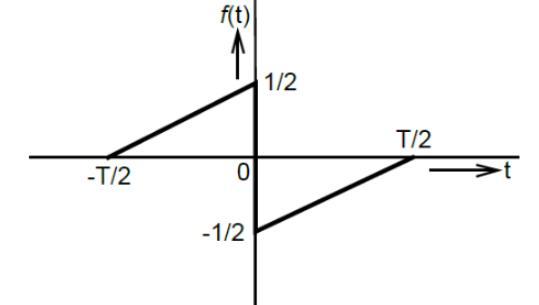
Question : A function \(f(t)\) is shown in the figure. The Fourier transform \(F(\omega)\) of \(f(t)\) is
real and even function of w
real and odd function of w
imaginary and odd function of w
imaginary and even function of w
Solution:
Concept: The function \(f(t)\) is graphically symmetric about the origin, which means it is a real and odd function, satisfying \(f(t) = -f(-t)\).
Symmetry Property (Real & Odd): The Fourier transform \(F(\omega)\) of a real and odd function \(f(t)\) is imaginary and odd. Ans- C
Question : Let \(\nabla\cdot(f\mathbf{v})=x^{2}y+y^{2}z+z^{2}x\), where \(f\) and \(\mathbf{v}\) are scalar and vector fields respectively. If \(\mathbf{v}=y\mathbf{i}+z\mathbf{j}+x\mathbf{k}\) then \(\mathbf{v}\cdot(\nabla f)\) is
\(x^{2}y+y^{2}z+z^{2}x\)
\(2xy+2yz+2zx\)
\(x+y+z\)
\(0\)
Solution:
Concept: Use the vector identity \(\nabla \cdot (f\mathbf{v}) = (\nabla f) \cdot \mathbf{v} + f (\nabla \cdot \mathbf{v})\).
1. Calculate \(\nabla \cdot \mathbf{v}\): \[\nabla \cdot \mathbf{v} = \frac{\partial}{\partial x}(y) + \frac{\partial}{\partial y}(z) + \frac{\partial}{\partial z}(x) = 0 + 0 + 0 = 0\]
2. Solve for \(\mathbf{v}\cdot(\nabla f)\): Since \(f (\nabla \cdot \mathbf{v}) = 0\), the identity simplifies to: \[\nabla \cdot (f\mathbf{v}) = (\nabla f) \cdot \mathbf{v} = \mathbf{v} \cdot (\nabla f)\] Given \(\nabla \cdot (f\mathbf{v}) = x^{2}y+y^{2}z+z^{2}x\), then: \[\mathbf{v}\cdot(\nabla f) = x^{2}y+y^{2}z+z^{2}x\] Ans- A
Question (NAT): Lifetime of an electric bulb is a random variable with density \(f(x)=kx^{2}\), where \(x\) is measured in years. If the minimum and maximum lifetimes of bulb are 1 and 2 years respectively, then the value of \(k\) is .
Solution:
Concept: The integral of the probability density function over its domain must equal 1. \[\int_{1}^{2} f(x) dx = 1\]
Calculation: \[\int_{1}^{2} k x^2 dx = 1\] \[k \left[ \frac{x^3}{3} \right]_{1}^{2} = 1\] \[k \left( \frac{2^3}{3} - \frac{1^3}{3} \right) = 1\] \[k \left( \frac{7}{3} \right) = 1 \implies k = \frac{3}{7}\] Ans- \(\frac{3}{7}\)
Question : Two matrices \(A\) and \(B\) are given below: \[A=\begin{bmatrix} p & q \\ r & s \end{bmatrix}; B=\begin{bmatrix} p^{2}+q^{2} & pr+qs \\ pr+qs & r^{2}+s^{2} \end{bmatrix}\] If the rank of matrix \(A\) is \(N\), then the rank of matrix \(B\) is
\(N/2\)
\(N-1\)
\(N\)
\(2N\)
Solution:
Concept: The rank of a \(2 \times 2\) matrix is 2 if its determinant is non-zero, and 1 (or 0) if its determinant is zero. We find the relationship between the determinants: \[|A| = ps-qr\] \[|B| = (p^2+q^2)(r^2+s^2) - (pr+qs)^2\] Expanding \(|B|\) shows that \(|B| = (ps-qr)^2 = |A|^2\).
Relating the Ranks:
If \(\text{Rank}(A) = N = 2\), then \(|A| \ne 0\). Since \(|B| = |A|^2 \ne 0\), \(\text{Rank}(B)=2\).
If \(\text{Rank}(A) = N = 1\), then \(|A| = 0\). Since \(|B| = |A|^2 = 0\), \(\text{Rank}(B)=1\).
In all cases, \(\text{Rank}(B) = \text{Rank}(A) = N\). Ans- C