1-Mark Questions
QQuestion 1 1 Mark
The following columns present various modes of induction machine operation and the ranges of slip
\begin{tabular}{|l|l|l|l|} \hline \multicolumn{2}{|c|}{Column A} & \multicolumn{2}{c|}{Column B} \\ \hline & Mode of operation & & Range of Slip \\ \hline a. & Running in generator mode & p) & From 0.0 to 1.0 \\ b. & Running in motor mode & q) & From 1.0 to 2.0 \\ c. & Plugging in motor mode & r) & From -1.0 to 0.0 \\ \hline \end{tabular}
The correct matching between the elements in column A with those of column B is
AOptions
- a-r, b-p, and c-q
- a-r, b-q, and c-p
- a-p, b-r, and c-q
- a-q, b-p, and c-r
SSolution
Understanding Induction Machine Operation Modes:
Key Concept: Slip Definition
For an induction machine:
where:
- \(N_s\) = Synchronous speed
- \(N_r\) = Rotor speed
- \(s\) = Slip
Analysis of Different Operating Modes:
1. Motor Mode (Normal Motoring):
- Rotor speed: \(N_r < N_s\) (rotor runs slower than synchronous speed)
- Slip: \(s = \frac{N_s - N_r}{N_s} > 0\)
- At standstill: \(N_r = 0\), \(s = 1\)
- At synchronous speed: \(N_r = N_s\), \(s = 0\)
- Range: 0 < s < 1 (or 0.0 to 1.0)
- Motor draws power from supply, develops mechanical power
- Torque is positive (in direction of rotation)
Matching: b → p
2. Generator Mode (Generating):
- Rotor speed: \(N_r > N_s\) (rotor runs faster than synchronous speed)
- Slip: \(s = \frac{N_s - N_r}{N_s} < 0\) (negative slip)
- Rotor is driven by prime mover above synchronous speed
- Machine feeds electrical power back to the supply
- Requires external mechanical drive
- Range: -1 < s < 0 (or -1.0 to 0.0)
- Torque is negative (opposes direction of rotation)
Matching: a → r
3. Plugging Mode (Braking):
- Also called "plugged" or "counter-current braking"
- Rotor rotates in opposite direction to rotating magnetic field
- Achieved by reversing phase sequence while motor is running
- Rotor speed: \(N_r < 0\) (negative, opposite to field rotation)
- Slip: \(s = \frac{N_s - N_r}{N_s} = \frac{N_s - (-|N_r|)}{N_s} = \frac{N_s + |N_r|}{N_s} > 1\)
- At maximum negative speed equal to \(-N_s\): \(s = \frac{N_s - (-N_s)}{N_s} = 2\)
- Range: 1 < s < 2 (or 1.0 to 2.0)
- Very high currents, high losses, severe braking torque
- Used for quick stopping or reversing
Matching: c → q
Summary Table:
\begin{tabular}{|l|c|c|c|} \hline Mode & Rotor Speed & Slip Range & Power Flow \\ \hline Generator & \(N_r > N_s\) & \(-1\) to \(0\) & To supply \\ Motor & \(0 < N_r < N_s\) & \(0\) to \(1\) & From supply \\ Plugging & \(N_r < 0\) & \(1\) to \(2\) & From supply (lost as heat) \\ \hline \end{tabular}
Physical Interpretation:
Motor Mode (s = 0 to 1):
- Normal operation
- Slip = 0: No-load, no torque
- Slip = 1: Locked rotor, maximum starting torque
- Typical rated slip: 2-5%
Generator Mode (s = -1 to 0):
- Requires external mechanical power
- Used in regenerative braking
- Wind turbines, overhauling loads
- Slip becomes negative
Plugging Mode (s = 1 to 2):
- Emergency braking
- Very high rotor currents (2-7 times rated)
- High thermal stress on rotor
- Rapid deceleration
- Should be used only briefly
Correct answer: A (a-r, b-p, and c-q)
QQuestion 2 1 Mark
A 10-pole, 50 Hz, 240 V, single phase induction motor runs at 540 RPM while driving rated load. The frequency of induced rotor currents due to backward field is
AOptions
- 100 Hz
- 95 Hz
- 10 Hz
- 5 Hz
SSolution
Given:
- Number of poles: \(P = 10\)
- Supply frequency: \(f = 50\) Hz
- Rated voltage: \(V = 240\) V
- Operating speed: \(N_r = 540\) RPM
- Find: Frequency of rotor currents due to backward field
Solution:
Relative speed between backward field and rotor:
Magnitude: \(1140\) RPM
Slip magnitude:
Step 5: Calculate rotor current frequency due to backward field
Frequency of rotor currents:
For backward field:
Verification:
The rotor current frequency due to forward field would be:
The backward field frequency is much higher because the backward field and rotor move in opposite directions, creating a much larger relative motion.
Physical Explanation:
- Forward field rotates at +600 RPM
- Rotor rotates at +540 RPM
- Relative speed: \(600 - 540 = 60\) RPM
- This produces 5 Hz rotor currents (forward field effect)
- Backward field rotates at -600 RPM
- Rotor rotates at +540 RPM
- Relative speed: \((-600) - (+540) = -1140\) RPM
- Magnitude: 1140 RPM
- This produces 95 Hz rotor currents (backward field effect)
General Formula:
For single-phase induction motor:
where \(s_f\) is the forward slip.
Correct answer: B (95 Hz)
\textit{Note: The backward field in a single-phase induction motor creates a braking torque. The high frequency rotor currents (95 Hz) due to the backward field produce additional losses and reduce motor efficiency.}
QQuestion 3 1 Mark
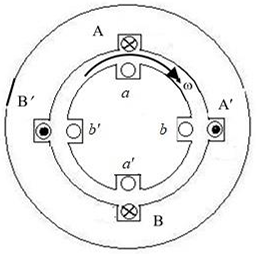
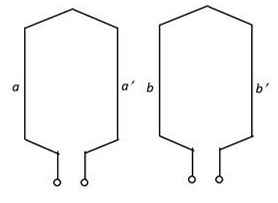
The four stator conductors (A, A', B and B') of a rotating machine are carrying DC currents of the same value, the directions of which are shown in the figure (i). The rotor coils a-a' and b-b' are formed by connecting the back ends of conductors 'a' and 'a" and 'b' and 'b", respectively, as shown in figure (ii). The e.m.f. induced in coil a-a' and coil b-b' are denoted by \(E_{a-a'}\) and \(E_{b-b'}\), respectively. If the rotor is rotated at uniform angular speed \(\omega\) rad/s in the clockwise direction then which of the following correctly describes the \(E_{a-a'}\) and \(E_{b-b'}\)?
\hspace{1cm}
(i): cross-sectional view \hspace{0.1cm} (ii): rotor winding connection diagram\\
AOptions
- \(E_{a-a'}\) and \(E_{b-b'}\) have finite magnitudes and are in the same phase
- \(E_{a-a'}\) and \(E_{b-b'}\) have finite magnitudes with \(E_{b-b'}\) leading \(E_{a-a'}\)
- \(E_{a-a'}\) and \(E_{b-b'}\) have finite magnitudes with \(E_{a-a'}\) leading \(E_{b-b'}\)
- \(E_{a-a'} = E_{b-b'} = 0\)
SSolution
Given:
- Four stator conductors: A, A', B, B' carrying DC currents
- Current directions shown in figure (i)
- Rotor coils: a-a' and b-b'
- Rotor angular speed: \(\omega\) rad/s (clockwise)
- Find: Relationship between induced EMFs
Solution:
Step 1: The stator produces a stationary four-pole field
Going once round the air gap the conductors are met in the order A' (out of the page, at \(0^\circ\)), A (into the page, at \(90^\circ\)), B' (out, at \(180^\circ\)), B (in, at \(270^\circ\)). Each conductor makes the air-gap mmf step by \(I\), so the mmf wave is the square wave
and the same pattern repeats over \(180^\circ < \theta < 360^\circ\). The currents are DC, so the field is fixed in space; its period is \(180^\circ\) mechanical, i.e. it is a four-pole field with a pole pitch of \(90^\circ\).
Step 2: Flux linked by the rotor coils
Conductors \(a\) and \(a'\) lie at the top and bottom of the rotor, so coil a-a' spans \(180^\circ\) mechanical; coil b-b' (right and left) spans the same \(180^\circ\). With the rotor at position \(\alpha\),
Since \(B \propto F\) has period \(180^\circ\) and zero mean over one period, the integral over any \(180^\circ\) window vanishes:
Physically, the half of the coil span facing a north pole is exactly cancelled by the half facing the adjacent south pole.
Step 3: Induced emf
The flux linkage is identically zero at every rotor position, so it cannot change with time:
Coil b-b' spans the same \(180^\circ\) in the same four-pole field, so \(e_{b-b'} = 0\) as well. The result holds for any speed \(\omega\) and either direction of rotation.
Correct answer: D (\(E_{a-a'} = E_{b-b'} = 0\))
\textit{Note: A coil generates an emf only when its pitch matches the pole pitch. Here the pole pitch is \(90^\circ\) while each coil spans \(180^\circ\), so every coil embraces one complete north-south pair and its net flux linkage is zero at all times.}
QQuestion 4 1 Mark
A separately excited DC motor rated 400 V, 15 A, 1500 RPM drives a constant torque load at rated speed operating from 400 V DC supply drawing rated current. The armature resistance is 1.2 \(\Omega\). If the supply voltage drops by 10% with field current unaltered then the resultant speed of the motor in RPM is ____________ (Round off to the nearest integer).
\vspace{5cm}
SSolution
Given:
- Rated voltage: \(V = 400\) V
- Rated current: \(I_a = 15\) A
- Rated speed: \(N_1 = 1500\) RPM
- Armature resistance: \(R_a = 1.2\) \(\Omega\)
- Supply voltage drops by 10%: \(V_2 = 0.9 \times 400 = 360\) V
- Field current: Constant (unchanged)
- Load: Constant torque
- Find: New speed \(N_2\)
Solution:
Step 1: Calculate initial back EMF
At rated conditions:
Step 2: DC motor speed equation
For a separately excited DC motor:
where:
- \(K\) = machine constant
- \(\phi\) = field flux (constant since field current is unchanged)
- \(N\) = speed in RPM
At rated conditions:
Step 3: Analyze new operating condition
Since load torque is constant and field is constant:
For constant torque and constant flux:
The armature current remains the same because:
- Torque is constant: \(T = K\phi I_a\)
- Field flux is constant: \(\phi =\) constant
- Therefore: \(I_a\) must be constant
Step 4: Calculate new back EMF
With reduced supply voltage:
Step 5: Calculate new speed
From equations (1) and (2):
Verification:
Speed drop:
Percentage drop:
This is reasonable given that voltage dropped by 10%.
Alternative Approach - Using Speed-Voltage Relationship:
For constant torque load with constant field:
Since \(I_a\) is constant:
Physical Explanation:
- When supply voltage drops, back EMF must also drop
- Since \(E = K\phi N\) and flux is constant, speed must drop
- For constant torque, current remains same
- The voltage drop \((I_a R_a = 18\) V) remains constant
- The back EMF (and hence speed) is proportional to \((V - I_a R_a)\)
Answer: 1343 RPM
2-Mark Questions
QQuestion 5 2 Mark
A three-phase synchronous motor with synchronous impedance of 0.1+j0.3 per unit per phase has a static stability limit of 2.5 per unit. The corresponding excitation voltage in per unit is ___________ (Round off to 2 decimal places).
SSolution
Given:
- Synchronous impedance: \(Z_s = 0.1 + j0.3\) pu
- Static stability limit: \(P_{max} = 2.5\) pu
- Find: Excitation voltage \(E_f\) (pu)
Solution:
For synchronous motor with impedance \(Z_s = R_a + jX_s\):
Write \(Z_s = R_a + jX_s = |Z_s|\angle\theta\) and take the terminal voltage as \(V = 1\) pu. The mechanical power developed by the motor is
which is greatest at \(\delta = \theta\), so the static stability limit is
Here \(|Z_s| = \sqrt{0.1^2 + 0.3^2} = \sqrt{0.1} = 0.3162\) pu, so \(|Z_s|^2 = 0.1\) and
The discriminant is \(3.1623^2 - 4(2.5) = 10 - 10 = 0\), so the roots coincide:
Answer: 1.58 pu
\textit{Note: The static stability limit represents the maximum power that can be transferred before the motor loses synchronism. It depends on both the excitation voltage and the synchronous impedance.}
QQuestion 6 2 Mark
A three phase 415 V, 50 Hz, 6-pole, 960 RPM, 4 HP squirrel cage induction motor drives a constant torque load at rated speed operating from rated supply and delivering rated output. If the supply voltage and frequency are reduced by 20%, the resultant speed of the motor in RPM (neglecting the stator leakage impedance and rotational losses) is __________ (Round off to the nearest integer).
\vspace{10cm}
SSolution
Given:
- Rated voltage: \(V_1 = 415\) V (line)
- Rated frequency: \(f_1 = 50\) Hz
- Number of poles: \(P = 6\)
- Rated speed: \(N_1 = 960\) RPM
- Rated power: 4 HP
- Load: Constant torque
- New voltage: \(V_2 = 0.8 \times 415 = 332\) V
- New frequency: \(f_2 = 0.8 \times 50 = 40\) Hz
- Neglect: Stator leakage impedance and rotational losses
- Find: New speed \(N_2\) (RPM)
Solution:
Step 1: Calculate rated synchronous speed and slip
Synchronous speed at rated frequency: \(N_{s1} = \frac{120 f_1}{P} = \frac{120 \times 50}{6} = 1000 \text{ RPM}\)
Rated slip: \(s_1 = \frac{N_{s1} - N_1}{N_{s1}} = \frac{1000 - 960}{1000} = 0.04 = 4%\)
Step 2: Synchronous speed at new frequency
\(N_{s2} = \frac{120 f_2}{P} = \frac{120 \times 40}{6} = 800 \text{ RPM}\)
Step 3: Torque under constant V/f
Neglecting the stator impedance, the torque is
With constant V/f we have \(V \propto f\), \(X_r' \propto f\) and \(\omega_s \propto f\). Substituting these and multiplying numerator and denominator by \(s^2\),
so the torque depends only on the product \(s f\), that is, on the slip frequency.
Step 4: Constant torque fixes the slip frequency, not the slip
For the torque to be unchanged,
Equivalently, the slip speed \(s N_s = \frac{120}{P}(s f)\) stays at its rated value:
Step 5: Calculate new speed
or directly, \(N_2 = 800 - 40 = 760\) RPM.
Physical Explanation:
Constant V/f holds the air-gap flux constant, and a constant torque then calls for the same rotor current and the same rotor emf frequency. The slip speed is therefore pegged at 40 RPM while the synchronous speed falls from 1000 to 800 RPM, so the speed drops by 200 RPM, not by a fixed 20% of 960.
Answer: 760 RPM
QQuestion 7 2 Mark
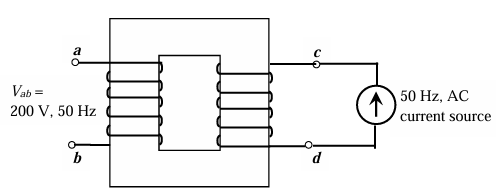
When the winding c-d of the single-phase, 50 Hz, two winding transformer is supplied from an AC current source of frequency 50 Hz, the rated voltage of 200 V (rms), 50 Hz is obtained at the open-circuited terminals a-b. The cross sectional area of the core is 5000 mm\(^2\) and the average core length traversed by the mutual flux is 500 mm. The maximum allowable flux density in the core is \(B_{max} = 1\) Wb/m\(^2\) and the relative permeability of the core material is 5000. The leakage impedance of the winding a-b and winding c-d at 50 Hz are \((5 + j100\pi \times 0.16)\) \(\Omega\) and \((11.25 + j100\pi \times 0.36)\) \(\Omega\), respectively. Considering the magnetizing characteristics to be linear and neglecting core loss, the self-inductance of the winding a-b in millihenry is ___________ (Round off to 1 decimal place).
SSolution
Given:
- Frequency: \(f = 50\) Hz
- Winding a-b (primary): Open circuit voltage \(V_{ab} = 200\) V (rms)
- Winding c-d (secondary): Supplied from AC current source
- Core cross-sectional area: \(A = 5000\) mm\(^2 = 5 \times 10^{-3}\) m\(^2\)
- Average core length: \(l = 500\) mm \(= 0.5\) m
- Maximum flux density: \(B_{max} = 1\) Wb/m\(^2\)
- Relative permeability: \(\mu_r = 5000\)
- Leakage impedance of a-b: \(Z_{ab} = 5 + j50.27\) \(\Omega\), i.e. \(L_{l,ab} = 0.16\) H
- Leakage impedance of c-d: \(Z_{cd} = 11.25 + j113.1\) \(\Omega\), i.e. \(L_{l,cd} = 0.36\) H
- Find: Self-inductance of winding a-b (\(L_{ab}\)) in mH
Solution:
Turns of winding a-b from the emf equation:
Reluctance of the mutual flux path:
Magnetizing inductance of winding a-b:
The leakage reactance of winding a-b is \(100\pi \times 0.16\) \(\Omega\) at 50 Hz, so its leakage inductance is
The self-inductance is the magnetizing inductance plus the leakage inductance:
Answer: 2195.8 mH
\textit{Note: The large value comes from the high relative permeability (5000) together with the 180 turns of the winding; the leakage part contributes only about 7% of the total.}