0-Mark Questions
QQuestion 1 0 Mark
The power input to a 500 V, 50 Hz, 6-pole, 3-phase induction motor running at 975 RPM is 40 kW. The total stator losses are 1 kW. If the total friction and windage losses are 2.025 kW, then the efficiency is \_\_\_\_\_\_\_%. (Round off to 2 decimal places.)
SSolution
Given:
- Supply voltage: \(V = 500\) V
- Frequency: \(f = 50\) Hz
- Number of poles: \(P = 6\)
- Speed: \(N_r = 975\) RPM
- Power input: \(P_{in} = 40\) kW
- Stator losses: \(P_{stator} = 1\) kW
- Friction and windage losses: \(P_{fw} = 2.025\) kW
Solution:
Step 1: Calculate synchronous speed
Step 2: Calculate slip
Step 3: Power flow in induction motor
Power flow diagram:
where:
- \(P_{in}\) = Input power (electrical)
- \(P_{stator}\) = Stator copper loss + core loss
- \(P_{ag}\) = Air-gap power
- \(P_{cu,rotor}\) = Rotor copper loss
- \(P_{mech}\) = Mechanical power developed
- \(P_{fw}\) = Friction and windage losses
- \(P_{out}\) = Output power
Step 4: Calculate air-gap power
Step 5: Calculate rotor copper loss
For an induction motor:
Step 6: Calculate mechanical power developed
Or alternatively:
Step 7: Calculate output power
Step 8: Calculate efficiency
Verification:
Total losses:
Output power:
Efficiency:
QQuestion 2 0 Mark
An alternator with internal voltage of \(1\angle\delta_1\) p.u and synchronous reactance of 0.4 p.u is connected by a transmission line of reactance 0.1 p.u to a synchronous motor having synchronous reactance 0.35 p.u and internal voltage of \(0.85\angle\delta_2\) p.u. If the real power supplied by the alternator is 0.866 p.u, then \((\delta_1 - \delta_2)\) is \_\_\_\_ degrees. (Round off to 2 decimal places.)
(Machines are of non-salient type. Neglect resistances.)
SSolution
Given:
- Alternator internal voltage: \(E_g = 1\angle\delta_1\) p.u.
- Alternator synchronous reactance: \(X_g = 0.4\) p.u.
- Line reactance: \(X_{line} = 0.1\) p.u.
- Motor synchronous reactance: \(X_m = 0.35\) p.u.
- Motor internal voltage: \(E_m = 0.85\angle\delta_2\) p.u.
- Real power supplied: \(P = 0.866\) p.u.
- Non-salient machines, resistances neglected
- Find: \(\delta_1 - \delta_2\) in degrees
Solution:
Step 1: Calculate total reactance
Total reactance between the two machines:
Step 2: Power transfer equation
For two synchronous machines connected through reactance:
where \(\delta_1 - \delta_2\) is the power angle between the two machines.
Step 3: Substitute values
Step 4: Calculate angle
Verification:
Check: \(\sin(60°) = \frac{\sqrt{3}}{2} = 0.866\) ✓
This is a standard angle where:
Physical Interpretation:
- Power angle of 60° indicates moderately heavy loading
- Generator internal voltage leads motor internal voltage by 60°
- This creates power flow from generator to motor
- The system is stable (angle < 90°)
Answer: 60.00 degrees
QQuestion 3 0 Mark
In a single-phase transformer, the total iron loss is 2500 W at nominal voltage of 440 V and frequency 50 Hz. The total iron loss is 850 W at 220 V and 25 Hz. Then, at nominal voltage and frequency, the hysteresis loss and eddy current loss respectively are
AOptions
- 1600 W and 900 W
- 900 W and 1600 W
- 250 W and 600 W
- 600 W and 250 W
SSolution
Given:
- At nominal: \(V_1 = 440\) V, \(f_1 = 50\) Hz, Total loss \(P_{i1} = 2500\) W
- At test: \(V_2 = 220\) V, \(f_2 = 25\) Hz, Total loss \(P_{i2} = 850\) W
- Find: Hysteresis and eddy current losses at nominal conditions
Solution:
Step 1: Iron loss equations
Total iron loss = Hysteresis loss + Eddy current loss
Hysteresis loss:
where typically \(n \approx 1.6\) to \(2\) (Steinmetz constant)
For constant flux: \(P_h \propto f\)
Eddy current loss:
For constant flux: \(P_e \propto f^2\)
Step 2: Flux density relationships
From transformer voltage equation:
For constant N and A:
At nominal conditions:
At test conditions:
At test (\(f_2 = 25\) Hz):
Step 4: Solve simultaneous equations
From equation (1):
From equation (2):
Multiply equation (2) by 2:
Subtract (3) from (1):
Substitute back into equation (2):
Step 5: Calculate losses at nominal conditions
Hysteresis loss at 50 Hz:
Eddy current loss at 50 Hz:
Verification:
QQuestion 4 0 Mark
A belt-driven DC shunt generator running at 300 RPM delivers 100 kW to a 200 V DC grid. It continues to run as a motor when the belt breaks, taking 10 kW from the DC grid. The armature resistance is 0.025 \(\Omega\), field resistance is 50 \(\Omega\), and brush drop is 2 V. Ignoring armature reaction, the speed of the motor is \_\_\_\_\_\_\_\_\_\_\_\_ RPM. (Round off to 2 decimal places.)
SSolution
Given:
- As generator: Speed \(N_g = 300\) RPM, Output power \(P_g = 100\) kW
- DC grid voltage: \(V = 200\) V
- As motor: Input power \(P_m = 10\) kW
- Armature resistance: \(R_a = 0.025\) \(\Omega\)
- Field resistance: \(R_f = 50\) \(\Omega\)
- Brush drop: \(V_b = 2\) V
- Ignore armature reaction
- Find: Motor speed \(N_m\)
Solution:
Step 1: Calculate field current (constant for both modes)
Field current remains constant in both generator and motor modes.
Step 2: Generator mode analysis
For a shunt generator the grid receives the load current:
where \(I_L\) is the load current.
Armature current:
Generated EMF:
Step 3: Motor mode analysis
Total input power:
For shunt motor:
Back EMF (motor):
Step 4: Speed relationship
For DC machine with constant flux (since \(I_f\) is constant):
Since \(\phi\) is constant:
Verification:
Check power balance:
Generator mode: - Generated power: \(E_g \times I_{a,g} = 214.6 \times 504 = 108.16\) kW - Armature copper loss: \(I_{a,g}^2 R_a = 504^2 \times 0.025 = 6.35\) kW - Brush loss: \(V_b \times I_{a,g} = 2 \times 504 = 1.01\) kW - Output: \(108.16 - 6.35 - 1.01 = 100.8\) kW ≈ 100 kW ✓
Motor mode: - Input power: 10 kW - Field loss: \(V \times I_f = 200 \times 4 = 0.8\) kW - Armature input: \(10 - 0.8 = 9.2\) kW - Armature copper loss: \(46^2 \times 0.025 = 0.053\) kW - Brush loss: \(2 \times 46 = 0.092\) kW - Mechanical power: \(9.2 - 0.053 - 0.092 = 9.055\) kW ✓
Answer: 275.17 RPM
QQuestion 5 0 Mark
An 8-pole, 50 Hz, three-phase, slip-ring induction motor has an effective rotor resistance of 0.08 \(\Omega\) per phase. Its speed at maximum torque is 650 RPM. The additional resistance per phase that must be inserted in the rotor to achieve maximum torque at start is \_\_\_\_\_\_\_\_\_ \(\Omega\). (Round off to 2 decimal places.) Neglect magnetizing current and stator leakage impedance. Consider equivalent circuit parameters referred to stator.
SSolution
Given:
- Number of poles: \(P = 8\)
- Frequency: \(f = 50\) Hz
- Effective rotor resistance: \(R_r' = 0.08\) \(\Omega\) (referred to stator)
- Speed at maximum torque: \(N_{mt} = 650\) RPM
- Find: Additional rotor resistance for maximum torque at start
- Neglect magnetizing current and stator leakage impedance
Solution:
Step 1: Calculate synchronous speed
Step 2: Calculate slip at maximum torque
Step 3: Condition for maximum torque
For maximum torque in an induction motor:
where:
- \(s_{mt}\) = slip at maximum torque
- \(R_r'\) = rotor resistance (referred to stator)
- \(X_r'\) = rotor leakage reactance (referred to stator)
From the given condition:
Step 4: Condition for maximum torque at starting
For maximum torque at starting (when \(s = 1\)):
Step 5: Calculate additional resistance
Additional resistance required:
Verification:
Original condition (maximum torque at 650 RPM):
QQuestion 6 0 Mark
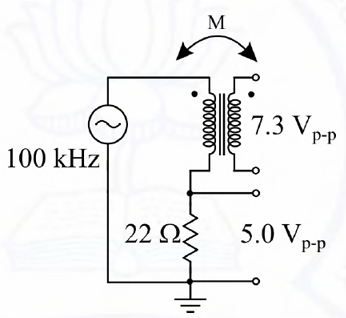
An air-core radio-frequency transformer as shown has a primary winding and a secondary winding. The mutual inductance M between the windings of the transformer is \_\_\_\_\_\_ μH. (Round off to 2 decimal places.)
SSolution
Given:
- Frequency: \(f = 100\) kHz
- Secondary open circuit voltage: \(V_{oc} = 7.3\) V (peak-to-peak)
- Voltage across the 22 \(\Omega\) resistor in series with the primary: \(V_{22} = 5.0\) V (peak-to-peak)
- Air-core transformer (loose coupling)
- Find: Mutual inductance M (μH)
Solution:
Step 1: Primary current from the 22 \(\Omega\) resistor
The 22 \(\Omega\) resistor sits in series with the primary winding, so it carries the primary current, and 5.0 V\(_{p-p}\) is measured across it:
Step 2: Voltage induced in the open secondary
The secondary is open-circuited, so it carries no current and the only voltage across it is the mutually induced one:
Both readings are peak-to-peak, so the conversion to rms cancels in the ratio.
Step 3: Mutual inductance
Answer: 51.12 μH