0-Mark Questions
QQuestion 1 0 Mark
A single-phase, 4 kVA, 200 V/100 V, 50 Hz transformer with laminated CRGO steel core has rated no-load loss of 450 W. When the high-voltage winding is excited with 160 V, 40 Hz sinusoidal ac supply, the no-load losses are found to be 320 W. When the high-voltage winding of the same transformer is supplied from a 100 V, 25 Hz sinusoidal ac source, the no-load losses will be \_\_\_\_\_\_\_\_\_ W (rounded off to 2 decimal places).
SSolution
Given: At 200 V, 50 Hz: \(P_c = 450\) W; At 160 V, 40 Hz: \(P_c = 320\) W
Since \(V/f\) is constant: \(\frac{200}{50} = \frac{160}{40} = \frac{100}{25} = 4\)
Core loss equation: \(P_c = Af + Bf^2\)
Setting up equations: \begin{align*} 450 &= A(50) + B(50)^2 \\ 320 &= A(40) + B(40)^2 \end{align*}
Dividing by frequency: \begin{align*} 9 &= A + 50B \\ 8 &= A + 40B \end{align*}
Subtracting: \(1 = 10B \Rightarrow B = 0.1\)
Therefore: \(A = 9 - 50(0.1) = 4\)
At 100 V, 25 Hz:
QQuestion 2 0 Mark
A three-phase, 50 Hz, 4-pole induction motor runs at no-load with a slip of 1%. With full load, the slip increases to 5%. The percentage speed regulation of the motor (rounded off to 2 decimal places) is \_\_\_\_\_\_\_\_.
SSolution
Given: 4-pole, 50 Hz motor; \(s_{nl} = 0.01\), \(s_{fl} = 0.05\)
Synchronous speed: \(N_s = \frac{120f}{P} = \frac{120 \times 50}{4} = 1500\) rpm
No-load speed: \(N_0 = N_s(1 - s_{nl}) = 1500(1 - 0.01) = 1485\) rpm
Full-load speed: \(N = N_s(1 - s_{fl}) = 1500(1 - 0.05) = 1425\) rpm
Speed regulation:
QQuestion 3 0 Mark
A three-phase cylindrical rotor synchronous generator has a synchronous reactance \(X_s\) and a negligible armature resistance. The magnitude of per phase terminal voltage is \(V_A\) and the magnitude of per phase induced emf is \(E_A\). Considering the following two statements:
P: For any three-phase balanced leading load connected across the terminals of this synchronous generator, \(V_A\) is always more than \(E_A\).
Q: For any three-phase balanced lagging load connected across the terminals of this synchronous generator, \(V_A\) is always less than \(E_A\).
Which of the following options is correct?
AOptions
- P is true and Q is true.
- P is true and Q is false.
- P is false and Q is false. P is false and Q is true.
SSolution
For a synchronous generator with negligible armature resistance:
Statement P (Leading load): When the load is leading (capacitive), the armature reaction is magnetizing. The terminal voltage \(V_A\) can be less than, equal to, or greater than \(E_A\) depending on the power factor and load conditions. Therefore, P is false.
Statement Q (Lagging load): When the load is lagging (inductive), the armature reaction is demagnetizing. The voltage drop across \(X_s\) subtracts from \(E_A\), making \(V_A < E_A\) for all lagging loads. Therefore, Q is true.
Correct answer: D
QQuestion 4 0 Mark
A single 50 Hz synchronous generator on droop control was delivering 100 MW power to a system. Due to increase in load, generator power had to be increased by 10 MW, as a result of which, system frequency dropped to 49.75 Hz. Further increase in load in the system resulted in a frequency of 49.25 Hz. At this condition, the power in MW supplied by the generator is \_\_\_\_\_\_\_\_ (rounded off to 2 decimal places).
SSolution
The droop characteristic is linear. Given points: (100 MW, 50 Hz) and (110 MW, 49.75 Hz)
Slope: \(\tan\theta = \frac{50 - 49.75}{110 - 100} = \frac{0.25}{10}\)
At 49.25 Hz, using similar triangles:
QQuestion 5 0 Mark
A 250 V dc shunt motor has an armature resistance of 0.2 \(\Omega\) and a field resistance of 100 \(\Omega\). When the motor is operated on no-load at rated voltage, it draws an armature current of 5 A and runs at 1200 rpm. When a load is coupled to the motor, it draws total line current of 50 A at rated voltage, with a 5% reduction in the air-gap flux due to armature reaction. Voltage drop across the brushes can be taken as 1 V per brush under all operating conditions. The speed of the motor, in rpm, under this loaded condition, is closest to:
AOptions
- 900
- 1200
- 1000
- 1220
SSolution
Given: \(V = 250\) V, \(R_a = 0.2\) \(\Omega\), \(R_{sh} = 100\) \(\Omega\), Brush drop = 2 V total
Shunt field current: \(I_{sh} = \frac{250}{100} = 2.5\) A (constant)
No-load: the armature current is given directly, \(I_{a0} = 5\) A
On load: \(I_{aL} = 50 - 2.5 = 47.5\) A
Using speed equation: \(\frac{N_2}{N_1} = \frac{E_{b2}}{E_{b1}} \times \frac{\phi_1}{\phi_2}\)
Correct answer: D
QQuestion 6 0 Mark
The temperature of the coolant oil bath for a transformer is monitored using a thermistor circuit. The thermistor has resistance \(R_{thermistor} = 2(1 + \alpha T)\) k\(\Omega\), where \(T\) is temperature in °C. The temperature coefficient \(\alpha = -(4 \pm 0.25)\)%/°C. Circuit parameters: \(R_1 = 1\) k\(\Omega\), \(R_2 = 1.3\) k\(\Omega\), \(R_3 = 2.6\) k\(\Omega\). The error in the output signal (in V, rounded off to 2 decimal places) at 150°C is \_\_\_\_\_\_\_\_.
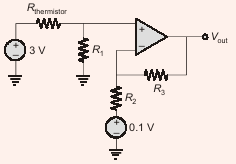
SSolution
Given: \(\alpha = -(0.04 \pm 0.0025)\) /°C, so \(\alpha_{max} = -0.0425\) /°C, \(\alpha_{min} = -0.0375\) /°C
At \(T = 150\)°C with \(\alpha = -0.04\) /°C:
Output voltage: \(V_0 = \left[\frac{R_1}{R_1 + R_{th}}\right] \times 3 + \left[\frac{R_2}{R_3}\right] \times 0.1\)
With \(\alpha_{max} = -0.0425\): \(R_{th} = -10.75\) k\(\Omega\) \(\Rightarrow V_0 = 0.46\) V
With \(\alpha_{min} = -0.0375\): \(R_{th} = -9.25\) k\(\Omega\) \(\Rightarrow V_0 = 0.54\) V
Error = \(|0.5 - 0.46| = |0.5 - 0.54| = \boxed{0.04 \text{ V}}\)$
QQuestion 7 0 Mark
A cylindrical rotor synchronous generator has steady state synchronous reactance of 0.7 pu and subtransient reactance of 0.2 pu. It is operating at \((1+j0)\) pu terminal voltage with an internal emf of \((1+j0.7)\) pu. Following a three-phase solid short circuit fault at the terminal of the generator, the magnitude of the subtransient internal emf (rounded off to 2 decimal places) is \_\_\_\_\_\_\_\_ pu.
SSolution
Given: \(X_d = 0.7\) pu, \(X_d" = 0.2\) pu, \(V_t = 1\angle 0°\) pu, \(E_f = 1 + j0.7\) pu
Pre-fault current:
Subtransient internal emf:
QQuestion 8 0 Mark
A cylindrical rotor synchronous generator with constant real power output and constant terminal voltage is supplying 100 A current to a 0.9 lagging power factor load. An ideal reactor is now connected in parallel with the load, as a result of which the total lagging reactive power requirement of the load is twice the previous value while the real power remains unchanged. The armature current is now \_\_\_\_\_\_\_ A (rounded off to 2 decimal places).
SSolution
Given: \(I_{a1} = 100\) A, \(\cos\phi_1 = 0.9\) (lagging)
From \(\cos\phi_1 = 0.9\): \(\tan\phi_1 = \frac{\sqrt{1-0.9^2}}{0.9} = 0.484\)
This gives: \(\frac{Q_1}{P} = 0.484\)
After reactor connection: \(Q_2 = 2Q_1\), so \(\frac{Q_2}{P} = 2(0.484) = 0.9686\)
Therefore: \(\tan\phi_2 = 0.9686\), which gives \(\cos\phi_2 = 0.7182\)
Since real power is constant:
QQuestion 9 0 Mark
Consider a permanent magnet dc (PMDC) motor which is initially at rest. At \(t = 0\), a dc voltage of 5 V is applied to the motor. Its speed monotonically increases from 0 rad/s to 6.32 rad/s in 0.5 s and finally settles to 10 rad/s. Assuming that the armature inductance of the motor is negligible, the transfer function for the motor is:
AOptions
- \(\frac{10}{0.5s + 1}\)
- \(\frac{2}{0.5s}\)
- \(\frac{10}{0.5s}\)
SSolution
First-order system: \(G(s) = \frac{K}{Ts + 1}\)
From steady-state response to 5 V input:
At 63.2% of steady state (one time constant):
Therefore: \(T = 0.5\) s
Transfer function: \(G(s) = \boxed{\frac{2}{0.5s + 1}}\)
Correct answer: A