0-Mark Questions
QQuestion 1 0 Mark
A 5 kVA, 50 V/100 V, single-phase transformer has a secondary terminal voltage of 95 V when loaded. The regulation of the transformer is
AOptions
- 4.5%
- 9%
- 5%
- 1%
SSolution
Voltage regulation is defined as:
Given: Secondary no-load voltage \(V_{no-load} = 100\) V, Secondary loaded voltage \(V_{full-load} = 95\) V
Correct answer: C
QQuestion 2 0 Mark
The parameter of an equivalent circuit of a three-phase induction motor affected by reducing the rms value of the supply voltage at the rated frequency is
AOptions
- rotor resistance
- rotor leakage reactance magnetizing reactance
- stator resistance
SSolution
When the supply voltage is reduced at rated frequency:
Magnetizing reactance (\(X_m\)) is affected because:
- Magnetizing reactance depends on the saturation level of the core
- Lower voltage reduces the flux density in the core
- This changes the magnetic operating point, moving to a less saturated region
- The magnetizing reactance increases as saturation decreases
The resistances (\(R_1\), \(R_2\)) and leakage reactances (\(X_1\), \(X_2\)) are physical parameters that remain constant with voltage changes.
Correct answer: C
QQuestion 3 0 Mark
A three-phase synchronous motor draws 200 A from the line at unity power factor at rated load. Considering the same line voltage and load, the line current at a power factor of 0.5 leading is
AOptions
- 100 A
- 200 A
- 300 A
- 400 A
SSolution
For a synchronous motor at constant load (constant real power):
Real power: \(P = \sqrt{3} V_L I_L \cos\phi = \text{constant}\)
At unity power factor (\(\cos\phi_1 = 1\)):
At \(\cos\phi_2 = 0.5\) leading:
Since power and voltage are constant:
At constant real power and voltage:
The shaft load is unchanged, so the real power drawn is unchanged; only the excitation has been raised to make the current lead. The armature current therefore rises in inverse proportion to the power factor.
Correct answer: D
QQuestion 4 0 Mark
The magnetic circuit shown has uniform cross-sectional area and air gap of 0.2 cm. The mean path length of the core is 40 cm. When the core relative permeability is assumed to be infinite, the magnetic flux density computed in the air gap is 1 tesla. With same Ampere-turns, if the core relative permeability is assumed to be 1000 (linear), the flux density in tesla (rounded off to three decimal places) calculated in the air gap is \_\_\_\_\_\_\_\_.
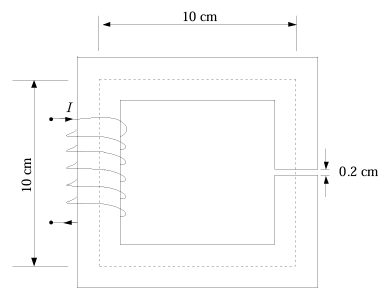
SSolution
Given: Air gap \(l_g = 0.2\) cm \(= 0.002\) m, Core length \(l_c = 40\) cm \(= 0.4\) m, \(B_{g1} = 1\) T
Case 1: \(\mu_r = \infty\) (infinite permeability)
MMF equation: \(NI = H_g l_g + H_c l_c\)
With \(\mu_r = \infty\): \(H_c = 0\), so \(NI = H_g l_g\)
Case 2: \(\mu_r = 1000\)
Since flux is continuous: \(B_g = B_c = B_{g2}\)
QQuestion 5 0 Mark
A single-phase transformer of rating 25 kVA, supplies a 12 kW load at power factor of 0.6 lagging. The additional load at unity power factor in kW (rounded off to two decimal places) that may be added before this transformer exceeds its rated kVA is \_\_\_\_\_\_\_\_.
SSolution
Given: Transformer rating \(S_{rated} = 25\) kVA, Existing load: \(P_1 = 12\) kW, \(\cos\phi_1 = 0.6\) lagging
Existing load apparent power:
Reactive power: \(Q_1 = S_1 \sin\phi_1 = 20 \times 0.8 = 16\) kVAR
Additional unity power factor load: Let additional load be \(P_2\) kW at unity pf, so \(Q_2 = 0\) kVAR
Total real power: \(P_{total} = 12 + P_2\) kW
Total reactive power: \(Q_{total} = 16\) kVAR (unchanged)
Total apparent power must not exceed rating:
QQuestion 6 0 Mark
A 220 V DC shunt motor takes 3 A at no-load. It draws 25 A when running at full-load at 1500 rpm. The armature and shunt resistances are 0.5 \(\Omega\) and 220 \(\Omega\), respectively. The no-load speed in rpm (rounded off to two decimal places) is \_\_\_\_\_\_\_\_.
SSolution
Given: \(V = 220\) V, \(I_{L,nl} = 3\) A, \(I_{L,fl} = 25\) A, \(N_{fl} = 1500\) rpm, \(R_a = 0.5\) \(\Omega\), \(R_{sh} = 220\) \(\Omega\)
Shunt field current: \(I_{sh} = \frac{220}{220} = 1\) A (constant)
No-load condition: Armature current: \(I_{a,nl} = I_{L,nl} - I_{sh} = 3 - 1 = 2\) A
Back emf: \(E_{b,nl} = V - I_{a,nl}R_a = 220 - 2(0.5) = 219\) V
Full-load condition: Armature current: \(I_{a,fl} = I_{L,fl} - I_{sh} = 25 - 1 = 24\) A
Back emf: \(E_{b,fl} = V - I_{a,fl}R_a = 220 - 24(0.5) = 208\) V
Speed relationship: Since flux is constant (shunt motor):
QQuestion 7 0 Mark
A delta-connected, 3.7 kW, 400 V(line), three-phase, 4-pole, 50-Hz squirrel-cage induction motor has the following equivalent circuit parameters per phase referred to the stator: \(R_1 = 5.39\) \(\Omega\), \(R_2 = 5.72\) \(\Omega\), \(X_1 = X_2 = 8.22\) \(\Omega\). Neglect shunt branch in the equivalent circuit. The starting line current in amperes (rounded off to two decimal places) when it is connected to a 100 V (line), 10 Hz, three-phase AC source is \_\_\_\_\_\_\_\_.
SSolution
At starting, slip \(s = 1\), and frequency \(f = 10\) Hz.
Impedance calculation at 10 Hz:
Reactances scale with frequency:
Resistances remain unchanged: \(R_1 = 5.39\) \(\Omega\), \(R_2 = 5.72\) \(\Omega\)
Total impedance per phase at starting:
For delta connection:
Phase voltage: \(V_{ph} = V_L = 100\) V
Phase current: \(I_{ph} = \frac{V_{ph}}{Z} = \frac{100}{11.59} = 8.63\) A
Line current: \(I_L = \sqrt{3} \times I_{ph} = \sqrt{3} \times 8.63 = \boxed{14.94 \text{ A}}\)$
QQuestion 8 0 Mark
A 220 V (line), three-phase, Y-connected, synchronous motor has a synchronous impedance of \((0.25 + j2.5)\) \(\Omega\)/phase. The motor draws the rated current of 10 A at 0.8 pf leading. The rms value of line-to-line internal voltage in volts (rounded off to two decimal places) is \_\_\_\_\_\_\_\_.
SSolution
Given: \(V_L = 220\) V, \(Z_s = 0.25 + j2.5\) \(\Omega\)/phase, \(I_a = 10\) A, \(\cos\phi = 0.8\) leading
Phase voltage: \(V_{ph} = \frac{220}{\sqrt{3}} = 127.02\) V
For leading power factor: \(\phi = -\cos^{-1}(0.8) = -36.87°\)
Taking phase voltage as reference: \(\vec{V}_{ph} = 127.02\angle 0°\) V
Armature current: \(\vec{I}_a = 10\angle 36.87°\) A (leading)
Internal voltage per phase:
Line-to-line internal voltage: