1-Mark Questions
QQuestion 1 1 Mark
In a constant V/f induction motor drive, the slip at the maximum torque
AOptions
- is directly proportional to the synchronous speed.
- remains constant with respect to the synchronous speed.
- has an inverse relation with the synchronous speed.
- has no relation with the synchronous speed.
SSolution
In an induction motor, the slip at maximum torque is:
In constant V/f control:
- \(E \propto f\) (maintains constant flux)
- \(X_r = 2\pi f L_r \propto f \propto N_s\)
- \(R_r\) remains constant
Therefore:
The slip at maximum torque has an inverse relation with synchronous speed.
Correct answer: C
QQuestion 2 1 Mark
Consider a system consisting of a synchronous generator working at a lagging power factor, a synchronous motor working at an overexcited condition and a directly grid-connected induction generator. Consider capacitive VAr to be a source and inductive VAr to be a sink of reactive power. Which one of the following statements is TRUE?
AOptions
- Synchronous motor and synchronous generator are sources and induction generator is a sink of reactive power.
- Synchronous motor and induction generator are sources and synchronous generator is a sink of reactive power.
- Synchronous motor is a source and induction generator and synchronous generator are sinks of reactive power.
- All are sources of reactive power.
SSolution
Analysis of each machine:
1. Synchronous Generator at lagging pf:
- Its current lags its terminal voltage, which means the machine is overexcited
- It therefore delivers both real power and lagging reactive power to the system
- Source of reactive power
2. Overexcited Synchronous Motor:
- Excitation: \(E_f > V_t\)
- Operates at leading power factor
- Supplies capacitive VAr to system
- Source of reactive power
3. Induction Generator:
- Always requires magnetizing current from grid
- Acts as inductive load
- Sink of reactive power (absorbs capacitive VAr)
Conclusion: the synchronous motor and the synchronous generator are both sources; only the induction generator is a sink.
Correct answer: A
QQuestion 3 1 Mark
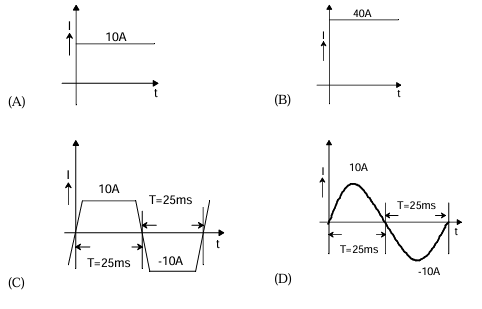
A 4-pole, lap-connected, separately excited dc motor is drawing a steady current of 40 A while running at 600 rpm. A good approximation for the waveshape of the current in an armature conductor of the motor is given by
AOptions
- 10A DC constant
- 40A DC constant
- \(\pm\)10A square wave, T=25ms per half-cycle
- \(\pm\)10A sinusoid, T=25ms per half-cycle
SSolution
For a DC motor with lap winding:
Number of parallel paths: \(A = P = 4\)
Current per conductor:
Current direction:
- Current flows in one direction under one pole
- Reverses direction under adjacent pole
- Creates square wave pattern
Timing:
- Speed: 600 rpm = 10 rev/s, so one revolution takes \(T_{rev} = 100\) ms
- The conductor passes under all 4 poles in one revolution and holds one polarity under each pole
- Each level therefore lasts \(\frac{100}{4} = 25\) ms, the interval marked \(T\) in the option figures
- A full cycle is 50 ms, i.e. \(f = \frac{PN}{120} = \frac{4 \times 600}{120} = 20\) Hz
The current is a square wave switching between \(+10\) A and \(-10\) A, each level held for 25 ms. Option D shows a sinusoid, which the commutated conductor current is not.
Correct answer: C (\(\pm\)10A, T=25ms)
QQuestion 4 1 Mark
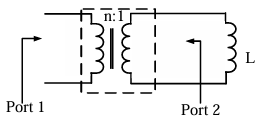
If an ideal transformer has an inductive load element at port 2 as shown in the figure below, the equivalent inductance at port 1 is
AOptions
- \(nL\)
- \(n^2L\)
- \(\frac{L}{n}\)
- \(\frac{L}{n^2}\)
SSolution
For an ideal transformer with turns ratio \(n:1\):
Voltage and current relations:
Impedance transformation:
For inductor at port 2:
Equivalent impedance at port 1:
Therefore: \(L_{eq} = n^2 L\)
Correct answer: B
2-Mark Questions
QQuestion 5 2 Mark
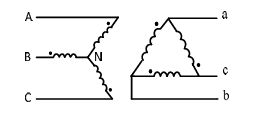
If the star side of the star-delta transformer shown in the figure is excited by a negative sequence voltage, then
AOptions
- \(V_{AB}\) leads \(V_{ab}\) by 60°
- \(V_{AB}\) lags \(V_{ab}\) by 60°
- \(V_{AB}\) leads \(V_{ab}\) by 30°
- \(V_{AB}\) lags \(V_{ab}\) by 30°
SSolution
For a star-delta (Y-\(\Delta\)) transformer:
Positive sequence:
- Standard connection: Delta side leads star side by 30°
- \(V_{AB}\) leads \(V_{ab}\) by 30°
Negative sequence:
- Phase sequence reverses (abc \(\rightarrow\) acb)
- Angular relationships reverse
- The +30° lead becomes -30° (lag)
Therefore, for negative sequence:
Correct answer: D
QQuestion 6 2 Mark
A single-phase 400 V, 50 Hz transformer has an iron loss of 5000 W at the rated condition. When operated at 200 V, 25 Hz, the iron loss is 2000 W. When operated at 416 V, 52 Hz, the value of the hysteresis loss divided by the eddy current loss is \_\_\_\_\_\_.
SSolution
Iron loss components:
where:
- Hysteresis: \(P_h = K_h f B_m^2\)
- Eddy current: \(P_e = K_e f^2 B_m^2\)
- Flux density: \(B_m \propto \frac{V}{f}\)
Condition 1: 400 V, 50 Hz
Condition 2: 200 V, 25 Hz
So \(B_2 = B_1\)
Let \(x = K_h B_1^2\) and \(y = K_e B_1^2\):
From (2): \(x + 25y = 80\)
From (1): \(x + 50y = 100\)
Subtracting: \(25y = 20\), so \(y = 0.8\)
Therefore: \(x = 80 - 20 = 60\)
Condition 3: 416 V, 52 Hz
So \(B_3 = B_1\)
Answer: 1.44 (range: 1.4 to 1.5)
QQuestion 7 2 Mark
A DC shunt generator delivers 45 A at a terminal voltage of 220 V. The armature and the shunt field resistances are 0.01 \(\Omega\) and 44 \(\Omega\) respectively. The stray losses are 375 W. The percentage efficiency of the DC generator is \_\_\_\_\_\_\_\_\_\_\_\_.
SSolution
Given:
- Load current: \(I_L = 45\) A
- Terminal voltage: \(V_t = 220\) V
- \(R_a = 0.01\) \(\Omega\), \(R_{sh} = 44\) \(\Omega\)
- Stray losses = 375 W
Field current:
Armature current:
Output power:
Losses:
- Armature copper loss: \(50^2 \times 0.01 = 25\) W
- Field copper loss: \(220 \times 5 = 1100\) W
- Stray losses: 375 W
- Total losses: \(25 + 1100 + 375 = 1500\) W
Efficiency:
Answer: 86.84% (range: 86.0 to 88.0)
QQuestion 8 2 Mark
A three-phase, 50 Hz salient-pole synchronous motor has a per-phase direct-axis reactance (\(X_d\)) of 0.8 pu and a per-phase quadrature-axis reactance (\(X_q\)) of 0.6 pu. Resistance of the machine is negligible. It is drawing full-load current at 0.8 pf (leading). When the terminal voltage is 1 pu, per-phase induced voltage, in pu, is \_\_\_\_\_\_\_\_\_\_.
SSolution
Given: \(X_d = 0.8\) pu, \(X_q = 0.6\) pu, \(V_t = 1\) pu, pf = 0.8 leading
Assuming \(I_a = 1\) pu at full load.
For leading pf: \(\phi = -36.87°\)
Current phasor: \(\bar{I}_a = 1\angle 36.87°\)
Locate the q-axis first, using the fictitious voltage \(\vec{E}_q = \vec{V}_t - jX_q\vec{I}_a\) (motor convention):
So the load angle is \(\delta = -19.44°\): \(\vec{E}_f\) lags \(\vec{V}_t\), as it must for a motor.
Resolve the current about that axis. \(\vec{I}_a\) leads the q-axis by \(36.87° - (-19.44°) = 56.31°\), so
The machine is drawing leading current, so the direct-axis component is magnetising and adds to \(|\vec{E}_q|\):
Answer: 1.61 pu (range: 1.58 to 1.62)
QQuestion 9 2 Mark
A single-phase, 22 kVA, 2200 V/ 220 V, 50 Hz, distribution transformer is to be connected as an auto-transformer to get an output voltage of 2420 V. Its maximum kVA rating as an auto-transformer is
AOptions
- 22
- 24.2
- 242
- 2420
SSolution
Two-winding configuration:
- HV: 2200 V, \(I_H = 10\) A
- LV: 220 V, \(I_L = 100\) A
- Rating: 22 kVA
Auto-transformer configuration:
- Input voltage: 2200 V (common)
- Series addition: 220 V
- Output voltage: 2420 V
The 2200 V winding is the common winding and the 220 V winding is the series winding. The series winding carries the output current, so the output current is limited to that winding's own rating, 100 A.
Output rating:
Check: the input current is \(242000/2200 = 110\) A, so the common winding carries \(110 - 100 = 10\) A, exactly its rating. Equivalently
Correct answer: C (242 kVA)