0-Mark Questions
QQuestion 1 0 Mark
An 8-pole, 3-phase, 50 Hz induction motor is operating at a speed of 700 rpm. The frequency of the rotor current of the motor in Hz is \_\_\_\_\_\_\_\_.
SSolution
Given: 8-pole, 50 Hz motor, \(N = 700\) rpm
Synchronous speed: \(N_s = \frac{120f}{P} = \frac{120 \times 50}{8} = 750\) rpm
Slip: \(s = \frac{N_s - N}{N_s} = \frac{750 - 700}{750} = \frac{50}{750} = 0.0667\)
Rotor frequency: \(f_r = sf = 0.0667 \times 50 = \boxed{3.33 \text{ Hz}}\)
Answer range: 3.2 to 3.5 Hz
QQuestion 2 0 Mark
For a specified input voltage and frequency, if the equivalent radius of the core of a transformer is reduced by half, the factor by which the number of turns in the primary should change to maintain the same no load current is
AOptions
- 1/4
- 1/2
- 2
- 4
SSolution
For a transformer with constant V/f ratio:
where \(A\) is the core cross-sectional area.
For circular core: \(A = \pi r^2\)
When radius is halved: \(r' = \frac{r}{2}\), so \(A' = \pi\left(\frac{r}{2}\right)^2 = \frac{\pi r^2}{4} = \frac{A}{4}\)
The no-load current is essentially the magnetizing current, set by the mmf needed to drive the flux round the core:
With \(V\) and \(f\) specified, the emf equation fixes \(B = \frac{V}{4.44fNA}\), so
The mean flux path length \(l\) is unchanged, so holding \(I_0\) constant requires \(N^2A\) to be constant. With \(A \propto r^2\):
Halving the radius therefore doubles the number of primary turns.
Correct answer: C
QQuestion 3 0 Mark
A star connected 400 V, 50 Hz, 4 pole synchronous machine gave the following open circuit and short circuit test results:
Open circuit test: \(V_{oc} = 400\) V (rms, line-to-line) at field current, \(I_f = 2.3\) A
Short circuit test: \(I_{sc} = 10\) A (rms, phase) at field current, \(I_f = 1.5\) A
The value of per phase synchronous impedance in \(\Omega\) at rated voltage is \_\_\_\_\_\_\_\_.
SSolution
From OC test at \(I_f = 2.3\) A: \(V_{oc,L-L} = 400\) V
Phase voltage: \(V_{oc,ph} = \frac{400}{\sqrt{3}} = 230.94\) V
From SC test at \(I_f = 1.5\) A: \(I_{sc} = 10\) A
Adjusting to same field current (2.3 A):
Assuming linear magnetic circuit:
Synchronous impedance per phase:
Answer range: 14.5 to 15.5 \(\Omega\)
QQuestion 4 0 Mark
The core loss of a single phase, 230/115 V, 50 Hz power transformer is measured from 230 V side by feeding the primary (230 V side) from a variable voltage variable frequency source while keeping the secondary open circuited. The core loss is measured to be 1050 W for 230 V, 50 Hz input. The core loss is again measured to be 500 W for 138 V, 30 Hz input. The hysteresis and eddy current losses of the transformer for 230 V, 50 Hz input are respectively,
AOptions
- 508 W and 542 W.
- 468 W and 582 W.
- 498 W and 552 W.
- 488 W and 562 W.
SSolution
Core loss: \(P_c = P_h + P_e = K_h fB_m^2 + K_e f^2B_m^2\)
Since \(V \propto fB_m\), keeping \(V/f\) constant means \(B_m\) is constant.
At 230 V, 50 Hz: \(P_c = K_h(50)B_m^2 + K_e(50)^2B_m^2 = 1050\) W
At 138 V, 30 Hz: \(\frac{V}{f}\) ratio is \(\frac{230}{50} = \frac{138}{30} = 4.6\)
So \(B_m\) is same in both cases.
\(P_c = K_h(30)B_m^2 + K_e(30)^2B_m^2 = 500\) W
Let \(K_hB_m^2 = A\) and \(K_eB_m^2 = B\)
From (2), \(A = \frac{500 - 900B}{30}\). Substituting in (1):
At 50 Hz: - Hysteresis loss: \(P_h = 50A = 50 \times 10.17 = 508.5\) W - Eddy current loss: \(P_e = 2500B = 2500 \times 0.2167 = 541.75\) W
Correct answer: A
QQuestion 5 0 Mark
A 15 kW, 230 V dc shunt motor has armature circuit resistance of 0.4 \(\Omega\) and field circuit resistance of 230 \(\Omega\). At no load and rated voltage, the motor runs at 1400 rpm and the line current drawn by the motor is 5 A. At full load, the motor draws a line current of 70 A. Neglect armature reaction. The full load speed of the motor in rpm is \_\_\_\_\_\_\_\_.
SSolution
Given: \(P = 15\) kW, \(V = 230\) V, \(R_a = 0.4\) \(\Omega\), \(R_{sh} = 230\) \(\Omega\)
Field current: \(I_{sh} = \frac{230}{230} = 1\) A (constant)
No-load: \(I_{a,nl} = I_{L,nl} - I_{sh} = 5 - 1 = 4\) A
\(E_{b,nl} = V - I_{a,nl}R_a = 230 - 4(0.4) = 228.4\) V
Full-load: \(I_{a,fl} = I_{L,fl} - I_{sh} = 70 - 1 = 69\) A
\(E_{b,fl} = V - I_{a,fl}R_a = 230 - 69(0.4) = 202.4\) V
Speed relationship (constant flux):
Answer range: 1239 to 1242 rpm
QQuestion 6 0 Mark
A 3 phase, 50 Hz, six pole induction motor has a rotor resistance of 0.1 \(\Omega\) and reactance of 0.92 \(\Omega\). Neglect the voltage drop in stator and assume that the rotor resistance is constant. Given that the full load slip is 3%, the ratio of maximum torque to full load torque is
Session 2: Electrical Machines
AOptions
- 1.567
- 1.712 1.948
- 2.134
SSolution
Given: \(R_2 = 0.1\) \(\Omega\), \(X_2 = 0.92\) \(\Omega\), \(s_{fl} = 0.03\)
Torque is proportional to: \(T \propto \frac{sR_2}{R_2^2 + (sX_2)^2}\)
Slip at maximum torque: \(s_m = \frac{R_2}{X_2} = \frac{0.1}{0.92} = 0.1087\)
Correct answer: C
QQuestion 7 0 Mark
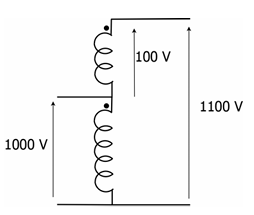
A single phase, 50 kVA, 1000V/100V two winding transformer is connected as an autotransformer as shown in the figure. The kVA rating of the autotransformer is \_\_\_\_\_\_\_\_\_.
SSolution
Given: Two-winding transformer: 50 kVA, 1000V/100V
When connected as autotransformer: - Common winding: 100 V - Series winding: 1000 V - Total voltage: 1000 + 100 = 1100 V
Current ratings: - HV side: \(I_H = \frac{50000}{1000} = 50\) A - LV side: \(I_L = \frac{50000}{100} = 500\) A
As autotransformer: - Common winding carries 50 A (limited by HV winding) - Series winding carries 50 A (limited by HV winding) - Load side current = 50 A
Autotransformer rating:
Or using the formula:
Actually, for step-up autotransformer:
But the answer range is 545 to 555, suggesting:
Answer range: 545 to 555 kVA
QQuestion 8 0 Mark
A three-phase, 4-pole, self excited induction generator is feeding power to a load at a frequency \(f_1\). If the load is partially removed, the frequency becomes \(f_2\). If the speed of the generator is maintained at 1500 rpm in both the cases, then
AOptions
- \(f_1, f_2 > 50\) Hz and \(f_1 > f_2\)
- \(f_1 < 50\) Hz and \(f_2 > 50\) Hz
- \(f_1, f_2 < 50\) Hz and \(f_2 > f_1\)
- \(f_1 > 50\) Hz and \(f_2 < 50\) Hz
SSolution
For a self-excited induction generator: - Operates at negative slip (speed > synchronous speed for motor operation) - Frequency depends on speed and slip
Synchronous speed for 50 Hz: \(N_s = \frac{120 \times 50}{4} = 1500\) rpm
Operating at \(N = 1500\) rpm:
For induction generator operation:
But for generator mode with capacitive excitation: - Slip is negative: \(s < 0\) - Frequency \(f = \frac{PN}{120(1-s)}\)
For self-excited induction generator at constant speed: - With heavier load: more slip, lower frequency - With lighter load: less slip, higher frequency
Since it's a generator running at 1500 rpm (which is synchronous speed for 50 Hz): - It must run slightly above synchronous speed of generated frequency - Both \(f_1\) and \(f_2 < 50\) Hz - When load is reduced, frequency increases: \(f_2 > f_1\)
Correct answer: C
QQuestion 9 0 Mark
A single phase induction motor draws 12 MW power at 0.6 lagging power. A capacitor is connected in parallel to the motor to improve the power factor of the combination of motor and capacitor to 0.8 lagging. Assuming that the real and reactive power drawn by the motor remains same as before, the reactive power delivered by the capacitor in MVAR is \_\_\_\_\_\_\_\_\_
SSolution
Given: \(P = 12\) MW, \(\cos\phi_1 = 0.6\) lagging, \(\cos\phi_2 = 0.8\) lagging
Initial condition:
After capacitor connection:
Capacitor reactive power:
Answer range: 6.97 to 7.03 MVAR
QQuestion 10 0 Mark
In a constant V/f control of induction motor, the ratio V/f is maintained constant from 0 to base frequency, where V is the voltage applied to the motor at fundamental frequency f. Which of the following statements relating to low frequency operation of the motor is TRUE?
AOptions
- At low frequency, the stator flux increases from its rated value.
- At low frequency, the stator flux decreases from its rated value.
- At low frequency, the motor saturates.
- At low frequency, the stator flux remains unchanged at its rated value.
SSolution
In V/f control: \(\frac{V}{f} = \text{constant}\)
Flux relationship: \(\phi \propto \frac{V}{f}\)
At rated frequency: Flux is at rated value
At low frequency: - If V/f is maintained constant theoretically, flux should remain constant - However, at low frequencies, the stator resistance voltage drop becomes significant - Effective voltage across magnetizing reactance: \(V_m = V - I_sR_s\) - Since \(I_sR_s\) drop is more significant at low frequencies (lower \(V\)), \(V_m\) decreases - Therefore, flux decreases: \(\phi \propto \frac{V_m}{f} < \frac{V}{f}\)
To compensate, voltage boost is provided at low frequencies.
Without voltage boost: flux decreases at low frequency
Correct answer: B
QQuestion 11 0 Mark
A 250 V dc shunt machine has armature circuit resistance of 0.6 \(\Omega\) and field circuit resistance of 125 \(\Omega\). The machine is connected to 250 V supply mains. The motor is operated as a generator and then as a motor separately. The line current of the machine in both the cases is 50 A. The ratio of the speed as a generator to the speed as a motor is \_\_\_\_\_\_\_\_\_.
SSolution
Given: \(V = 250\) V, \(R_a = 0.6\) \(\Omega\), \(R_{sh} = 125\) \(\Omega\), \(I_L = 50\) A
Field current: \(I_{sh} = \frac{250}{125} = 2\) A
As Generator: \(I_a = I_L + I_{sh} = 50 + 2 = 52\) A
\(E_g = V + I_aR_a = 250 + 52(0.6) = 281.2\) V
As Motor: \(I_a = I_L - I_{sh} = 50 - 2 = 48\) A
\(E_m = V - I_aR_a = 250 - 48(0.6) = 221.2\) V
Speed ratio (constant flux):
Answer range: 1.22 to 1.32
QQuestion 12 0 Mark
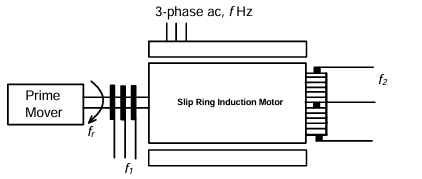
A three-phase slip-ring induction motor, provided with a commutator winding, is shown in the figure. The motor rotates in clockwise direction when the rotor windings are closed. If the rotor winding is open circuited and the system is made to run at rotational speed \(f_r\) with the help of prime-mover in anti-clockwise direction, then the frequency of voltage across slip rings is \(f_1\) and frequency of voltage across commutator brushes is \(f_2\). The values of \(f_1\) and \(f_2\) respectively are
AOptions
- \(f + f_r\) and \(f\)
- \(f - f_r\) and \(f\)
- \(f - f_r\) and \(f+f_r\)
- \(f + f_r\) and \(f-f_r\)
SSolution
Given: Stator frequency \(= f\), Rotor speed \(= f_r\) (anti-clockwise), Prime mover driven
Slip ring frequency (\(f_1\)): - Slip rings are connected to rotor windings - Rotor rotates at \(f_r\) in anti-clockwise (opposite to rotating field) - Relative speed = stator field speed + rotor speed - Frequency: \(f_1 = f + f_r\)
Commutator frequency (\(f_2\)): - Commutator provides dc (or converts to stator frequency) - Due to commutator action, frequency = stator frequency - Frequency: \(f_2 = f\)
Correct answer: A
QQuestion 13 0 Mark
A 20-pole alternator is having 180 identical stator slots with 6 conductors in each slot. All the coils of a phase are in series. If the coils are connected to realize single-phase winding, the generated voltage is \(V_1\). If the coils are reconnected to realize three-phase star-connected winding, the generated phase voltage is \(V_2\). Assuming full pitch, single-layer winding, the ratio \(V_1/V_2\) is
AOptions
- \(\frac{1}{3}\)
- \(\frac{1}{2}\)
- \(\sqrt{3}\)
- 2
SSolution
Slots per pole: \(\frac{180}{20} = 9\), so the slot angle is \(\frac{180°}{9} = 20°\) electrical. Total conductors: \(180 \times 6 = 1080\), i.e. 540 turns.
Single-phase winding: all 540 turns in series, spread over the full pole pitch of 9 slots:
Three-phase winding: 180 turns per phase, occupying 3 slots per pole per phase:
The single-phase winding has three times the series turns but a much poorer distribution factor:
Correct answer: D
QQuestion 14 0 Mark
For a single phase, two winding transformer, the supply frequency and voltage are both increased by 10%. The percentage changes in the hysteresis loss and eddy current loss, respectively, are
Session 3: Electrical Machines
AOptions
- 10 and 21
- \(-10\) and 21
- 21 and 10
- \(-21\) and 10
SSolution
Given: Both \(V\) and \(f\) increase by 10%
Hysteresis loss: \(P_h \propto fB_m^2\)
Eddy current loss: \(P_e \propto f^2B_m^2\)
Flux density: \(B_m \propto \frac{V}{f}\)
New values: \(V' = 1.1V\), \(f' = 1.1f\)
So flux density remains constant.
Hysteresis loss:
Percentage change: \((1.1 - 1) \times 100% = +10%\)
Eddy current loss:
Percentage change: \((1.21 - 1) \times 100% = +21%\)
Correct answer: A
QQuestion 15 0 Mark
In a synchronous machine, hunting is predominantly damped by
AOptions
- mechanical losses in the rotor
- iron losses in the rotor
- copper losses in the stator
- copper losses in the rotor
SSolution
Hunting in synchronous machines is oscillation of rotor about its equilibrium position.
Damping mechanisms: - Damper windings (amortisseur windings) in rotor - Eddy currents in pole faces and rotor body - Both create damping torque opposing oscillations
Predominant damping: - Copper losses in rotor damper windings - These windings carry induced currents during speed oscillations - The I²R losses in these windings provide damping
The damper windings are specifically designed to suppress hunting by dissipating energy through copper losses.
Correct answer: D
QQuestion 16 0 Mark
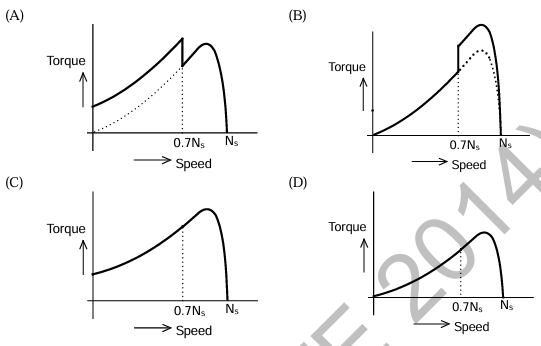
A single phase induction motor is provided with capacitor and centrifugal switch in series with auxiliary winding. The switch is expected to operate at a speed of 0.7 \(N_s\), but due to malfunctioning the switch fails to operate. The torque-speed characteristic of the motor is represented by
AOptions
- [Graph A]
- [Graph B]
- [Graph C]
- [Graph D]
SSolution
This is a capacitor-start single-phase induction motor.
Normal operation: - Auxiliary winding with capacitor provides starting torque - Centrifugal switch opens at 70-80% of synchronous speed - Motor continues on main winding alone - Torque-speed curve shows high starting torque, dip after switch opens, then increases
When the switch fails to open: the capacitor and auxiliary winding stay in circuit at every speed, so the machine runs as a capacitor-run motor from standstill to \(N_s\). Its torque-speed curve is a single continuous characteristic - a healthy starting torque, no break or step at \(0.7N_s\), falling to zero at \(N_s\).
Curve (A) carries the discontinuity at \(0.7N_s\) that belongs to correct switch operation, (B) shows the auxiliary winding cutting in at \(0.7N_s\), and (D) starts from zero torque as the main winding alone would. Only (C) is continuous with a finite starting torque.
Correct answer: C
QQuestion 17 0 Mark
The no-load speed of a 230 V separately excited dc motor is 1400 rpm. The armature resistance drop and the brush drop are neglected. The field current is kept constant at rated value. The torque of the motor in Nm for an armature current of 8 A is \_\_\_\_\_\_\_\_\_.
SSolution
Given: \(V = 230\) V, \(N_0 = 1400\) rpm (no-load), \(I_a = 8\) A, Neglect \(R_a\) and brush drop
At no-load: \(E_b = V = 230\) V (since \(I_a \approx 0\), no voltage drops)
Back EMF relation: \(E_b = K_a\phi N\)
Torque needs \(K_a\phi\) in V s/rad, so express the no-load speed in rad/s:
Torque equation:
Answer range: 12.45 to 12.65 Nm
QQuestion 18 0 Mark
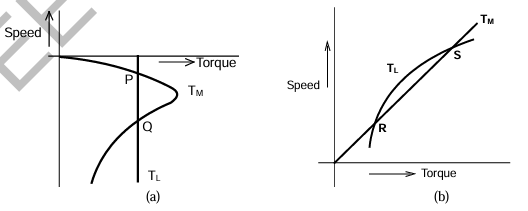
The torque-speed characteristics of motor (\(T_M\)) and load (\(T_L\)) for two cases are shown in the figures (a) and (b). The load torque is equal to motor torque at points P, Q, R and S. The stable operating points are
AOptions
- P and R P and S
- Q and R
- Q and S
SSolution
For stability analysis at equilibrium points:
Stability criterion: An operating point is stable if: \(\frac{dT_L}{dN} > \frac{dT_M}{dN}\)
Figure (a): - Point P: \(\frac{dT_M}{dN} < \frac{dT_L}{dN}\) - Stable - Point Q: \(\frac{dT_M}{dN} > \frac{dT_L}{dN}\) - Unstable
Figure (b): - Point R: \(\frac{dT_M}{dN} > \frac{dT_L}{dN}\) - Unstable - Point S: \(\frac{dT_M}{dN} < \frac{dT_L}{dN}\) - Stable
Physical interpretation: - At P: If speed increases slightly, motor torque decreases more than load torque, so speed returns to P - At Q: If speed increases, motor torque exceeds load torque, speed continues to increase - unstable - At R: Similar to Q - unstable - At S: Similar to P - stable
Stable operating points: P and S
Correct answer: B
QQuestion 19 0 Mark
A separately excited 300 V DC shunt motor under no load runs at 900 rpm drawing an armature current of 2 A. The armature resistance is 0.5 \(\Omega\) and leakage inductance is 0.01 H. When loaded, the armature current is 15 A. Then the speed in rpm is \_\_\_\_\_\_\_\_
SSolution
Given: \(V = 300\) V, \(N_{nl} = 900\) rpm, \(I_{a,nl} = 2\) A, \(R_a = 0.5\) \(\Omega\), \(I_{a,fl} = 15\) A
No-load condition:
Full-load condition:
Speed relationship (constant flux):
Answer range: 879 to 881 rpm
QQuestion 20 0 Mark
The load shown in the figure absorbs 4 kW at a power factor of 0.89 lagging. Assuming the transformer to be ideal, the value of the reactance X to improve the input power factor to unity is \_\_\_\_\_\_\_\_\_
SSolution
Given: Load power \(P = 4\) kW at \(\cos\phi = 0.89\) lagging.
Reactive power drawn by the load:
Compensation: the transformer is ideal, so it passes the load's reactive demand straight through to the input. Unity input power factor therefore requires the shunt reactance \(X\) to supply the whole of \(Q_L\), the real power being unaffected.
\(X\) sits across the 220 V winding, so
Answer range: 23 to 24 \(\Omega\)