1-Mark Questions
QQuestion 1 1 Mark
A single-phase transformer has no-load loss of 64 W, as obtained from an open-circuit test. When a short-circuit test is performed on it with 90% of the rated currents flowing in its both LV and HV windings, the measured loss is 81 W. The transformer has maximum efficiency when operated at
AOptions
- 50.0% of the rated current.
- 64.0% of the rated current.
- 80.0% of the rated current.
- 88.8% of the rated current.
SSolution
For a transformer, maximum efficiency occurs when copper losses equal iron losses.
Given:
- No-load (iron) loss: \(P_i = 64\) W
- SC test at 90% current: \(P_{cu,90%} = 81\) W
Copper loss at rated current:
Copper loss \(\propto I^2\)
For maximum efficiency:
Therefore, maximum efficiency occurs at 80% of rated current.
Correct answer: C
QQuestion 2 1 Mark
The angle \(\delta\) in the swing equation of a synchronous generator is the
AOptions
- angle between stator voltage and current.
- angular displacement of the rotor with respect to the stator.
- angular displacement of the stator mmf with respect to a synchronously rotating axis.
- angular displacement of an axis fixed to the rotor with respect to a synchronously rotating axis.
SSolution
The swing equation of a synchronous generator is:
where \(\delta\) is the power angle or rotor angle.
Definition of \(\delta\):
The angle \(\delta\) represents the angular displacement of an axis fixed to the rotor (d-axis or direct axis) with respect to a synchronously rotating reference frame.
Explanation:
- The synchronously rotating reference frame rotates at synchronous speed
- An axis fixed to the rotor (typically the d-axis aligned with the field pole)
- \(\delta\) measures how far ahead or behind the rotor is from synchronous position
- This is different from the mechanical angle between rotor and stator (which changes constantly)
Correct answer: D
QQuestion 3 1 Mark
Leakage flux in an induction motor is
AOptions
- flux that leaks through the machine
- flux that links both stator and rotor windings
- flux that links none of the windings
- flux that links the stator winding or the rotor winding but not both
SSolution
In an induction motor, there are two types of flux:
1. Mutual flux (Main flux):
- Links both stator and rotor windings
- Crosses the air gap
- Responsible for torque production
- Creates the mutual inductance
2. Leakage flux:
- Links only one winding (either stator OR rotor, but not both)
- Does not cross the air gap effectively
- Returns through air or frame
- Creates leakage inductance
- Does not contribute to torque production
Examples of leakage flux paths:
- Slot leakage flux (confined to slot)
- End-winding leakage flux
- Tooth-top leakage flux
Correct answer: D
QQuestion 4 1 Mark
A 4-pole induction motor, supplied by a slightly unbalanced three-phase 50 Hz source, is rotating at 1440 rpm. The electrical frequency in Hz of the induced negative sequence current in the rotor is
Section 2: Power Systems
AOptions
- 100
- 98
- 52
- 48
SSolution
Given:
- Poles: \(P = 4\)
- Supply frequency: \(f = 50\) Hz
- Rotor speed: \(N_r = 1440\) rpm
- Negative sequence present due to unbalanced supply
Synchronous speed:
Slip:
Negative sequence analysis:
The negative sequence field rotates in opposite direction at synchronous speed.
Relative speed between negative sequence field and rotor:
(Both are in opposite directions, so speeds add)
Slip with respect to negative sequence:
Rotor frequency for negative sequence:
Alternatively: \(f_{rotor,neg} = (2 - s) \times f = (2 - 0.04) \times 50 = 98\) Hz
Correct answer: B
QQuestion 5 1 Mark
A single-phase load is supplied by a single-phase voltage source. If the current flowing from the load to the source is \(10\angle -150°\) A and if the voltage at the load terminals is \(100\angle 60°\) V, then the
AOptions
- load absorbs real power and delivers reactive power.
- load absorbs real power and absorbs reactive power.
- load delivers real power and delivers reactive power.
- load delivers real power and absorbs reactive power.
SSolution
Given:
- Current from load to source: \(\bar{I} = 10\angle -150°\) A
- Voltage at load terminals: \(\bar{V} = 100\angle 60°\) V
Note: Current direction is from load to source (opposite to conventional direction for a load).
Current into the load: \(\bar{I}_{load} = -\bar{I} = 10\angle 30°\) A
Phase angle:
Complex power:
Since we used current into the load:
- \(P > 0\): Load absorbs real power
- \(Q > 0\): Load absorbs reactive power (inductive)
The same result follows if the given current is used directly. With \(\bar{I} = 10\angle -150°\) leaving the load,
is the complex power delivered by the load. Both parts are negative, so the load in fact absorbs:
The load absorbs real power and absorbs reactive power, i.e. it is inductive.
Correct answer: B
2-Mark Questions
QQuestion 6 2 Mark
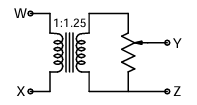
The following arrangement consists of an ideal transformer and an attenuator which attenuates by a factor of 0.8. An ac voltage \(V_{WX1} = 100\) V is applied across WX to get an open circuit voltage \(V_{YZ1}\) across YZ. Next, an ac voltage \(V_{YZ2} = 100\) V is applied across YZ to get an open circuit voltage \(V_{WX2}\) across WX. Then, \(V_{YZ1}/V_{WX1}\) and \(V_{WX2}/V_{YZ2}\) are respectively,
AOptions
- 125/100 and 80/100
- 100/100 and 80/100
- 100/100 and 100/100
- 80/100 and 80/100
SSolution
Configuration:
- Transformer turns ratio: 1:1.25 (step-up)
- Attenuator factor: 0.8
Case 1: Input at WX, output at YZ
Voltage after transformer:
Voltage after attenuator:
Ratio:
Case 2: Input at YZ, output at WX
The attenuator is the resistive divider across the secondary, so with YZ open \(V_{YZ} = 0.8 V_{sec}\).
Now WX is the open port. An ideal transformer whose primary is open circuited can carry no secondary current either, so no current flows in the series arm of the divider and that arm drops no voltage. The applied 100 V therefore appears in full across the secondary winding:
Reflecting to the primary through the 1:1.25 ratio:
Correct answer: B (100/100 and 80/100)
QQuestion 7 2 Mark
For a power system network with \(n\) nodes, \(Z_{33}\) of its bus impedance matrix is j0.5 per unit. The voltage at node 3 is \(1.3\angle -10°\) per unit. If a capacitor having reactance of \(-j3.5\) per unit is now added to the network between node 3 and the reference node, the current drawn by the capacitor per unit is
Section 3: Power Electronics
AOptions
- \(0.325\angle -100°\)
- \(0.325\angle 80°\)
- \(0.371\angle -100°\)
- \(0.433\angle 80°\)
SSolution
Given:
- \(Z_{33} = j0.5\) pu (driving point impedance at bus 3)
- \(V_3 = 1.3\angle -10°\) pu (voltage before adding capacitor)
- Capacitor reactance: \(X_C = -j3.5\) pu
Thevenin equivalent at bus 3:
The Thevenin impedance is \(Z_{th} = Z_{33} = j0.5\) pu
The Thevenin voltage is the open circuit voltage = \(V_3 = 1.3\angle -10°\) pu
After adding the capacitor:
The capacitor is connected across this Thevenin source, so the current it draws is simply the pre-fault bus voltage divided by the total loop impedance:
Correct answer: D
QQuestion 8 2 Mark
In the circuit shown below, the knee current of the ideal Zener diode is 10 mA. To maintain 5 V across \(R_L\), the minimum value of \(R_L\) in \(\Omega\) and the minimum power rating of the Zener diode in mW respectively are
\vspace{0.2cm}
\begin{circuitikz} \draw (0,0) to[battery1, l=10V] (0,2); \draw (0,2) to[R, l=100\(\Omega\)] (2,2); \draw (2,2) to[short] (4,2); \draw (2,2) to[zDo, l=5V] (2,0); \draw (4,2) to[R, l=\(R_L\)] (4,0); \draw (0,0) to[short] (4,0); \end{circuitikz}
\vspace{0.2cm}
AOptions
- 125 and 125
- 125 and 250
- 250 and 125
- 250 and 250
SSolution
Given:
- Source voltage: \(V_s = 10\) V
- Series resistance: \(R_s = 100\) \(\Omega\)
- Zener voltage: \(V_Z = 5\) V (to maintain across \(R_L\))
- Knee current: \(I_{Z,min} = 10\) mA
Total current through series resistor:
While the Zener holds 5 V, the drop across \(R_s\) is fixed at 5 V, so the source current is fixed:
Minimum \(R_L\):
The load current is largest when the Zener is left with only its knee current:
Minimum power rating of Zener:
Maximum Zener current occurs when \(R_L\) is maximum (open circuit):
Correct answer: B (125 \(\Omega\) and 250 mW)
QQuestion 9 2 Mark
The separately excited dc motor in the figure below has a rated armature current of 20 A and a rated armature voltage of 150 V. An ideal chopper switching at 5 kHz is used to control the armature voltage. If \(L_a = 0.1\) mH, \(R_a = 1\) \(\Omega\), neglecting armature reaction, the duty ratio of the chopper to obtain 50% of the rated torque at the rated speed and the rated field current is
\vspace{0.2cm}
\begin{circuitikz} \draw (0,0) to[battery1, l=200V] (0,2); \draw (0,2) to[short] (2,2); \draw (2,2) to[switch] (4,2); \draw (4,2) to[short] (6,2); \draw (6,2) to[R, l=\(R_a\)] (8,2); \draw (8,2) to[L, l=\(L_a\)] (10,2); \draw (10,2) to[short] (10,0); \draw (10,0.5) to[short] (10,1.5); \draw[<-] (10.3,0.5) -- (10.3,1.5); \node at (11,1) {Motor}; \draw (0,0) to[short] (10,0); \end{circuitikz}
\vspace{0.2cm}
AOptions
- 0.4
- 0.5
- 0.6
- 0.7
SSolution
Given:
- Rated: \(I_{a,rated} = 20\) A, \(V_{a,rated} = 150\) V
- Source: \(V_s = 200\) V
- \(R_a = 1\) \(\Omega\), \(L_a = 0.1\) mH
- Required: 50% rated torque at rated speed and rated field
At rated conditions:
Back EMF:
At 50% rated torque:
Since \(T \propto \phi I_a\) and field is at rated value:
At rated speed, back EMF remains same (since \(E_b \propto \phi N\)):
Required armature voltage:
Duty ratio:
Correct answer: D
QQuestion 10 2 Mark
In the circuit shown below the op-amps are ideal. Then \(V_{out}\) in Volts is
\vspace{0.2cm}
The first op-amp has its non-inverting input tied to a 1 V source. A \(-2\) V source feeds its inverting input through a 1 k\(\Omega\) resistor, and a 1 k\(\Omega\) feedback resistor runs from its output \(V_1\) back to that inverting input.
\(V_1\) drives the non-inverting input of the second op-amp, which is a non-inverting amplifier: 1 k\(\Omega\) from its inverting input to ground and 1 k\(\Omega\) feedback from \(V_{out}\).
\vspace{0.2cm}
AOptions
- 4
- 6
- 8
- 10
SSolution
First stage:
The virtual short holds the inverting node at 1 V, so the current supplied through the input resistor is
No current enters the op-amp input, so all of it flows on through the feedback resistor:
Second stage: a non-inverting amplifier with two equal resistors, gain \(1 + \frac{1k}{1k} = 2\):
Correct answer: C
QQuestion 11 2 Mark
Thyristor T in the figure below is initially off and is triggered with a single pulse of width 10 \(\mu\)s. It is given that \(L = \frac{100}{\pi}\) \(\mu\)H and \(C = \frac{100}{\pi}\) \(\mu\)F. Assuming latching and holding currents of the thyristor are both zero and the initial charge on C is zero, T conducts for
\vspace{0.2cm}
\begin{circuitikz} \draw (0,0) to[battery1, l=15V] (0,2); \draw (0,2) to[short] (2,2); \draw (2,2) to[Tly] (2,0); \draw (2,2) to[L, l=\(L\)] (4,2); \draw (4,2) to[C, l=\(C\)] (4,0); \draw (0,0) to[short] (4,0); \end{circuitikz}
\vspace{0.2cm}
AOptions
- 10 \(\mu\)s
- 50 \(\mu\)s
- 100 \(\mu\)s
- 200 \(\mu\)s
SSolution
This is an LC resonant circuit. When the thyristor is triggered, the capacitor charges through the inductor.
Natural frequency:
Period of oscillation:
The thyristor conducts for half cycle (until current tries to reverse):
Correct answer: C