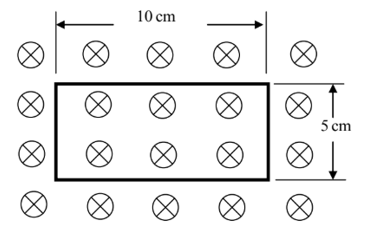
Consider a one-turn rectangular loop of wire placed in a uniform magnetic field as shown in the figure. The plane of the loop is perpendicular to the field lines. The resistance of the loop is \(0.4\Omega\), and its inductance is negligible. The magnetic flux density (in Tesla) is a function of time, and is given by \(B(t) = 0.25 \sin \omega t\), where \(\omega = 2\pi \times 50\) radian/second. The power absorbed (in Watt) by the loop from the magnetic field is ________ .
Solution
The power dissipated in a resistor is given by:
Equation
\[P = \frac{V_{emf}^2}{R}\]
The induced EMF is given by Faraday's Law:
Equation
\[V_{emf} = -\frac{d\psi}{dt}\]
The magnetic flux \(\psi\) passing through the loop area \(S\):
Equation
\[\psi = \int_S \vec{B} \cdot d\vec{S} = B \cdot S\]
Consider a function \(\vec{f} = \frac{1}{r^2}\hat{r}\), where \(r\) is the distance from the origin and \(\hat{r}\) is the unit vector in the radial direction. The divergence of the function over a sphere of radius R, which includes the origin, is
0
\(2\pi\)
\(4\pi\)
\(R\pi\)
Solution
The phrase “over a sphere … which includes the origin” signals that we want the total divergence integrated over the volume, which by the divergence theorem equals the outward flux of \(\vec{f}\) through the sphere:
Equation
\[\iiint_V (\nabla \cdot \vec{f})\, dV = \oiint_S \vec{f} \cdot d\vec{S}.\]
First, the pointwise divergence in spherical coordinates (for \(F_r = 1/r^2,\ F_\theta = F_\phi = 0\)) is
So the divergence vanishes everywhere except at the origin. The field \(\vec{f} = \hat{a}_r/r^2\) is exactly the form of a point-source field, and its divergence is a Dirac delta there: \(\nabla \cdot \vec{f} = 4\pi\,\delta^3(\vec{r})\). Because the sphere encloses the origin, this contribution must be counted. Evaluating the flux directly over a sphere of radius \(R\) (where \(d\vec{S} = R^2 \sin\theta\, d\theta\, d\phi\, \hat{a}_r\)):
Hence the divergence integrated over the sphere containing the origin is \(4\pi\).
Correction noteThe pointwise divergence away from the origin is \(0\), but the question explicitly takes a sphere that includes the origin, so the singular contribution at \(r=0\) must be retained. By the divergence theorem this gives \(4\pi\) (Option C), not \(0\).
C
Final Answer
Correct answer: C (\(4\pi\)).
Question 03
Question 3
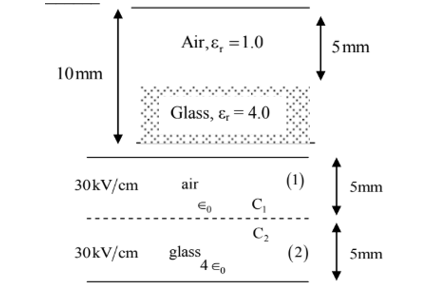
A parallel plate capacitor is partially filled with glass of dielectric constant 4.0 as shown below. The dielectric strengths of air and glass are 30 kV/cm and 300 kV/cm, respectively. The maximum voltage (in kilovolts), which can be applied across the capacitor without any breakdown, is ________ .
This means the electric field in the air gap is 4 times stronger than in the glass. The air will break down first.
Limit set by Air Breakdown (\(E_{\text{air}} \le 30 \text{ kV/cm}\)):
Two semi-infinite dielectric regions are separated by a plane boundary at \(y=0\). The dielectric constant of region 1 (\(y<0\)) and region 2 (\(y>0\)) are 2 and 5. Region 1 has uniform electric field \(\vec{E}_1 = 3\hat{a}_x + 4\hat{a}_y + 2\hat{a}_z\). The electric field in region 2 is: