The gain at the breakaway point of the root locus of a unity feedback system with open loop transfer function \[G(s) = \frac{Ks}{(s-1)(s-4)}\] is
\(1\)
\(2\)
\(5\)
\(9\)
Correct answer: A: \(1\).
The characteristic equation is \(1 + G(s) = 0\): \[1 + \frac{Ks}{(s-1)(s-4)} = 0 \implies s^2 - 5s + 4 + Ks = 0\] Isolate the gain \(K\): \[K = -\frac{s^2 - 5s + 4}{s} = 5 - s - \frac{4}{s}\]
1. Find the breakaway point (\(\mathbf{\frac{dK}{ds} = 0}\)) \[\frac{dK}{ds} = -1 + \frac{4}{s^2} = 0 \implies s^2 = 4 \implies s = \pm 2\]
The open-loop poles are at \(1\) and \(4\), with a zero at the origin. The segment of the real axis between the two poles belongs to the root locus, so the branches starting at those poles meet and leave the axis at \(s = 2\); this is the breakaway point. The other root, \(s = -2\), lies on the locus to the left of the zero and is the break-in point.
2. Calculate the gain \(\mathbf{K}\) at the breakaway point \[K = -\frac{(2)^2 - 5(2) + 4}{2} = -\frac{4 - 10 + 4}{2} = 1\]
The gain at the breakaway point is \(\mathbf{K = 1}\).
A second-order real system has the following properties:
the damping ratio \(\xi = 0.5\) and undamped natural frequency \(\omega_n = 10 \text{ rad/s}\);
the steady state value of the output, to a unit step input, is \(1.02\).
The transfer function of the system is
\(\frac{1.02}{s^2+5s+100}\)
\(\frac{102}{s^2+10s+100}\)
\(\frac{100}{s^2+10s+100}\)
\(\frac{102}{s^2+5s+100}\)
Correct answer: B: \(\frac{102}{s^2+10s+100}\).
The standard form of a second-order system transfer function is: \[T(s) = \frac{K \omega_n^2}{s^2 + 2\xi\omega_n s + \omega_n^2}\] where \(K\) is the DC gain.
1. Determine the Denominator (Based on \(\mathbf{\xi}\) and \(\mathbf{\omega_n}\))
Given properties:
Damping ratio \(\xi = 0.5\)
Undamped natural frequency \(\omega_n = 10 \text{ rad/s}\)
Substitute these values into the denominator: \[\text{Denominator} = s^2 + 2\xi\omega_n s + \omega_n^2\] \[\text{Denominator} = s^2 + 2(0.5)(10)s + (10)^2\] \[\text{Denominator} = \mathbf{s^2 + 10s + 100}\] This eliminates options A and D. The correct T(s) must be either B or C.
2. Determine the DC Gain (Based on Steady-State Value)
The steady-state value \(y(\infty)\) of the output to a unit step input \(R(s) = 1/s\) is found using the Final Value Theorem: \[y(\infty) = \lim_{s \to 0} s R(s) T(s)\] Given \(y(\infty) = 1.02\) and \(R(s) = 1/s\): \[1.02 = \lim_{s \to 0} s \left( \frac{1}{s} \right) T(s) = \lim_{s \to 0} T(s)\] The DC gain \(T(0)\) must equal \(1.02\).
3. Evaluate Options B and C at \(\mathbf{s=0}\) Let the numerator constant be \(N\). The transfer function is \(T(s) = \frac{N}{s^2 + 10s + 100}\). \[T(0) = \frac{N}{0^2 + 10(0) + 100} = \frac{N}{100}\] Setting this equal to the required steady-state value: \[\frac{N}{100} = 1.02\] \[N = 1.02 \times 100 = \mathbf{102}\] Therefore, the transfer function is: \[T(s) = \frac{102}{s^2 + 10s + 100}\] This matches Option B.
Consider a linear time invariant system \(\dot{\mathbf{x}}=\mathbf{A}\mathbf{x}\), with initial condition \(\mathbf{x}(0)\) at \(t=0\). Suppose \(\alpha\) and \(\beta\) are eigenvectors of \((2 \times 2)\) matrix \(\mathbf{A}\) corresponding to distinct eigenvalues \(\lambda_1\) and \(\lambda_2\) respectively. Then the response \(\mathbf{x}(t)\) of the system due to initial condition \(\mathbf{x}(0)=\alpha\) is
\(e^{\lambda_1 t}\alpha\)
\(e^{\lambda_2 t}\beta\)
\(e^{\lambda_2 t}\alpha\)
\(e^{\lambda_1 t}\alpha+e^{\lambda_2 t}\beta\)
Correct answer: A: \(e^{\lambda_1 t}\alpha\).
The state equation for a linear time-invariant (LTI) system is: \[\dot{\mathbf{x}} = \mathbf{A}\mathbf{x}\] with the solution for the zero-input response given by: \[\mathbf{x}(t) = e^{\mathbf{A}t} \mathbf{x}(0)\]
The matrix \(\mathbf{A}\) has eigenvectors \(\alpha\) and \(\beta\) corresponding to distinct eigenvalues \(\lambda_1\) and \(\lambda_2\), respectively. By definition of an eigenvector and eigenvalue: \[\mathbf{A}\alpha = \lambda_1 \alpha\] \[\mathbf{A}\beta = \lambda_2 \beta\]
Now, consider the initial condition \(\mathbf{x}(0) = \alpha\). We can calculate the matrix exponential \(e^{\mathbf{A}t}\alpha\):
We know that the matrix exponential \(e^{\mathbf{A}t}\) is defined by its Taylor series: \[e^{\mathbf{A}t} = \mathbf{I} + \mathbf{A}t + \frac{\mathbf{A}^2 t^2}{2!} + \frac{\mathbf{A}^3 t^3}{3!} + \dots\]
Applying this to the initial condition \(\mathbf{x}(0) = \alpha\): \[\begin{aligned} \mathbf{x}(t) &= e^{\mathbf{A}t} \alpha \\ &= \left( \mathbf{I} + \mathbf{A}t + \frac{\mathbf{A}^2 t^2}{2!} + \frac{\mathbf{A}^3 t^3}{3!} + \dots \right) \alpha \\ &= \mathbf{I}\alpha + \mathbf{A}\alpha t + \mathbf{A}(\mathbf{A}\alpha) \frac{t^2}{2!} + \mathbf{A}(\mathbf{A}^2\alpha) \frac{t^3}{3!} + \dots \\ \end{aligned}\] Using the property \(\mathbf{A}\alpha = \lambda_1 \alpha\):
\(\mathbf{A}\alpha = \lambda_1 \alpha\)
\(\mathbf{A}^2\alpha = \mathbf{A}(\lambda_1 \alpha) = \lambda_1 (\mathbf{A}\alpha) = \lambda_1 (\lambda_1 \alpha) = \lambda_1^2 \alpha\)
\(\mathbf{A}^n\alpha = \lambda_1^n \alpha\)
Substituting these back into the series: \[\begin{aligned} \mathbf{x}(t) &= \alpha + (\lambda_1 \alpha) t + (\lambda_1^2 \alpha) \frac{t^2}{2!} + (\lambda_1^3 \alpha) \frac{t^3}{3!} + \dots \\ &= \alpha \left( 1 + \lambda_1 t + \frac{(\lambda_1 t)^2}{2!} + \frac{(\lambda_1 t)^3}{3!} + \dots \right) \end{aligned}\] The series in the parentheses is the Taylor series for \(e^{\lambda_1 t}\). \[\mathbf{x}(t) = \alpha e^{\lambda_1 t} = \mathbf{e^{\lambda_1 t}\alpha}\]
When the initial state is an eigenvector, the subsequent state response \(\mathbf{x}(t)\) simply scales the initial eigenvector by the corresponding exponential term \(e^{\lambda t}\).
The open loop transfer function of a unity feedback control system is given by \[G(s)=\frac{K(s+1)}{s(1+Ts)(1+2s)}, \quad K>0, T>0\] The closed loop system will be stable if,
\(0<T<\frac{4(K+1)}{K-1}\)
\(0<K<\frac{4(T+2)}{T-2}\)
\(0<K<\frac{T+2}{T-2}\)
\(0<T<\frac{8(K+1)}{K-1}\)
Correct answer: C: \(0 < K < \frac{T + 2}{T - 2}\).
The characteristic equation derived using \(1 + G(s) = 0\) is: \[2Ts^3 + (T+2)s^2 + (1+K)s + K = 0\] The critical element \(b_1\) in the Routh array must be positive: \[b_1 = \frac{(T+2)(1+K) - 2TK}{T+2} > 0\] This requires the numerator to be positive: \[(T+2)(1+K) - 2TK > 0\] \[T + TK + 2 + 2K - 2TK > 0\] \[2 + T + 2K - TK > 0\] Group the terms with \(K\): \[K(2 - T) + (2 + T) > 0\]
To find the range for \(K\), we isolate \(K\) and consider the case where the denominator of the bound \((2-T)\) is negative, which gives the upper limit for \(K\):
Assume \(\mathbf{T > 2}\) (so \(2-T\) is negative and we must reverse the inequality): \[K(2 - T) > -(2 + T)\] \[K < \frac{-(T + 2)}{2 - T}\] Multiply the fraction by \(\frac{-1}{-1}\): \[K < \frac{T + 2}{-(2 - T)} \implies K < \frac{T + 2}{T - 2}\] Combining this with the necessary condition \(K>0\): \[\mathbf{0 < K < \frac{T + 2}{T - 2}}\]
Given the following polynomial equation \(s^3+5.5s^2+8.5s+3=0\), the number of roots of the polynomial, which have real parts strictly less than \(-1\), is __________.
Correct answer: A: once in clockwise direction.
The Nyquist Stability Criterion relates the number of encirclements ( \(N\)) of the critical point \((-1+j0)\) by the Nyquist plot to the number of open-loop poles (\(P\)) and open-loop zeros (\(Z\)) in the Right-Half Plane (RHP): \[N = P - Z\] where:
\(N\): Number of clockwise encirclements of \((-1+j0)\).
\(P\): Number of open-loop poles of \(G(s)H(s)\) in the RHP.
\(Z\): Number of closed-loop poles in the RHP (number of unstable closed-loop roots).
For a closed-loop system to be stable, the number of unstable closed-loop poles must be zero, so we require \(Z=0\). If the system is stable, the number of required encirclements is \(N_{req} = P - 0 = P\).
The open-loop transfer function is: \[G(s)H(s) = \frac{s+3}{s^2(s-3)}\]
1. Determine Open-Loop Poles (\(P\)) The poles are the roots of the denominator: \(s^2(s-3) = 0\). The poles are at \(s=0\) (double pole) and \(s=3\).
\(s=0\): On the \(j\omega\)-axis (neither RHP nor LHP).
\(s=3\): In the RHP.
The number of open-loop poles in the RHP is \(P = \mathbf{1}\).
2. Determine Open-Loop Zeros The zero is the root of the numerator: \(s+3 = 0\). The zero is at \(s=-3\) (in the LHP).
3. Determine Required Encirclements (\(N\)) To find the number of encirclements of \((-1+j0)\) by the Nyquist plot, we assume the system is stable (\(Z=0\) is the goal): \[N = P - Z = 1 - Z\] The Nyquist plot is the mapping of the Nyquist contour. Since the Nyquist contour is taken in the clockwise direction, \(N\) represents the number of clockwise encirclements.
The number of encirclements required for the system to be stable ( \(Z=0\)) is: \[N_{req} = 1 - 0 = \mathbf{1}\] This means the Nyquist plot must encircle the critical point \((-1+j0)\) once in the clockwise direction for the closed-loop system to be stable.
However, the question asks for the number of encirclements of the given open-loop system, \(G(s)H(s)\), around \(-1+j0\). Since the system has \(P=1\) (one RHP pole), if the Nyquist plot does not encircle \((-1+j0)\), then \(N=0\), and \(Z = P-N = 1-0 = 1\) (unstable). If it encircles it once clockwise, \(N=1\), and \(Z=P-N=1-1=0\) (stable).
The options describe the actual encirclements the plot makes. For systems typically encountered in control theory, the Nyquist plot will encircle the critical point such that the stability criterion is met (or nearly met) by the given \(G(s)H(s)\). If \(G(s)H(s)\) is the actual transfer function of an existing system, we cannot assume stability. We must rely on the criterion \(N=P-Z\) to describe the relationship. Since \(P=1\), if the system is stable, \(N\) must be 1 (clockwise).
In the context of this multiple-choice question, the plot of \(G(s)H(s)\) for large \(K\) (which controls \(Z\)) will typically result in the number of encirclements required to make the system stable. Given \(P=1\), the expected and correct answer is \(N=1\) clockwise.
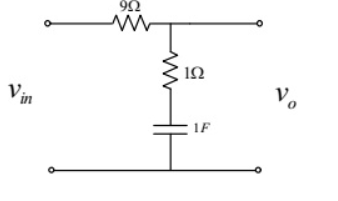
For the network shown in the figure below, the frequency (in rad/s) at which the maximum phase lag occurs is, __________.
The frequency at which the maximum phase lag occurs, \(\omega_{\max}\), is \(\mathbf{0.316 \text{ rad/s}}\).
The network is a lag compensator: \(R_1\) is in series with the branch formed by \(R_2\) and \(C\) in series, and the output \(V_o(s)\) is taken across that branch.
1. Transfer Function \(\mathbf{T(s)}\) By the voltage divider rule: \[\frac{V_o(s)}{V_{in}(s)} = \frac{R_2 + \frac{1}{sC}}{R_1 + R_2 + \frac{1}{sC}} = \frac{1 + R_2 C s}{1 + (R_1+R_2) C s}\]
2. Time Constants from the Given Element Values For the values marked in the figure, \(R_2C = 1\ \text{s}\) and \((R_1+R_2)C = 10\ \text{s}\), so \[\frac{V_o(s)}{V_{in}(s)} = \frac{1+s}{1+10s} = \frac{1+Ts}{1+\beta Ts}\] with
\(\mathbf{T} = R_2 C = \mathbf{1 \text{ s}}\)
\(\mathbf{\beta} = \frac{R_1+R_2}{R_2} = \mathbf{10}\)
Note: For this specific form \(\frac{1+Ts}{1+\beta Ts}\) with \(\beta > 1\), the network is a Lag Compensator, and the corner frequencies are \(\omega_z = 1/T\) and \(\omega_p = 1/(\beta T)\).
3. Frequency of Maximum Phase Lag (\(\mathbf{\omega_{\max}}\)) The frequency at which the maximum phase lag (\(\phi_{\min}\)) occurs is the geometric mean of the two corner frequencies: \[\omega_{\max} = \sqrt{\omega_z \omega_p} = \sqrt{\frac{1}{T} \cdot \frac{1}{\beta T}} = \frac{1}{T\sqrt{\beta}}\] Substituting the calculated values \(T=1\) and \(\beta=10\): \[\omega_{\max} = \frac{1}{(1 \text{ sec})\sqrt{10}} = \frac{1}{\sqrt{10}} \text{ rad/s}\] \[\omega_{\max} \approx \frac{1}{3.162} \approx \mathbf{0.316 \text{ rad/s}}\]
Consider the following asymptotic Bode magnitude plot (\(\omega\) is in rad/s).
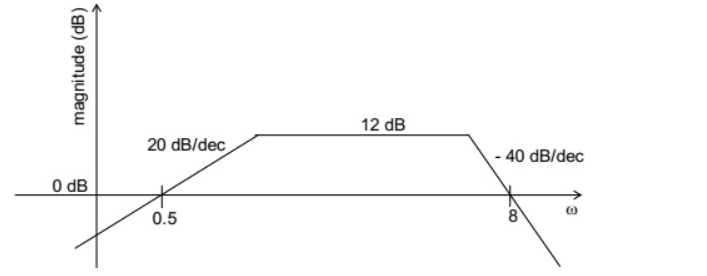
Which one of the following transfer functions is best represented by the above Bode magnitude plot?
\(\frac{2s}{(1+0.5s)(1+0.25s)^2}\)
\(\frac{4(1+0.5s)}{s(1+0.25s)}\)
\(\frac{2s}{(1+2s)(1+4s)}\)
\(\frac{4s}{(1+2s)(1+4s)^2}\)
Correct answer: A: \(\frac{2s}{(1+0.5s)(1+0.25s)^2}\).
The transfer function is identified by analyzing the features of the Bode plot:
1. Initial Slope and System Type
The initial slope is \(\mathbf{+20 \text{ dB/decade}}\).
This slope corresponds to a single \(\mathbf{zero \ at \ the \ origin}\), meaning the term \(\mathbf{s}\) must be in the numerator.
2. Corner Frequencies and Factors The transfer function in Option A is: \[G(s) = \frac{2s}{(1+0.5s)(1+0.25s)^2}\]
Numerator: The term \(s\) matches the \(+20 \text{ dB/decade}\) initial slope.
Pole \(\omega_1\): The factor \((1+0.5s)\) corresponds to a corner frequency \(\omega_1 = \frac{1}{0.5} = \mathbf{2 \text{ rad/s}}\).
Double Pole \(\omega_2\): The factor \((1+0.25s)^2\) corresponds to a corner frequency \(\omega_2 = \frac{1}{0.25} = \mathbf{4 \text{ rad/s}}\).
3. Gain (\(\mathbf{K}\)) The constant gain factor is \(\mathbf{2}\).
Option B has a pole at the origin, so its initial slope would be \(-20 \text{ dB/decade}\). Options C and D also have a zero at the origin, but their break points are at \(1/2 = 0.5\) and \(1/4 = 0.25\) rad/s instead of \(2\) and \(4\) rad/s. Only option A matches both corner frequencies of the plot and the gain \(K = 2\).
The phase cross-over frequency of the transfer function \(G(s)=\frac{100}{(s+3)^3}\) in rad/s is
\(\frac{3}{\sqrt{3}}\)
\(\frac{1}{\sqrt{3}}\)
\(3\)
\(3\sqrt{3}\)
The phase cross-over frequency (\(\omega_{pc}\)) for \(G(s)=\frac{100}{(s+1)^3}\) is \(\mathbf{\sqrt{3} \text{ rad/s}}\).
The phase cross-over frequency (\(\omega_{pc}\)) occurs when the Nyquist plot intersects the negative real axis, meaning the imaginary part of \(G(j\omega)\) is zero.
The given transfer function is: \[G(s) = \frac{100}{(s+1)^3}\]
1. Express \(\mathbf{G(j\omega)}\) with Real and Imaginary Parts Substitute \(s = j\omega\) and expand the denominator using the binomial formula: \[G(j\omega) = \frac{100}{(1 + j\omega)^3} = \frac{100}{(1 - 3\omega^2) + j(3\omega - \omega^3)}\]
2. Isolate the Imaginary Part To set the imaginary part to zero, we only need to look at the numerator of the rationalized form. \[G(j\omega) = \frac{100}{D(j\omega)} \cdot \frac{D(-j\omega)}{D(-j\omega)} = \frac{100 \cdot [(1 - 3\omega^2) - j(3\omega - \omega^3)]}{|D(j\omega)|^2}\] The imaginary part is proportional to the negative of the imaginary part of the denominator: \[\text{Img}[G(j\omega)] \propto -(3\omega - \omega^3)\]
3. Solve for \(\mathbf{\omega_{pc}}\) Set the imaginary part to zero: \[-(3\omega - \omega^3) = 0\] Factor out \(\omega\): \[-\omega(3 - \omega^2) = 0\] The solutions are \(\omega = 0\) and \(3 - \omega^2 = 0\). \[\omega^2 = 3 \implies \omega = \pm \sqrt{3}\] Since frequency must be positive, the phase cross-over frequency is: \[\omega_{pc} = \mathbf{\sqrt{3} \text{ rad/s}}\]