For the system governed by the set of equations: \[\frac{dx_1}{dt} = 2x_1 + x_2 + u\] \[\frac{dx_2}{dt} = -2x_1 + u\] \[y = 3x_1\] the transfer function \(Y(s)/U(s)\) is given by
\(\dfrac{3(s+1)}{s^2-2s+2}\)
\(\dfrac{3(2s+1)}{s^2-2s+1}\)
\(\dfrac{(s+1)}{s^2-2s+2}\)
\(\dfrac{3(2s+1)}{s^2-2s+2}\)
Topic: Mathematical Models of Physical Systems
Solution
Ans. A
State-space representation: \[A = \begin{bmatrix}2 & 1 \\ -2 & 0\end{bmatrix}, \quad B = \begin{bmatrix}1 \\ 1\end{bmatrix}, \quad C = \begin{bmatrix}3 & 0\end{bmatrix}, \quad D = 0\]
Compute \((sI - A)\): \[sI - A = \begin{bmatrix}s-2 & -1 \\ 2 & s\end{bmatrix}\] \[\det(sI - A) = (s-2)s - (-1)(2) = s^2 - 2s + 2\] \[(sI - A)^{-1} = \frac{1}{s^2 - 2s + 2} \begin{bmatrix}s & 1 \\ -2 & s-2\end{bmatrix}\]
Transfer function: \[G(s) = C(sI - A)^{-1}B = \frac{1}{s^2 - 2s + 2} \begin{bmatrix}3 & 0\end{bmatrix} \begin{bmatrix}s & 1 \\ -2 & s-2\end{bmatrix} \begin{bmatrix}1 \\ 1\end{bmatrix}\] \[= \frac{1}{s^2 - 2s + 2} \begin{bmatrix}3 & 0\end{bmatrix} \begin{bmatrix}s+1 \\ s-4\end{bmatrix} = \frac{3(s+1)}{s^2 - 2s + 2}\]
An open loop transfer function \(G(s)\) of a system is \[G(s) = \frac{K}{s(s+1)(s+2)}\] For a unity feedback system, the breakaway point of the root loci on the real axis occurs at
\(-0.42\)
\(-1.58\)
\(-0.42\) and \(-1.58\)
none of the above
Topic: Root Locus Techniques
Solution
Ans. A
Characteristic equation: \[1 + G(s) = 0 \Rightarrow 1 + \frac{K}{s(s+1)(s+2)} = 0\] \[K = -s(s+1)(s+2) = -s(s^2 + 3s + 2) = -s^3 - 3s^2 - 2s\]
For breakaway points: \[\frac{dK}{ds} = 0 \Rightarrow -3s^2 - 6s - 2 = 0\] \[3s^2 + 6s + 2 = 0 \Rightarrow s = \frac{-6 \pm \sqrt{36 - 24}}{6} = \frac{-6 \pm \sqrt{12}}{6} = \frac{-6 \pm 2\sqrt{3}}{6}\] \[s = -1 \pm \frac{\sqrt{3}}{3} \approx -1 \pm 0.577\] \[s \approx -0.423, -1.577\]
Only \(s = -0.423\) lies on the real axis root locus between poles at \(0\) and \(-1\).
Therefore, breakaway point is at \(-0.42\).
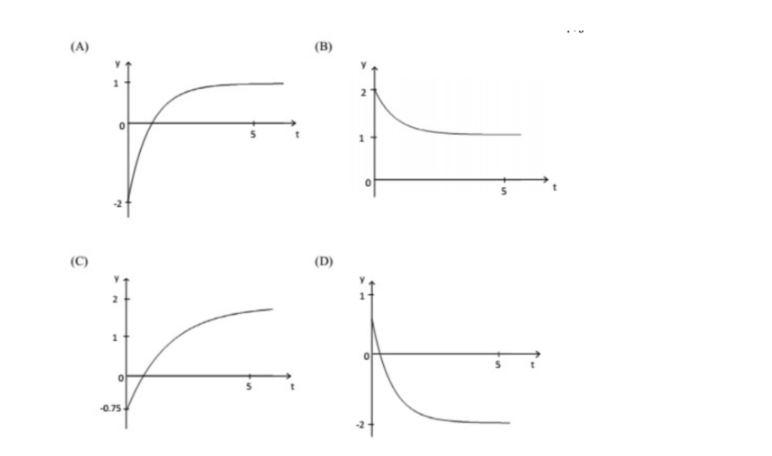
The unit step response of a system with the transfer function \(G(s) = \dfrac{1-2s}{1+s}\) is given by which one of the following waveforms?
Topic: Time Response Analysis
Solution
Ans. A
Given: \(G(s) = \dfrac{1-2s}{1+s}\)
For unit step input \(R(s) = \dfrac{1}{s}\): \[C(s) = G(s)R(s) = \frac{1-2s}{s(s+1)}\]
Using partial fractions: \[\frac{1-2s}{s(s+1)} = \frac{A}{s} + \frac{B}{s+1}\] \[1-2s = A(s+1) + Bs = (A+B)s + A\]
Comparing coefficients: \[A + B = -2, \quad A = 1 \Rightarrow B = -3\] \[C(s) = \frac{1}{s} - \frac{3}{s+1}\]
Taking inverse Laplace transform: \[c(t) = 1 - 3e^{-t} \quad \text{for } t \geq 0\]
The response starts at \(1 - 3 = -2\) and approaches \(1\) as \(t \to \infty\).
Nyquist plots of two functions \(G_1(s)\) and \(G_2(s)\) are shown in figure.
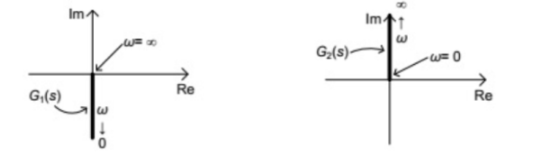
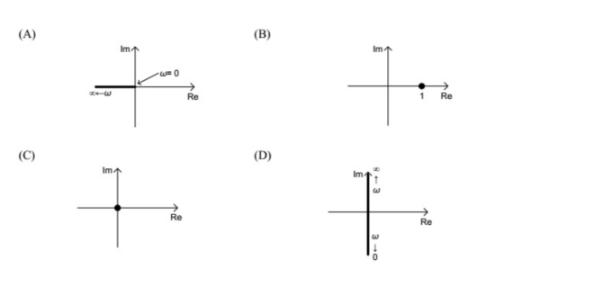
Nyquist plot of the product of \(G_1(s)\) and \(G_2(s)\) is
Topic: Frequency Response Analysis
Solution
Ans. B
From the Nyquist plots:
\(G_1(s)\) appears to be an integrator: \(G_1(s) = \dfrac{1}{s}\)
\(G_2(s)\) appears to be a differentiator: \(G_2(s) = s\)
Product: \[G_1(s)G_2(s) = \frac{1}{s} \cdot s = 1\]
The Nyquist plot of \(G(s) = 1\) is a single point at \((1, 0)\) on the real axis.
Therefore, the correct Nyquist plot is option B.
An open loop control system results in a response of \(e^{-2t}(\sin 5t + \cos 5t)\) for a unit impulse input. The DC gain of the control system is ______.
Topic: Time Response Analysis
Solution
Ans. 0.241
Impulse response: \(h(t) = e^{-2t}(\sin 5t + \cos 5t)\)
Transfer function = Laplace transform of impulse response: \[H(s) = \mathcal{L}\{e^{-2t}\sin 5t\} + \mathcal{L}\{e^{-2t}\cos 5t\}\] \[= \frac{5}{(s+2)^2 + 25} + \frac{s+2}{(s+2)^2 + 25} = \frac{s+7}{(s+2)^2 + 25}\]
DC gain = \(H(0)\): \[H(0) = \frac{0+7}{(0+2)^2 + 25} = \frac{7}{4 + 25} = \frac{7}{29} \approx 0.241\]
Therefore, the DC gain is 0.241.
The open loop poles of a third order unity feedback system are at 0, -1, -2. Let the frequency corresponding to the point where the root locus of the system transits to unstable region be \(K\). Now suppose we introduce a zero in the open loop transfer function at -3, while keeping all the earlier open loop poles intact. Which one of the following is TRUE about the point where the root locus of the modified system transits to unstable region?
It corresponds to a frequency greater than \(K\)
It corresponds to a frequency less than \(K\)
It corresponds to a frequency \(K\)
Root locus of modified system never transits to unstable region
Topic: Root Locus Techniques
Solution
Ans. D
Original system: \[G(s) = \frac{K}{s(s+1)(s+2)}, \quad P = 3, \quad Z = 0\] Asymptotes angles: \(60^\circ, 180^\circ, 300^\circ\) Centroid: \(\dfrac{0-1-2}{3} = -1\)
Modified system: \[G(s) = \frac{K(s+3)}{s(s+1)(s+2)}, \quad P = 3, \quad Z = 1\] Asymptotes angles: \(90^\circ, 270^\circ\) Centroid: \(\dfrac{0-1-2-(-3)}{2} = 0\)
With the zero at \(-3\), the characteristic equation of the modified system is \[s(s+1)(s+2) + K(s+3) = s^3 + 3s^2 + (2+K)s + 3K = 0\]
Forming the Routh array, the \(s^1\) entry is \[\frac{3(2+K) - 3K}{3} = 2\] which is positive irrespective of \(K\), and the \(s^0\) entry is \(3K > 0\) for all \(K > 0\).
The first column therefore never changes sign, so no positive gain drives a closed-loop pole onto the imaginary axis: every branch of the modified root locus stays in the left half plane.
Therefore, the modified system never becomes unstable.
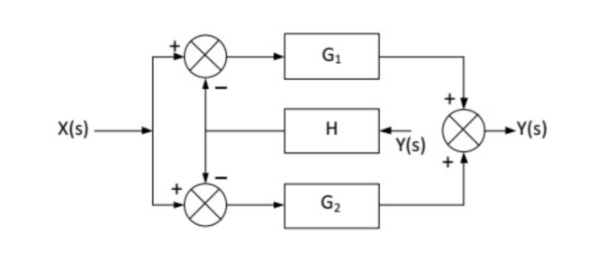
Find the transfer function \(\dfrac{Y(s)}{X(s)}\) of the system given below.
\(\dfrac{G_1}{1-HG_1} + \dfrac{G_2}{1-HG_2}\)
\(\dfrac{G_1}{1+HG_1} + \dfrac{G_2}{1+HG_2}\)
\(\dfrac{G_1+G_2}{1+H(G_1+G_2)}\)
\(\dfrac{G_1+G_2}{1-H(G_1+G_2)}\)
Topic: Mathematical Models of Physical Systems
Solution
Ans. C
Using block diagram reduction or Mason’s formula:
The system has parallel forward paths \(G_1\) and \(G_2\) with common feedback \(H\).
From the block diagram: \[Y(s) = [X(s) - H(s)Y(s)]G_1(s) + [X(s) - H(s)Y(s)]G_2(s)\] \[Y(s) = [G_1(s) + G_2(s)][X(s) - H(s)Y(s)]\] \[Y(s) = [G_1(s) + G_2(s)]X(s) - [G_1(s) + G_2(s)]H(s)Y(s)\] \[Y(s) + [G_1(s) + G_2(s)]H(s)Y(s) = [G_1(s) + G_2(s)]X(s)\] \[Y(s)[1 + H(s)(G_1(s) + G_2(s))] = [G_1(s) + G_2(s)]X(s)\] \[\frac{Y(s)}{X(s)} = \frac{G_1(s) + G_2(s)}{1 + H(s)(G_1(s) + G_2(s))}\]