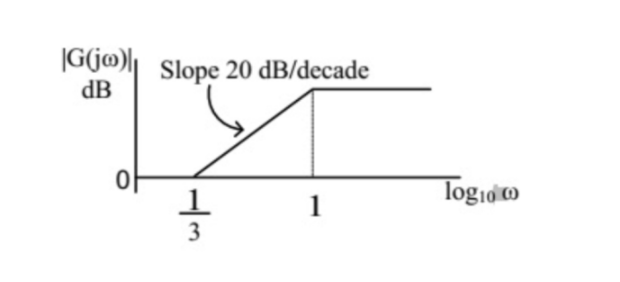
The magnitude Bode plot of a network is shown in the figure:
The maximum phase angle \(\phi_m\) and the corresponding gain \(G_m\) respectively, are
\(-30^\circ\) and 1.73 dB
\(-30^\circ\) and 4.77 dB
\(+30^\circ\) and 4.77 dB
\(+30^\circ\) and 1.73 dB
Topic: Frequency Response Analysis
Ans. C
From the Bode plot, corner frequencies are: \[\omega_{c1} = \frac{1}{3} \quad \text{and} \quad \omega_{c2} = 1\]
Transfer function: \[T(s) = \frac{1+3s}{1+s} = \frac{1+aTs}{1+Ts} \quad \text{with } T=3, aT=1\] \[\alpha = \frac{1}{aT} = \frac{1}{3}\]
Since \(\alpha < 1\), this is a lead compensator.
Maximum phase angle: \[\phi_m = \sin^{-1}\left(\frac{1-\alpha}{1+\alpha}\right) = \sin^{-1}\left(\frac{1-\frac{1}{3}}{1+\frac{1}{3}}\right) = \sin^{-1}\left(\frac{2/3}{4/3}\right) = \sin^{-1}(0.5) = 30^\circ\]
Frequency of maximum phase: \[\omega_m = \frac{1}{T\sqrt{\alpha}} = \frac{1}{3\sqrt{\frac{1}{3}}} = \frac{1}{\sqrt{3}}\]
Gain at \(\omega_m\): \[|T(j\omega_m)| = \frac{\sqrt{1+(\omega_m T)^2}}{\sqrt{1+(\omega_m aT)^2}} = \frac{\sqrt{1+3}}{\sqrt{1+1}} = \frac{\sqrt{4}}{\sqrt{2}} = \sqrt{2}\] \[G_m = 20\log_{10}(\sqrt{2}) = 10\log_{10}(2) \approx 3.01 \text{ dB}\]
Therefore: \(\phi_m = +30^\circ\), \(G_m \approx 4.77\) dB
Consider the system described by following state space equations: \[\begin{bmatrix} \dot{x}_1 \\ \dot{x}_2 \end{bmatrix} = \begin{bmatrix} 0 & 1 \\ -1 & -1 \end{bmatrix} \begin{bmatrix} x_1 \\ x_2 \end{bmatrix} + \begin{bmatrix} 0 \\ 1 \end{bmatrix} u; \quad y = \begin{bmatrix} 1 & 0 \end{bmatrix} \begin{bmatrix} x_1 \\ x_2 \end{bmatrix}\] If u is unit step input, then the steady state error of the system is
0
\(\frac{1}{2}\)
\(\frac{2}{3}\)
1
Topic: State Variable Analysis
Ans. A
Given: \[A = \begin{bmatrix}0 & 1 \\ -1 & -1\end{bmatrix}, \quad B = \begin{bmatrix}0 \\ 1\end{bmatrix}, \quad C = \begin{bmatrix}1 & 0\end{bmatrix}\]
Compute \((sI - A)\): \[sI - A = \begin{bmatrix}s & -1 \\ 1 & s+1\end{bmatrix}\] \[\det(sI - A) = s(s+1) + 1 = s^2 + s + 1\] \[(sI - A)^{-1} = \frac{1}{s^2 + s + 1} \begin{bmatrix}s+1 & 1 \\ -1 & s\end{bmatrix}\]
Transfer function: \[G(s) = C(sI - A)^{-1}B = \frac{1}{s^2 + s + 1} \begin{bmatrix}1 & 0\end{bmatrix} \begin{bmatrix}s+1 & 1 \\ -1 & s\end{bmatrix} \begin{bmatrix}0 \\ 1\end{bmatrix}\] \[= \frac{1}{s^2 + s + 1} \begin{bmatrix}1 & 0\end{bmatrix} \begin{bmatrix}1 \\ s\end{bmatrix} = \frac{1}{s^2 + s + 1}\]
For unit step input \(R(s) = \frac{1}{s}\): \[Y(s) = G(s)R(s) = \frac{1}{s(s^2 + s + 1)}\]
Steady-state value: \[y_{ss} = \lim_{s \to 0} sY(s) = \lim_{s \to 0} \frac{1}{s^2 + s + 1} = 1\]
Since output tracks input perfectly at steady state, steady-state error = 0.
The block diagram of a system is shown in the figure:
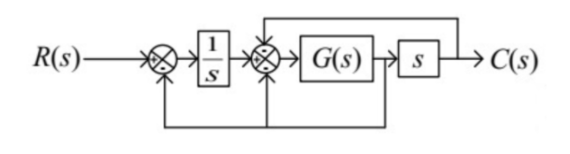
If the desired transfer function of the system is \(\frac{C(s)}{R(s)} = \frac{s}{s^2 + s + 1}\), then \(G(s)\) is
1
\(s\)
\(\frac{1}{s}\)
\(\frac{-s}{s^3 + s^2 - s - 2}\)
Topic: Feedback Characteristics of Control Systems
Ans. B
The forward path is \(G(s)\), and the inner feedback path of gain \(s\) together with the outer unity feedback path give a total feedback of \(H(s) = 1 + s\): \[\frac{C(s)}{R(s)} = \frac{G(s)}{1 + G(s)(1 + s)} = \frac{s}{s^2 + s + 1}\]
Cross-multiplying: \[G(s)(s^2 + s + 1) = s\left[1 + G(s)(1 + s)\right]\] \[G(s)(s^2 + s + 1) = s + G(s)(s + s^2)\] \[G(s)\left[(s^2 + s + 1) - (s^2 + s)\right] = s\] \[G(s) = s\]
Check: with \(G(s) = s\), \[\frac{C(s)}{R(s)} = \frac{s}{1 + s(1+s)} = \frac{s}{s^2 + s + 1}\] which is the required transfer function.
A single-input single-output feedback system has forward transfer function G(s) and feedback transfer function H(s). It is given that \(|G(s)H(s)| < 1\). Which of the following is true about the stability of the system?
The system is always stable
The system is stable if all zeros of \(G(s)H(s)\) are in left half of the s-plane
The system is stable if all poles of \(G(s)H(s)\) are in left half of the s-plane
It is not possible to say whether or not the system is stable from the information given
Topic: Concepts of Stability
Ans. D
The condition \(|G(s)H(s)| < 1\) alone is not sufficient to determine stability.
Stability depends on the location of closed-loop poles, which are the roots of \(1 + G(s)H(s) = 0\).
The given condition \(|G(s)H(s)| < 1\) doesn’t provide information about:
Phase of \(G(s)H(s)\)
Location of poles and zeros
Nyquist encirclements
Therefore, it’s not possible to determine stability from \(|G(s)H(s)| < 1\) alone.
The signal flow graph of a system is shown below:
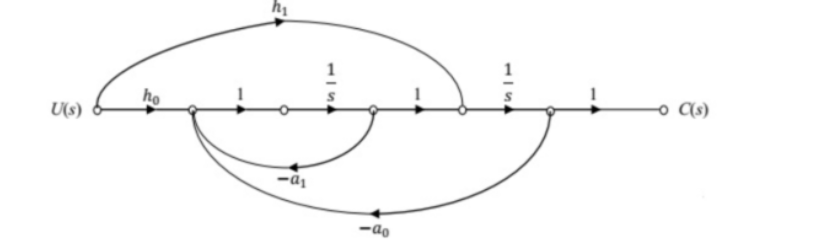
Assuming \(h_1 = b_1\) and \(h_0 = b_0 - b_1a_1\), the input-output transfer function \(G(s) = \frac{C(s)}{U(s)}\) of the system is given by
\(G(s) = \frac{b_1s + b_0}{s^2 + a_1s + a_0}\)
\(G(s) = \frac{b_0s + b_1}{s^2 + a_1s + a_0}\)
\(G(s) = \frac{b_1s + b_0}{s^2 + a_0s + a_1}\)
\(G(s) = \frac{b_0s + b_1}{s^2 + a_0s + a_1}\)
Topic: Mathematical Models of Physical Systems
Ans. A
Using Mason’s Gain Formula:
Forward paths:
\(P_1 = \frac{h_0}{s^2}\), \(\Delta_1 = 1\)
\(P_2 = \frac{h_1}{s}\); the \(a_1\) loop is non-touching with this path, so \(\Delta_2 = 1 + \frac{a_1}{s}\)
Loops:
\(L_1 = -\frac{a_1}{s}\)
\(L_2 = -\frac{a_0}{s^2}\)
Determinant: \[\Delta = 1 - (L_1 + L_2) = 1 + \frac{a_1}{s} + \frac{a_0}{s^2} = \frac{s^2 + a_1s + a_0}{s^2}\]
Transfer function: \[G(s) = \frac{P_1\Delta_1 + P_2\Delta_2}{\Delta} = \frac{\frac{h_0}{s^2} + \frac{h_1}{s}\left(1 + \frac{a_1}{s}\right)}{\frac{s^2 + a_1s + a_0}{s^2}} = \frac{h_1s + a_1h_1 + h_0}{s^2 + a_1s + a_0}\]
Substituting \(h_1 = b_1\) and \(h_0 = b_0 - b_1a_1\): \[G(s) = \frac{b_1s + a_1b_1 + (b_0 - b_1a_1)}{s^2 + a_1s + a_0} = \frac{b_1s + b_0}{s^2 + a_1s + a_0}\]
The second order dynamic system \[\frac{dX}{dt} = PX + Qu, \quad y = RX\] has the matrices \(P, Q\) and \(R\) as follows: \[P = \begin{bmatrix}-1 & 1 \\ 0 & -3\end{bmatrix}, \quad Q = \begin{bmatrix}0 \\ 1\end{bmatrix}, \quad R = \begin{bmatrix}0 & 1\end{bmatrix}\] The system has the following controllability and observability properties:
Controllable and observable
Not controllable but observable
Controllable but not observable
Not controllable and not observable
Topic: State Variable Analysis
Ans. C
Controllability: \[Q_c = \begin{bmatrix}Q & PQ\end{bmatrix} = \begin{bmatrix}0 & 1 \\ 1 & -3\end{bmatrix}\] \[\det(Q_c) = (0)(-3) - (1)(1) = -1 \neq 0 \Rightarrow \text{Controllable}\]
Observability: \[Q_o = \begin{bmatrix}R \\ RP\end{bmatrix} = \begin{bmatrix}0 & 1 \\ 0 & -3\end{bmatrix}\] \[\det(Q_o) = (0)(-3) - (1)(0) = 0 \Rightarrow \text{Not Observable}\]
Conclusion: Controllable but not observable