The state variable formulation of a system is given as \[\begin{bmatrix} \dot{x}_1 \\ \dot{x}_2 \end{bmatrix} = \begin{bmatrix} -2 & 0 \\ 0 & -1 \end{bmatrix} \begin{bmatrix} x_1 \\ x_2 \end{bmatrix} + \begin{bmatrix} 1 \\ 1 \end{bmatrix} u, \quad x_1(0) = 0, \quad x_2(0) = 0\] and \[y = \begin{bmatrix}1 & 0\end{bmatrix} \begin{bmatrix} x_1 \\ x_2 \end{bmatrix}\] The response \(y(t)\) to the unit step input is
\(\frac{1}{2} - \frac{1}{2} e^{-2t}\)
\(1 - \frac{1}{2} e^{-2t} - \frac{1}{2} e^{-2t}\)
\(e^{-2t} - e^{-t}\)
\(1 - e^{-t}\)
Topic: State Variable Analysis
Ans. A
Given: \[A = \begin{bmatrix}-2 & 0 \\ 0 & -1\end{bmatrix}, \quad B = \begin{bmatrix}1 \\ 1\end{bmatrix}, \quad C = \begin{bmatrix}1 & 0\end{bmatrix}, \quad D = 0\]
Compute \((sI - A)\): \[sI - A = \begin{bmatrix}s+2 & 0 \\ 0 & s+1\end{bmatrix}\] \[(sI - A)^{-1} = \begin{bmatrix}\frac{1}{s+2} & 0 \\ 0 & \frac{1}{s+1}\end{bmatrix}\]
Transfer function: \[G(s) = C(sI - A)^{-1}B = \begin{bmatrix}1 & 0\end{bmatrix} \begin{bmatrix}\frac{1}{s+2} & 0 \\ 0 & \frac{1}{s+1}\end{bmatrix} \begin{bmatrix}1 \\ 1\end{bmatrix} = \frac{1}{s+2}\]
For unit step input \(U(s) = \frac{1}{s}\): \[Y(s) = G(s)U(s) = \frac{1}{s(s+2)} = \frac{1}{2}\left(\frac{1}{s} - \frac{1}{s+2}\right)\]
Taking inverse Laplace transform: \[y(t) = \frac{1}{2}(1 - e^{-2t}) = \frac{1}{2} - \frac{1}{2}e^{-2t}\]
The state variable formulation of a system is given as \[\begin{bmatrix} \dot{x}_1 \\ \dot{x}_2 \end{bmatrix} = \begin{bmatrix} -2 & 0 \\ 0 & -1 \end{bmatrix} \begin{bmatrix} x_1 \\ x_2 \end{bmatrix} + \begin{bmatrix} 1 \\ 1 \end{bmatrix} u, \quad x_1(0) = 0, \quad x_2(0) = 0\] and \[y = \begin{bmatrix}1 & 0\end{bmatrix} \begin{bmatrix} x_1 \\ x_2 \end{bmatrix}\] The system is
controllable but not observable
not controllable but observable
both controllable and observable
both not controllable and not observable
Topic: State Variable Analysis
Ans. A
Given: \[A = \begin{bmatrix}-2 & 0 \\ 0 & -1\end{bmatrix}, \quad B = \begin{bmatrix}1 \\ 1\end{bmatrix}, \quad C = \begin{bmatrix}1 & 0\end{bmatrix}\]
Controllability: \[Q_c = \begin{bmatrix}B & AB\end{bmatrix} = \begin{bmatrix}1 & -2 \\ 1 & -1\end{bmatrix}\] \[\det(Q_c) = (1)(-1) - (-2)(1) = -1 + 2 = 1 \neq 0\] \(\Rightarrow\) System is controllable
Observability: \[Q_o = \begin{bmatrix}C \\ CA\end{bmatrix} = \begin{bmatrix}1 & 0 \\ -2 & 0\end{bmatrix}\] \[\det(Q_o) = (1)(0) - (0)(-2) = 0\] \(\Rightarrow\) System is not observable
Conclusion: Controllable but not observable
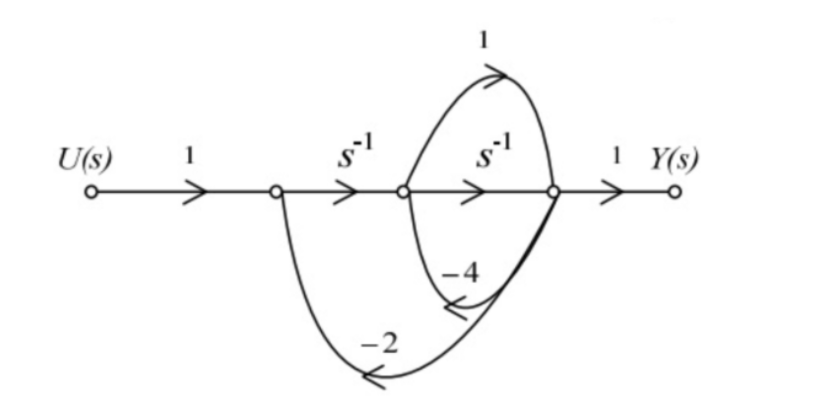
The signal flow graph for a system is given below. The transfer function \(\frac{Y(s)}{U(s)}\) for this system is
\(\frac{s+1}{5s^2+6s+2}\)
\(\frac{s+1}{s^2+6s+2}\)
\(\frac{s+1}{s^2+4s+2}\)
\(\frac{s+1}{5s^2+4s+2}\)
Topic: Mathematical Models of Physical Systems
Ans. A
Using Mason’s Gain Formula:
Forward paths:
\(P_1 = 1 \cdot s^{-1} \cdot s^{-1} \cdot 1 = \frac{1}{s^2}\)
\(P_2 = 1 \cdot s^{-1} \cdot 1 = \frac{1}{s}\)
Loops:
\(L_1 = -4\) (the self-loop at the summing node)
\(L_2 = -4s^{-1} = -\frac{4}{s}\)
\(L_3 = -2s^{-1} = -\frac{2}{s}\)
\(L_4 = -2s^{-2} = -\frac{2}{s^2}\)
Every loop passes through the summing node, so there are no non-touching loop pairs.
Determinant: \[\Delta = 1 - (L_1 + L_2 + L_3 + L_4) = 1 - \left(-4 - \frac{4}{s} - \frac{2}{s} - \frac{2}{s^2}\right)\] \[\Delta = 5 + \frac{6}{s} + \frac{2}{s^2} = \frac{5s^2 + 6s + 2}{s^2}\]
Cofactors:
\(\Delta_1 = 1\)
\(\Delta_2 = 1\)
Transfer function: \[\frac{Y(s)}{U(s)} = \frac{P_1\Delta_1 + P_2\Delta_2}{\Delta} = \frac{\frac{1}{s^2} + \frac{1}{s}}{\frac{5s^2 + 6s + 2}{s^2}} = \frac{s+1}{5s^2 + 6s + 2}\]
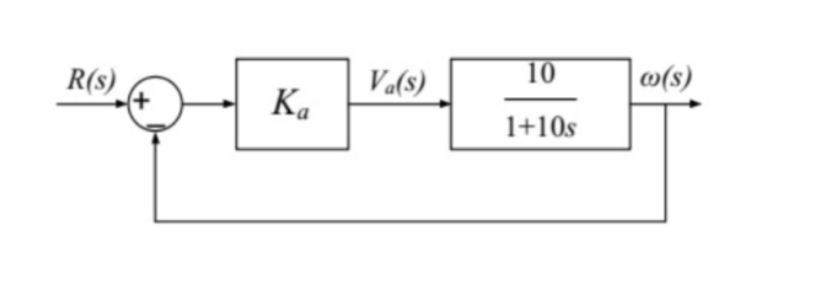
The open-loop transfer function of a dc motor is given as \(\frac{\omega(s)}{V_a(s)} = \frac{10}{1+10s}\). When connected in feedback as shown below, the approximate value of \(K_a\) that will reduce the time constant of the closed loop system by one hundred times as compared to that of the open-loop system is
1
5
10
100
Topic: Feedback Characteristics of Control Systems
Ans. C
Open-loop transfer function: \[G(s) = \frac{10}{1+10s}\] Open-loop time constant: \(\tau_{ol} = 10\)
Closed-loop transfer function: \[\frac{\omega(s)}{R(s)} = \frac{K_a G(s)}{1 + K_a G(s)} = \frac{\frac{10K_a}{1+10s}}{1 + \frac{10K_a}{1+10s}} = \frac{10K_a}{1+10s + 10K_a}\] \[= \frac{10K_a}{1+10K_a} \cdot \frac{1}{1 + \frac{10}{1+10K_a}s}\]
Closed-loop time constant: \[\tau_{cl} = \frac{10}{1+10K_a}\]
Given: \(\tau_{cl} = \frac{1}{100} \tau_{ol}\): \[\frac{10}{1+10K_a} = \frac{1}{100} \times 10\] \[\frac{10}{1+10K_a} = 0.1\] \[1+10K_a = 100\] \[K_a = 9.9 \approx 10\]
The Bode plot of a transfer function \(G(s)\) is shown in the figure below.
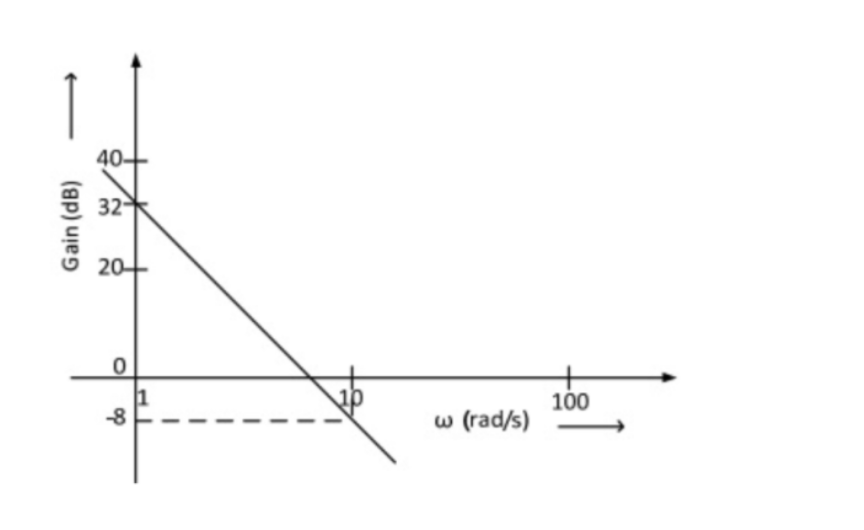
The gain (20 log \(|G(s)|\)) is 32 dB and -8 dB at 1 rad/s and 10 rad/s respectively. The phase is negative for all \(\omega\). Then \(G(s)\) is
\(\frac{39.8}{s}\)
\(\frac{39.8}{s^2}\)
\(\frac{32}{s}\)
\(\frac{32}{s^2}\)
Topic: Frequency Response Analysis
Ans. B
Assume \(G(s) = \frac{K}{s^n}\)
At \(\omega = 1\) rad/s, gain = 32 dB: \[20\log_{10}|G(j1)| = 20\log_{10}\left|\frac{K}{1^n}\right| = 20\log_{10}K = 32\] \[\log_{10}K = 1.6 \Rightarrow K = 10^{1.6} \approx 39.8\]
At \(\omega = 10\) rad/s, gain = -8 dB: \[20\log_{10}|G(j10)| = 20\log_{10}\left|\frac{39.8}{10^n}\right| = -8\] \[20\log_{10}39.8 - 20n\log_{10}10 = -8\] \[32 - 20n = -8 \Rightarrow 20n = 40 \Rightarrow n = 2\]
Therefore: \[G(s) = \frac{39.8}{s^2}\]
The negative phase for all \(\omega\) confirms it’s a double integrator (phase = \(-180^\circ\)).
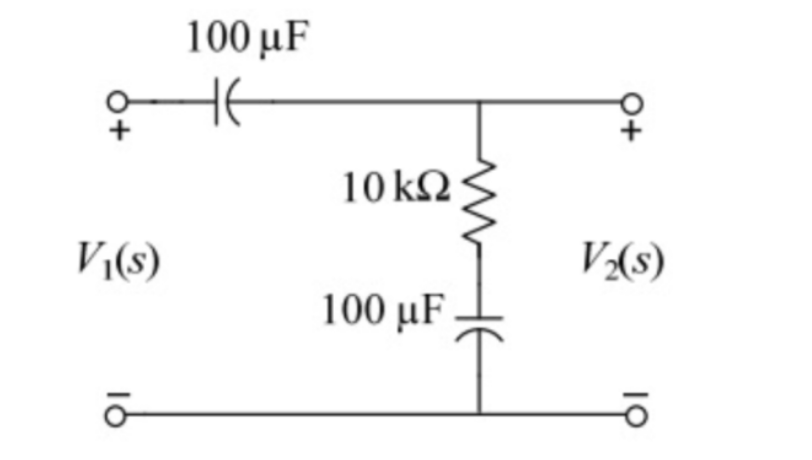
The transfer function \(\frac{V_2(s)}{V_1(s)}\) of the circuit shown below is
\(\frac{0.5s+1}{s+1}\)
\(\frac{3s+6}{s+2}\)
\(\frac{s+2}{s+1}\)
\(\frac{s+1}{s+2}\)
Topic: Mathematical Models of Physical Systems
Ans. D
Given: \(R = 10\ \text{k}\Omega\), \(C = 100\ \mu\text{F}\)
Impedance of capacitor: \(Z_C = \frac{1}{Cs}\)
Using the voltage divider rule, with \(V_2\) taken across the branch made up of \(R\) in series with the capacitor: \[\frac{V_2(s)}{V_1(s)} = \frac{R + Z_C}{Z_C + (R + Z_C)}\]
Substitute \(Z_C = \frac{1}{Cs}\): \[\frac{V_2(s)}{V_1(s)} = \frac{R + \frac{1}{Cs}}{R + \frac{2}{Cs}} = \frac{RCs + 1}{RCs + 2}\]
With \(R = 10^4\ \Omega\), \(C = 10^{-4}\ \text{F}\): \[RC = 10^4 \times 10^{-4} = 1\] \[\frac{V_2(s)}{V_1(s)} = \frac{s + 1}{s + 2}\]