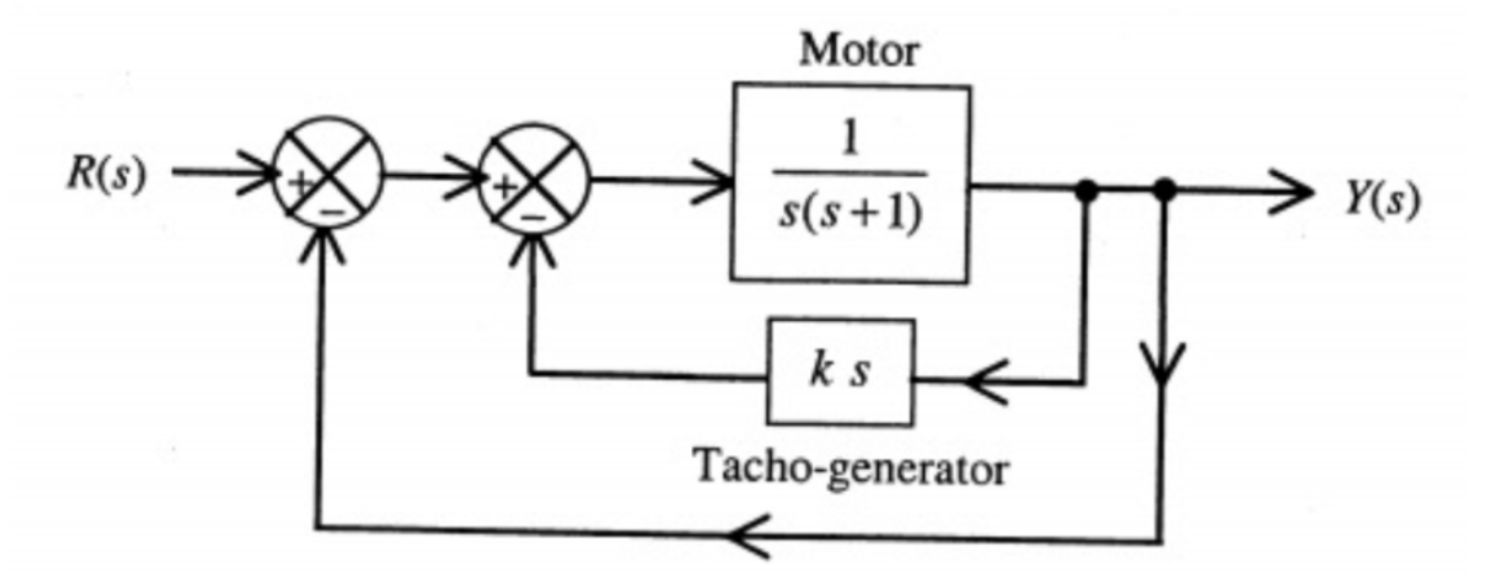
A two loop position control system is shown below
The gain K of the Tacho-generator influences mainly the
Peak overshoot
Natural frequency of oscillation
Phase shift of the closed loop transfer function at very low frequencies (\(\omega \rightarrow 0\))
Phase shift of the closed loop transfer function at very high frequencies (\(\omega \rightarrow \infty\))
Topic: Time Response Analysis
Solution
Ans. A
Given: \(G(s) = \dfrac{1}{s(s+1)}\) and \(H(s) = 1 + Ks\)
Characteristic equation: \[1 + G(s)H(s) = 0 \Rightarrow 1 + \frac{1 + Ks}{s(s+1)} = 0\] \[\Rightarrow s(s+1) + 1 + Ks = 0\] \[\Rightarrow s^2 + (K+1)s + 1 = 0\]
Comparing with standard form \(s^2 + 2\xi\omega_n s + \omega_n^2 = 0\): \[\omega_n = 1 \quad \text{(constant, independent of K)}\] \[2\xi\omega_n = K+1 \Rightarrow \xi = \frac{K+1}{2}\]
Peak overshoot: \[M_p = e^{-\frac{\xi\pi}{\sqrt{1-\xi^2}}}\]
Since \(M_p\) depends on \(\xi\) and \(\xi\) depends on K, the peak overshoot is influenced by the gain K of the tacho-generator.
The response \(h(t)\) of a linear time invariant system to an impulse \(\delta(t)\), under initially relaxed condition is \(h(t) = e^{-t} + e^{-2t}\). The response of this system for a unit step input \(u(t)\) is
\(u(t) + e^{-t} + e^{-2t}\)
\((e^{-t} + e^{-2t})u(t)\)
\((1.5 - e^{-t} - 0.5e^{-2t})u(t)\)
\(e^{-t}\delta(t) + e^{-2t}u(t)\)
Topic: Mathematical Models of Physical Systems
Solution
Ans. C
Transfer function = Laplace transform of impulse response: \[H(s) = \mathcal{L}\{e^{-t} + e^{-2t}\} = \frac{1}{s+1} + \frac{1}{s+2}\]
For unit step input \(R(s) = \dfrac{1}{s}\): \[C(s) = R(s) \cdot H(s) = \frac{1}{s} \left( \frac{1}{s+1} + \frac{1}{s+2} \right)\] \[C(s) = \frac{1}{s(s+1)} + \frac{1}{s(s+2)}\]
Using partial fractions: \[\frac{1}{s(s+1)} = \frac{1}{s} - \frac{1}{s+1}, \quad \frac{1}{s(s+2)} = \frac{0.5}{s} - \frac{0.5}{s+2}\]
Combining: \[C(s) = \left( \frac{1}{s} - \frac{1}{s+1} \right) + \left( \frac{0.5}{s} - \frac{0.5}{s+2} \right) = \frac{1.5}{s} - \frac{1}{s+1} - \frac{0.5}{s+2}\]
Taking inverse Laplace transform: \[c(t) = \mathcal{L}^{-1}[C(s)] = (1.5 - e^{-t} - 0.5e^{-2t})u(t)\]
The open loop transfer function G(s) of a unity feedback control system is given as \[G(s) = \frac{k(s+\frac{2}{3})}{s^2(s+2)}\] From the root locus, it can be inferred that when k tends to positive infinity,
Three roots with nearly equal real parts exist on the left half of the s-plane
One real root is found on the right half of the s-plane
The root loci cross the \(j\omega\) axis for a finite value of \(k\); \(k\neq 0\)
Three real roots are found on the right half of the s-plane
Topic: Root Locus Techniques
Solution
Ans. A
Given: \(G(s) = \dfrac{k(s+\frac{2}{3})}{s^2(s+2)}\), \(H(s) = 1\)
Poles: \(s = 0, 0, -2\) (P = 3, multiple pole at origin)
Zero: \(s = -\frac{2}{3}\) (Z = 1)
Branches to infinity: P - Z = 2
Asymptotes: \[\text{Centroid} = \frac{(0 + 0 - 2) - (-\frac{2}{3})}{3 - 1} = \frac{-2 + \frac{2}{3}}{2} = \frac{-\frac{4}{3}}{2} = -\frac{2}{3}\] \[\text{Angles} = \frac{(2k+1)\pi}{2} = 90^\circ, 270^\circ\]
Routh analysis shows system is stable for \(k > 0\) with no \(j\omega\)-axis crossing.
As \(k \to \infty\), two branches go to infinity along asymptotes at \(\pm 90^\circ\) with real part \(-\frac{2}{3}\), and one branch terminates at the finite zero at \(-\frac{2}{3}\).
Therefore, three roots have nearly equal real parts around \(-\frac{2}{3}\) in LHS.
Q.4 An open loop system represented by the transfer function \(G(s) = \dfrac{(s-1)}{(s+2)(s+3)}\) is
Stable and of the minimum phase type
Stable and of the non-minimum phase type
Unstable and of the minimum phase type
Unstable and of non-minimum phase type
Topic: Concepts of Stability
Solution
Ans. B
Given: \(G(s) = \dfrac{s-1}{(s+2)(s+3)}\)
Stability Analysis:
Poles: \(s = -2, -3\) (both in LHS)
No poles in RHS \(\Rightarrow\) System is stable
Minimum Phase Analysis:
Zero: \(s = 1\) (in RHS)
Minimum phase systems have all zeros in LHS
Since there’s a zero in RHS, this is a non-minimum phase system
Conclusion: Stable and non-minimum phase type.
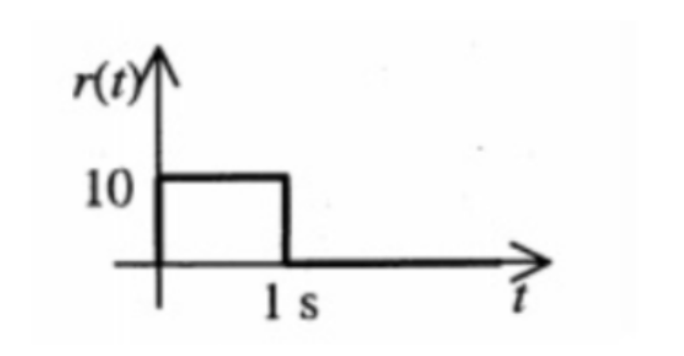
The steady state error of a unity feedback linear system for a unit step input is 0.1. The steady state error of the same system, for a pulse input r(t) having a magnitude of 10 and a duration of one second, as shown in the figure is
0
0.1
1
10
Topic: Time Response Analysis
Solution
Ans. A
Given: For unit step input, \(e_{ss} = 0.1\)
For unity feedback system with step input: \[e_{ss} = \frac{1}{1 + K_p} \quad \text{where } K_p = \lim_{s \to 0} G(s)\] \[0.1 = \frac{1}{1 + K_p} \Rightarrow 1 + K_p = 10 \Rightarrow K_p = 9\]
The pulse input can be written as: \[r(t) = 10[u(t) - u(t-1)] \Rightarrow R(s) = \frac{10}{s}(1 - e^{-s})\]
Steady-state error: \[e_{ss} = \lim_{s \to 0} sE(s) = \lim_{s \to 0} s \cdot \frac{R(s)}{1 + G(s)}\] \[e_{ss} = \lim_{s \to 0} s \cdot \frac{\frac{10}{s}(1 - e^{-s})}{1 + G(s)} = \lim_{s \to 0} \frac{10(1 - e^{-s})}{1 + G(s)}\]
Using L’Hôpital’s rule or noting that as \(s \to 0\), \(1 - e^{-s} \to 0\): \[e_{ss} = \frac{10 \times 0}{1 + 9} = 0\]
For finite duration inputs, steady-state error is zero for stable systems.
The frequency response of a linear system \(G(j\omega)\) is provided in the tabular form below
| \(|G(j\omega)|\) | 1.3 | 1.2 | 1.0 | 0.8 | 0.5 | 0.3 |
| \(\angle G(j\omega)\) | \(-130^\circ\) | \(-140^\circ\) | \(-150^\circ\) | \(-160^\circ\) | \(-180^\circ\) | \(-200^\circ\) |
Gain Margin and phase margin are
6 dB and 30\(^\circ\)
6 dB and -30\(^\circ\)
-6 dB and 30\(^\circ\)
-6 dB and -30\(^\circ\)
Topic: Frequency Response Analysis
Solution
Ans. A
Phase Margin Calculation:
At gain crossover frequency (\(\omega_{gc}\)): \(|G(j\omega)| = 1\)
From table, when \(|G(j\omega)| = 1\), \(\angle G(j\omega) = -150^\circ\)
Phase Margin = \(180^\circ + \angle G(j\omega_{gc}) = 180^\circ - 150^\circ = 30^\circ\)
Gain Margin Calculation:
At phase crossover frequency (\(\omega_{pc}\)): \(\angle G(j\omega) = -180^\circ\)
From table, when \(\angle G(j\omega) = -180^\circ\), \(|G(j\omega)| = 0.5\)
Gain Margin = \(20\log_{10}\left(\dfrac{1}{|G(j\omega_{pc})|}\right) = 20\log_{10}\left(\dfrac{1}{0.5}\right) = 20\log_{10}(2) \approx 6\) dB
Conclusion: Gain Margin = 6 dB, Phase Margin = 30 \(^\circ\)