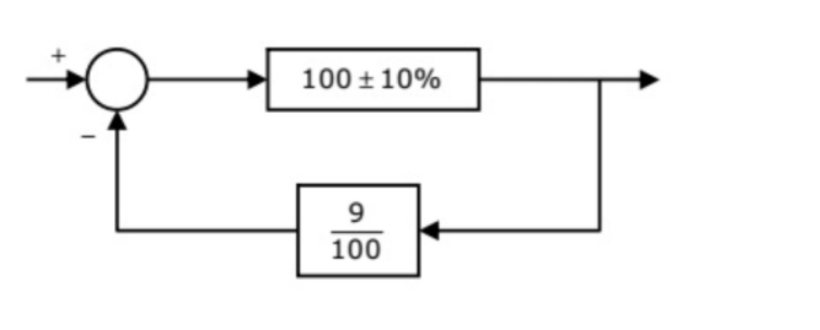
Q.1 As shown in the figure, a negative feedback system has an amplifier of gain 100 with ±10% tolerance in the forward path, and an attenuator of value 9/100 in the feedback path. The overall system gain is approximately:
10 ± 1%
10 ± 2%
10 ± 5%
10 ± 10%
Topic: Sensitivity Analysis
Solution
Ans. A
Given:
\(G = 100 \pm 10\%\), \(\frac{\Delta G}{G} = 10\% = 0.1\)
\(H = \frac{9}{100}\)
Overall closed-loop gain: \[T = \frac{G}{1+GH} = \frac{100}{1+100 \times \frac{9}{100}} = \frac{100}{1+9} = 10\]
Sensitivity with respect to \(G\): \[S_G^T = \frac{1}{1+GH} \times \frac{\Delta G}{G} = \frac{1}{1+9} \times 10\% = \frac{10\%}{10} = 1\%\]
Therefore, overall system gain is \(10 \pm 1\%\).
Q.2 For the system \(\dfrac{2}{s+1}\), the approximate time taken for a step response to reach 98% of the final value is
1s
2s
3s
4s
Topic: Time Response Analysis
Solution
Ans. D
Given transfer function: \[\frac{C(s)}{R(s)} = \frac{2}{s+1}\]
For step input \(R(s) = \frac{1}{s}\): \[C(s) = R(s) \cdot \frac{2}{s+1} = \frac{2}{s(s+1)} = 2\left(\frac{1}{s} - \frac{1}{s+1}\right)\]
Taking inverse Laplace transform: \[c(t) = \mathcal{L}^{-1}[C(s)] = 2(1 - e^{-t})\]
Final value: \(c_{ss} = 2\)
98% of final value: \(0.98 \times 2 =
1.96\)
Let \(t = T\) when response reaches 98%: \[1.96 = 2(1 - e^{-T})\] \[0.98 = 1 - e^{-T}\] \[e^{-T} = 0.02\] \[T = -\ln(0.02) \approx 3.91 \text{ s} \approx 4 \text{ s}\]
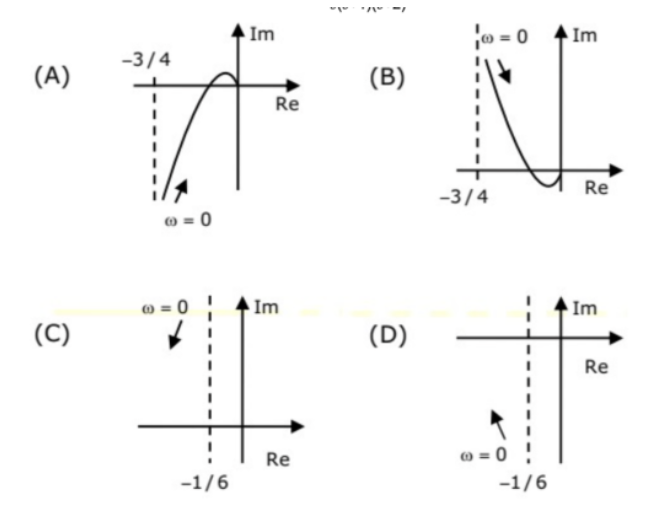
Q.3 The frequency response of \(G(s) = \dfrac{1}{s(s+1)(s+2)}\) plotted in the complex \(G(j\omega)\) plane (for \(0 < \omega < \infty\)) is
Topic: Nyquist Plots
Solution
Ans. A
Given: \(G(s) = \dfrac{1}{s(s+1)(s+2)}\)
Type-1 system \(\Rightarrow\) Nyquist plot starts at \(\infty\angle-90^\circ\)
As \(\omega \to 0^+\): \(G(j\omega) \to \infty\angle-90^\circ\)
As \(\omega \to \infty\): \(G(j\omega) \to 0\angle-270^\circ\)
Real axis crossing: Set imaginary part = 0
The correct Nyquist plot corresponds to option A, which shows:
Starting from \(\infty\) at \(-90^\circ\)
Crossing real axis between 0 and -1
Ending at origin from \(-270^\circ\)
Q.4 The system \(\dot{x} = Ax + Bu\) with \(A = \begin{bmatrix}-1 & 2 \\ 0 & 2\end{bmatrix}\), \(B = \begin{bmatrix}0 \\ 1\end{bmatrix}\) is
Stable and controllable
Stable but uncontrollable
Unstable but controllable
Unstable and uncontrollable
Topic: Stability and Controllability
Solution
Ans. C
Stability Analysis:
Eigenvalues from \(A\) matrix: \[\det(sI - A) = \det\begin{bmatrix} s+1 & -2
\\ 0 & s-2 \end{bmatrix} = (s+1)(s-2) = 0\] Eigenvalues:
\(s = -1, 2\)
Since one pole at \(s = 2\) (RHS), system is unstable.
Controllability Analysis:
Controllability matrix: \[Q_c = \begin{bmatrix} B & AB \end{bmatrix} = \begin{bmatrix} 0 & 2 \\ 1 & 2 \end{bmatrix}\] \[\det(Q_c) = (0)(2) - (2)(1) = -2 \neq 0\] Since \(\det(Q_c) \neq 0\), system is controllable.
Conclusion: Unstable but controllable.
Q.5 The characteristic equation of a closed-loop system is \(s(s+1)(s+3)+k(s+2)=0\), \(k > 0\). Which of the following statements is true?
Its roots are always real
It cannot have a breakaway point in the range \(-1 < Re[s] < 0\)
Two of its roots tend to infinity along the asymptotes \(Re[s] = -1\)
It may have complex roots in the right half plane
Topic: Root Locus
Solution
Ans. C
Characteristic equation: \[s(s+1)(s+3) + k(s+2) = 0\] \[1 + \frac{k(s+2)}{s(s+1)(s+3)} = 0\]
Open-loop transfer function: \[G(s)H(s) = \frac{k(s+2)}{s(s+1)(s+3)}\]
Poles: \(s = 0, -1, -3\) (P = 3)
Zero: \(s = -2\) (Z = 1)
Branches to infinity: P - Z = 2
Asymptotes: \[\text{Centroid} = \frac{(0 - 1 - 3) - (-2)}{3 - 1} = \frac{-2}{2} = -1\] \[\text{Angles} = \frac{(2k+1)\pi}{2} = 90^\circ, 270^\circ\]
Two branches go to infinity along asymptotes with \(Re[s] = -1\).
Breakaway point lies in \(-1 < Re[s] < 0\), and roots can be complex but not in RHP for \(k > 0\).