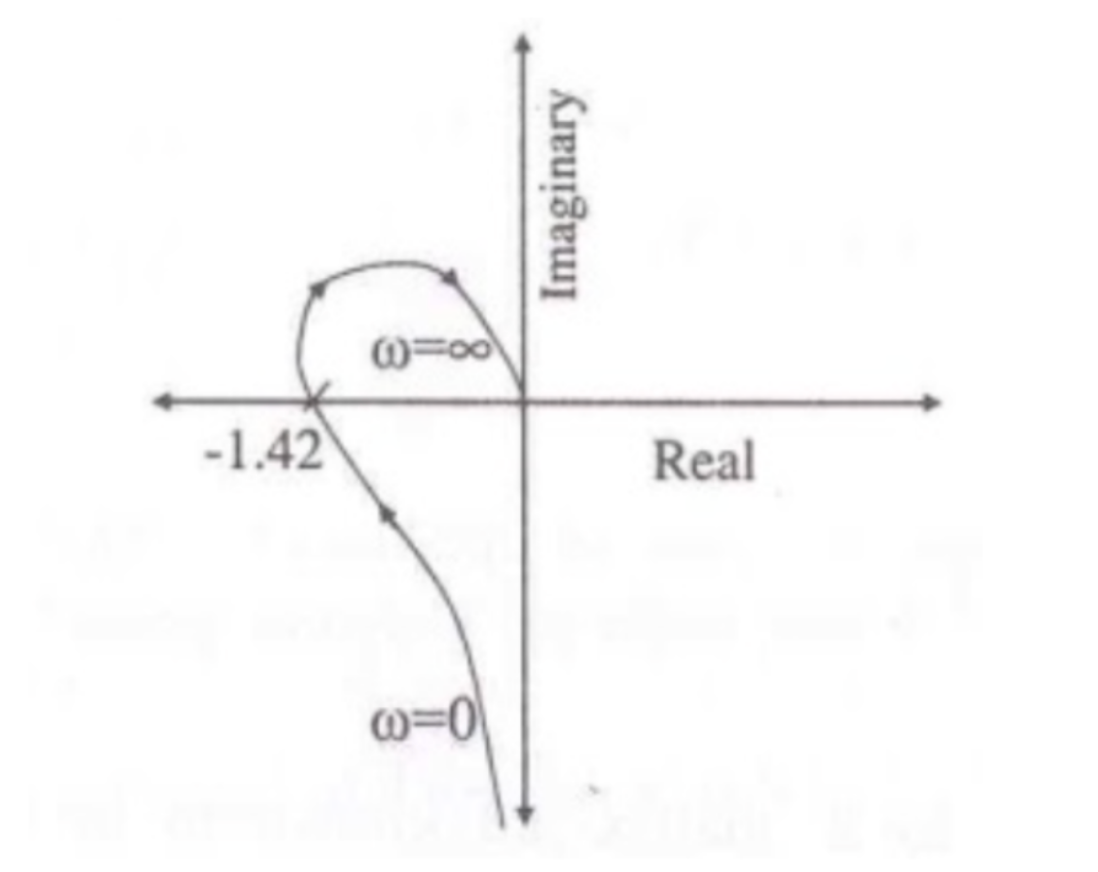
The polar plot of an open loop stable system is shown below. The closed loop system is
always stable
marginally stable
unstable with one pole on the RH s-plane
unstable with two poles on the RH s-plane
Topic: Frequency Response Analysis
Answer: D
Analysis using Nyquist Stability Criterion:
The polar plot shows two clockwise encirclements of the point \(-1 + j0\)
Therefore, \(N = -2\)
Given that the open-loop system is stable: \(P = 0\)
Applying Nyquist criterion: \(N = P - Z\)
\(-2 = 0 - Z \Rightarrow Z = 2\)
\(Z\) represents the number of closed-loop poles in the right-half s-plane
Conclusion: The system is unstable with two poles in the right-half s-plane
The first two rows of Routh’s tabulation of a third order equation are as follows:
\[\begin{array}{c|cc} s^3 & 2 & 2 \\ s^2 & 4 & 4 \\ \end{array}\]
This means there are
Two roots at \(s = \pm j\) and one root in right half s-plane
Two roots at \(s = \pm j2\) and one root in left half s-plane
Two roots at \(s = \pm j2\) and one root in right half s-plane
Two roots at \(s = \pm j\) and one root in left half s-plane
Topic: Routh-Hurwitz Stability Criterion
Answer: D
Routh Array Analysis:
Given initial Routh array: \[\begin{array}{c|cc} s^3 & 2 & 2 \\ s^2 & 4 & 4 \\ s^1 & 0 & \\ \end{array}\]
The third row becomes zero, indicating the presence of imaginary axis roots
Form auxiliary equation from \(s^2\) row: \[4s^2 + 4 = 0 \Rightarrow s^2 = -1 \Rightarrow s = \pm j\]
Differentiate the auxiliary equation: \(\frac{d}{ds}(4s^2 + 4) = 8s\)
Replace the \(s^1\) row with coefficients of the derivative: \[\begin{array}{c|cc} s^3 & 2 & 2 \\ s^2 & 4 & 4 \\ s^1 & 8 & 0 \\ s^0 & 4 & \\ \end{array}\]
No sign changes in the first column \(\Rightarrow\) no roots in RHS
Conclusion: Two roots at \(s = \pm j\) and one root in LHS
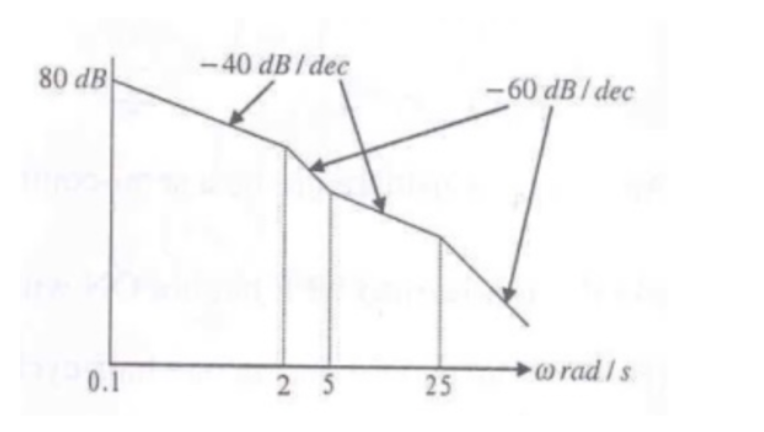
The asymptotic approximation of the log-magnitude vs frequency plot of a system containing only real poles and zeros is shown. Its transfer function is
\(\dfrac{10(s+5)}{s(s+2)(s+25)}\)
\(\dfrac{1000(s+5)}{s^2(s+2)(s+25)}\)
\(\dfrac{100(s+5)}{s(s+2)(s+25)}\)
\(\dfrac{80(s+5)}{s^2(s+2)(s+25)}\)
Topic: Bode Plots
Answer: B
Bode Plot Analysis:
Initial slope = \(-40\) dB/dec \(\Rightarrow\) type-2 system \(\Rightarrow \dfrac{K}{s^2}\)
At \(\omega = 2\) rad/s: slope changes by \(-20\) dB/dec \(\Rightarrow\) pole at \(s = -2\)
At \(\omega = 5\) rad/s: slope changes by \(+20\) dB/dec \(\Rightarrow\) zero at \(s = -5\)
At \(\omega = 25\) rad/s: slope changes by \(-20\) dB/dec \(\Rightarrow\) pole at \(s = -25\)
General form: \(G(s) = \dfrac{K(s+5)}{s^2(s+2)(s+25)}\)
At \(\omega = 0.1\) rad/s, \(|G(j\omega)|_{\text{dB}} = 80\) dB
Low-frequency approximation: \(|G(j\omega)| \approx \dfrac{K}{\omega^2}\)
\(20\log_{10}\left(\dfrac{K}{0.1^2}\right) = 80\) dB
\(20\log_{10}(100K) = 80 \Rightarrow \log_{10}(100K) = 4\)
\(100K = 10^4 \Rightarrow K = 100\)
Therefore, \(G(s) = \dfrac{1000(s+5)}{s^2(s+2)(s+25)}\)
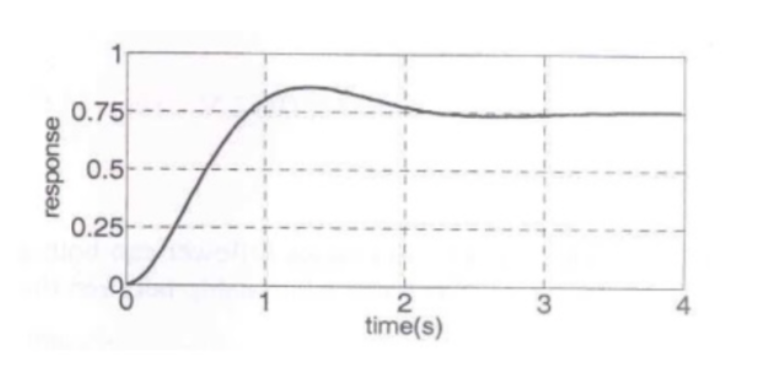
The unit-step response of a unity feedback system with open loop transfer function \(G(s) = \dfrac{K}{(s+1)(s+2)}\) is shown in the figure. The value of \(K\) is
0.5
2
4
6
Topic: Steady State Error
Answer: D
Steady-State Analysis:
From the step response plot, steady-state value = 0.75
Input is unit step: \(R(s) = \dfrac{1}{s}\)
Steady-state error: \(e_{ss} = 1 - 0.75 = 0.25\)
For unity feedback system: \[e_{ss} = \lim_{s \to 0} s \cdot \frac{R(s)}{1 + G(s)} = \frac{1}{1 + G(0)}\]
Calculate \(G(0)\): \[G(0) = \frac{K}{(1)(2)} = \frac{K}{2}\]
Substitute into error equation: \[e_{ss} = \frac{1}{1 + \frac{K}{2}} = 0.25\]
Solve for \(K\): \[1 + \frac{K}{2} = 4 \Rightarrow \frac{K}{2} = 3 \Rightarrow K = 6\]
The open loop transfer function of a unity feedback system is given by \(G(s) = \dfrac{e^{-0.1s}}{s}\). The gain margin of the system is
11.95 dB
17.67 dB
21.33 dB
23.9 dB
Topic: Gain Margin
Answer: D
Gain Margin Calculation:
Given: \(G(s) = \dfrac{e^{-0.1s}}{s}\)
Frequency response: \(G(j\omega) = \dfrac{e^{-j0.1\omega}}{j\omega}\)
Magnitude: \(|G(j\omega)| = \dfrac{1}{\omega}\)
Phase: \(\angle G(j\omega) = -\dfrac{\pi}{2} - 0.1\omega\)
Find phase crossover frequency \(\omega_{pc}\) where phase = \(-\pi\): \[-\frac{\pi}{2} - 0.1\omega_{pc} = -\pi \Rightarrow -0.1\omega_{pc} = -\frac{\pi}{2}\] \[\omega_{pc} = 5\pi \approx 15.708 \text{ rad/s}\]
Calculate gain at \(\omega_{pc}\): \[|G(j\omega_{pc})| = \frac{1}{5\pi} \approx 0.06366\]
Compute gain margin: \[GM = 20\log_{10}\left(\frac{1}{|G(j\omega_{pc})|}\right) = 20\log_{10}(5\pi) \approx 23.9 \text{ dB}\]
A system is described by the following state and output equations: \[\frac{dx_1(t)}{dt} = -3x_1(t) + x_2(t) + 2u(t)\] \[\frac{dx_2(t)}{dt} = -2x_2(t) + u(t)\] \[y(t) = x_1(t)\] where \(u(t)\) is the input and \(y(t)\) is the output. The system transfer function is
\(\dfrac{s+2}{s^2+5s-6}\)
\(\dfrac{s+3}{s^2+5s+6}\)
\(\dfrac{2s+5}{s^2+5s+6}\)
\(\dfrac{-2s-5}{s^2+5s-6}\)
Topic: State Space to Transfer Function
Answer: C
State Space to Transfer Function Conversion:
Extract state-space matrices: \[A = \begin{bmatrix} -3 & 1 \\ 0 & -2 \end{bmatrix}, \quad B = \begin{bmatrix} 2 \\ 1 \end{bmatrix}, \quad C = \begin{bmatrix} 1 & 0 \end{bmatrix}, \quad D = 0\]
Compute \((sI - A)\): \[sI - A = \begin{bmatrix} s+3 & -1 \\ 0 & s+2 \end{bmatrix}\]
Find inverse \((sI - A)^{-1}\): \[(sI - A)^{-1} = \frac{1}{(s+3)(s+2)} \begin{bmatrix} s+2 & 1 \\ 0 & s+3 \end{bmatrix}\]
Calculate transfer function: \[G(s) = C(sI - A)^{-1}B = \frac{1}{s^2 + 5s + 6} \begin{bmatrix} 1 & 0 \end{bmatrix} \begin{bmatrix} s+2 & 1 \\ 0 & s+3 \end{bmatrix} \begin{bmatrix} 2 \\ 1 \end{bmatrix}\]
Perform matrix multiplication: \[= \frac{1}{s^2 + 5s + 6} \begin{bmatrix} 1 & 0 \end{bmatrix} \begin{bmatrix} 2(s+2) + 1 \\ s+3 \end{bmatrix} = \frac{2s + 5}{s^2 + 5s + 6}\]
The state-transition matrix of the above system is
\(\begin{bmatrix} e^{-3t} & 0 \\ e^{-2t} + e^{-3t} & e^{-2t} \end{bmatrix}\)
\(\begin{bmatrix} e^{-3t} & e^{-2t} - e^{-3t} \\ 0 & e^{-2t} \end{bmatrix}\)
\(\begin{bmatrix} e^{3t} & e^{-2t} - e^{-3t} \\ 0 & e^{-2t} \end{bmatrix}\)
\(\begin{bmatrix} e^{-3t} & e^{-2t} + e^{-3t} \\ 0 & e^{-2t} \end{bmatrix}\)
Topic: State Transition Matrix
Answer: B
State Transition Matrix Calculation:
From previous solution: \[(sI - A)^{-1} = \begin{bmatrix} \frac{1}{s+3} & \frac{1}{(s+2)(s+3)} \\ 0 & \frac{1}{s+2} \end{bmatrix}\]
Partial fraction decomposition: \[\frac{1}{(s+2)(s+3)} = \frac{1}{s+2} - \frac{1}{s+3}\]
Rewrite \((sI - A)^{-1}\): \[(sI - A)^{-1} = \begin{bmatrix} \frac{1}{s+3} & \frac{1}{s+2} - \frac{1}{s+3} \\ 0 & \frac{1}{s+2} \end{bmatrix}\]
Take inverse Laplace transform: \[e^{At} = \mathcal{L}^{-1}[(sI - A)^{-1}] = \begin{bmatrix} e^{-3t} & e^{-2t} - e^{-3t} \\ 0 & e^{-2t} \end{bmatrix}\]
The state-transition matrix \(\Phi(t) = e^{At}\)