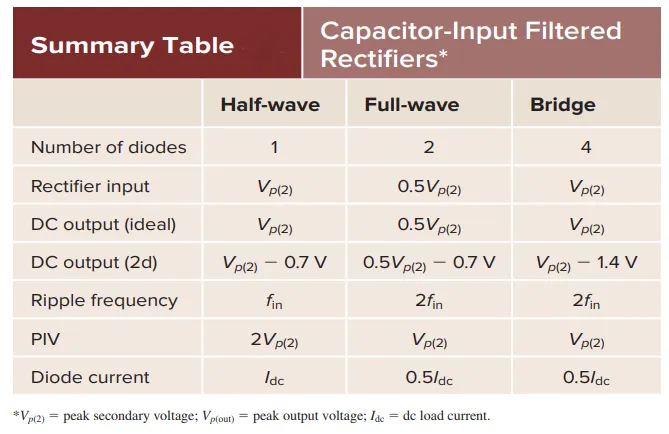
Peak Inverse Voltage (PIV): Maximum voltage across a non-conducting diode
PIV Requirement: Must be less than diode’s breakdown voltage
Worst Case: Capacitor-input filter
Symbols for Maximum Reverse Voltage: PIV, PRV, \(V_B\), \(V_{BR}\), \(V_{R}\), \(V_{RRM}\), \(V_{R(max)}\)
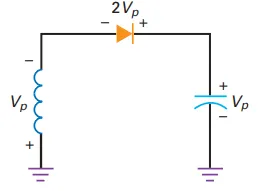
Half-Wave Rectifier with Capacitor-Input Filter
Critical part: Determines reverse voltage
Worst case: Peak secondary voltage negative, capacitor fully charged
Peak Inverse Voltage (PIV):
Example: Peak secondary voltage = 15 V
Diode must have breakdown voltage greater than PIV
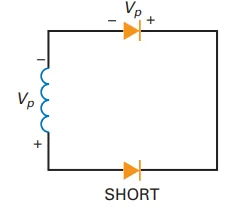
Full-Wave Rectifier with Capacitor-Input Filter
Critical part: Determines peak inverse voltage
Secondary voltage at negative peak
Lower diode: short (closed switch), upper diode: open
Peak Inverse Voltage (PIV):
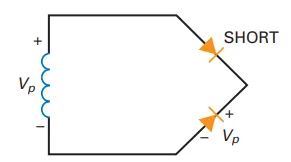
Bridge Rectifier with Capacitor-Input Filter
Critical part: Determines peak inverse voltage
Upper diode: short (closed switch), lower diode: open
Peak Inverse Voltage (PIV):
Advantage: Lowest PIV for a given load voltage
Compared to full-wave rectifier: Requires half the secondary voltage for same load voltage
Surge Resistor
Filter capacitor initially uncharged
At power-on, capacitor acts as a short
Initial charging current may be very large
Surge current: Initial rush of current
Charging path: Resistance of transformer windings and diode bulk resistance
Designer’s choice: Diode with sufficient current rating or use of a surge resistor
Surge resistor: Reduces surge current to safe level
\(R_{surge}\) inserted between bridge rectifier and capacitor-input filter
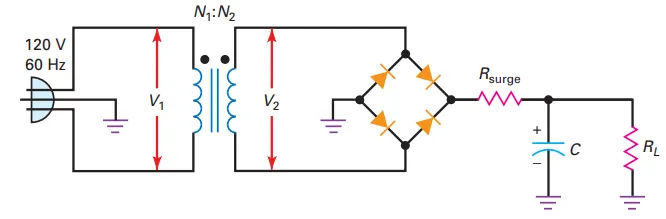
Surge resistors are infrequent in use
Problem on Peak inverse voltage
What is the peak inverse voltage if the turns ratio is \(8: 1\) ? The diode has a breakdown voltage of 50 V . Is it safe to use the diode in this circuit?
The rms secondary voltage is:
\[V_2=\frac{120 \mathrm{~V}}{8}=15 \mathrm{~V}\]The peak secondary voltage is:
\[V_p=\frac{15 \mathrm{~V}}{0.707}=21.2 \mathrm{~V}\]The peak inverse voltage is:
\[\text { PIV }=21.2 \mathrm{~V}\]The diode is more than adequate, since the peak inverse voltage is much less than the breakdown voltage of 50 V .