Electronic Devices & Circuits · Lecture 09

Diode Theory

p–n Junction Physics, Characteristic Curves & Load-Line Analysis

Dr. Mithun Mondal BITS Pilani, Hyderabad Campus
SECTION 01

Demonstrative Video

Lecture Recording
SECTION 02

Need for a Diode — Initial Thoughts

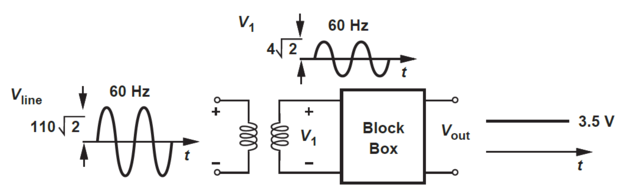
Charger Circuit Operation

Signal Conversion Chain

\[\xrightarrow[\text{110 V}]{\text{ac voltage}} \xrightarrow[\text{4 V}]{\text{Transformer}} \xrightarrow[\text{3.5 V}]{\text{dc voltage using LPF}}\]
Battery charger circuit block diagram showing AC mains, step-down transformer, diode rectifier and low-pass filter producing DC output
Fig. 2.1 — Battery charger circuit block diagram
Why a Diode is Needed
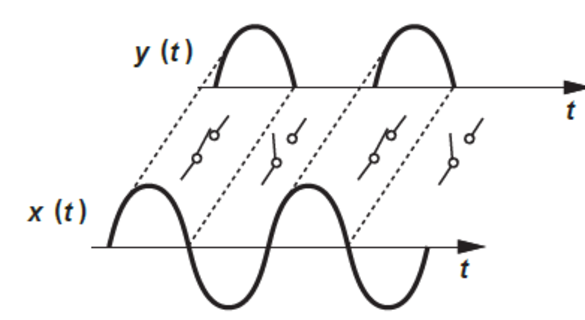
  • Output of the transformer using a black box exhibits a zero dc content — the negative and positive half-cycles enclose equal areas, leading to a zero average value.
  • A diode eliminates the negative half-cycle to produce a non-zero average (DC) output.
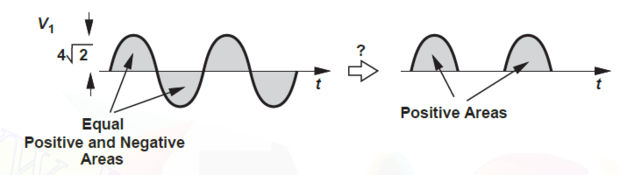
AC waveform showing positive and negative half cycles; negative half-cycle eliminated by the diode to yield pulsating DC
Fig. 2.2 — Negative half-cycle elimination by the diode
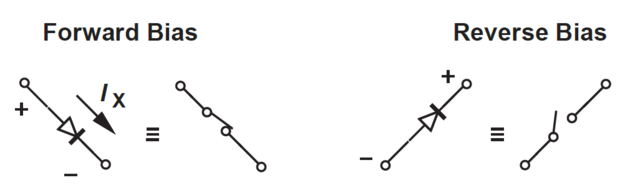
Switch analogy of a diode: closed switch (short circuit) in forward bias, open switch in reverse bias
Fig. 2.3 — Diode as a switch: ON (forward bias) and OFF (reverse bias)
SECTION 03

DIODE — Basic Ideas

Linear vs Nonlinear Device
  • Resistor \(\rightarrow\) linear device \(\rightarrow\) current vs voltage is a straight line.
  • Diode \(\rightarrow\) nonlinear device \(\rightarrow\) \(I\) vs \(V\) is not a straight line.
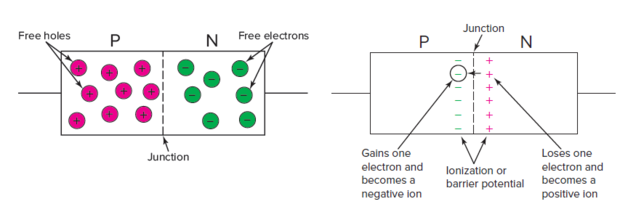
  • The reason is the barrier potential.
Energy band diagram of a p-n junction showing the contact potential (barrier potential Vb) at the depletion region
Fig. 3.1 — Barrier potential \(V_b\) at the p–n junction depletion region
\[\boxed{V_d < V_b \;\rightarrow\; I_d\downarrow} \qquad \boxed{V_d > V_b \;\rightarrow\; I_d\uparrow}\]
Diode Symbol and Circuit
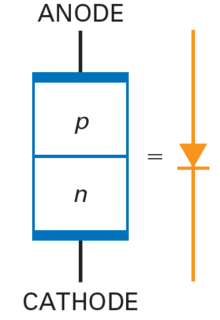
Standard IEEE diode schematic symbol with anode (A) and cathode (K) terminals labelled
Fig. 3.2 — Diode schematic symbol: anode (A), cathode (K)
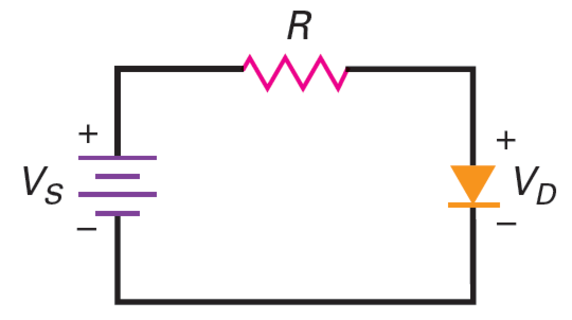
Simple series circuit with DC voltage source, resistor and diode showing voltage and current direction
Fig. 3.3 — Series diode circuit for I–V analysis
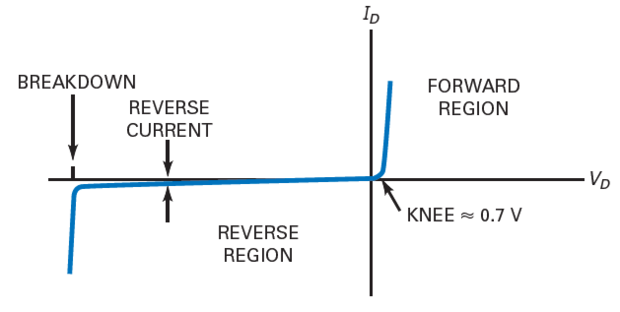
Typical I-V characteristic of a semiconductor diode showing forward conduction knee and reverse breakdown
Fig. 3.4 — Typical diode \(I\)–\(V\) characteristic
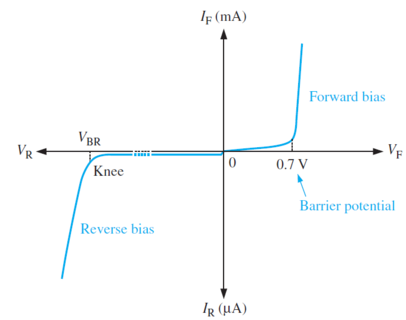
Annotated diode I-V curve labelling the cut-in voltage, forward conduction, reverse saturation and breakdown regions
Fig. 3.5 — Annotated \(I\)–\(V\) curve with operating regions
Ideal Diode

Definition

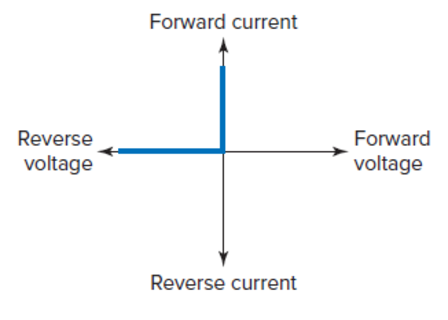
Ideal Diode: acts like a perfect conductor (zero resistance) when forward biased and like a perfect insulator (\(\infty\) resistance) when reverse biased.
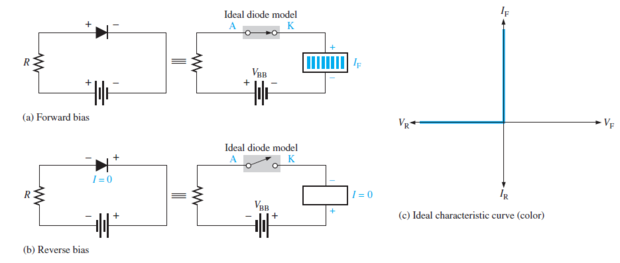
Ideal diode I-V characteristic: step function — short circuit for positive voltage, open circuit for negative voltage
Fig. 3.6 — Ideal diode \(I\)–\(V\) characteristic (first approximation)
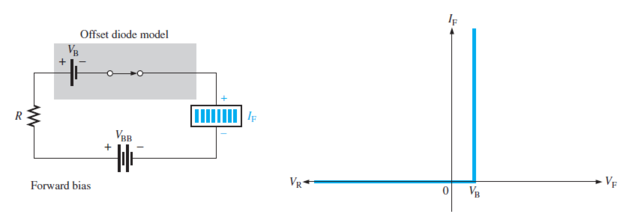
Offset-voltage diode model I-V curve showing forward knee at barrier potential (0.7 V for Si, 0.3 V for Ge)
Fig. 3.7 — Offset-voltage model (second approximation)
SECTION 04

Diode Characteristic Curve

Forward Biased p–n Junction
Forward-biased p-n junction: depletion region narrows, majority carriers cross junction, conventional current flows from anode to cathode
Fig. 4.1 — Forward-biased p–n junction
\[\begin{aligned} & V_{\text{anode}} > V_{\text{cathode}} \leftarrow \text{on} \\ & V_{\text{anode}} < V_{\text{cathode}} \leftarrow \text{off} \\ & V_{\text{anode}} - V_{\text{cathode}} = V_D \end{aligned}\]
I–V Characteristic Curves

Real Diode

Real semiconductor diode I-V curve: gradual exponential forward conduction knee, small reverse saturation current
Fig. 4.2 — Real diode \(I\)–\(V\) characteristic

Ideal Diode

Ideal diode I-V characteristic: zero forward voltage drop and infinite reverse resistance
Fig. 4.3 — Ideal diode \(I\)–\(V\) characteristic (piecewise-linear)

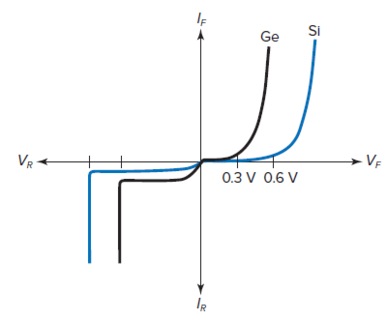
Si vs Ge

Comparison of Silicon (knee ~0.7 V) and Germanium (knee ~0.3 V) diode I-V curves
Fig. 4.4 — Silicon vs Germanium: cut-in voltages \(\approx 0.7\) V and \(\approx 0.3\) V respectively
  • Above the knee voltage, the diode current increases rapidly.
  • A small increase in the diode voltage causes large increases in diode current.
Key Diode Datasheet Parameters
  • Bulk Resistance:

    \[R_B = R_p + R_n\]

    \(R_B\) is less than 1 Ω and depends on the size of the p and n regions and how heavily doped they are.

  • Maximum DC Forward Current: If the current in a diode is too large, the excessive heat can destroy the diode. The \(I_{F(\max)}\) is one of the maximum ratings given on a datasheet.

  • Power Dissipation:

    \[\begin{aligned} P_D &= V_D \cdot I_D \\ P_{\max} &= V_{\max} \cdot I_{\max} \end{aligned}\]

    The power rating is the maximum power the diode can safely dissipate without shortening its life or degrading its properties.
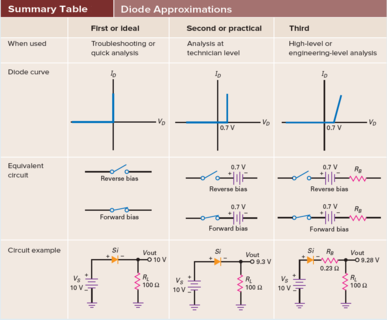
Three diode approximation models: (a) ideal switch, (b) offset-voltage, (c) piecewise-linear with bulk resistance R_B
Fig. 4.5 — Diode approximation models: ideal switch, offset-voltage, piecewise-linear with \(R_B\)
SECTION 05

Diode Current Equation

Shockley Diode Equation

The diode current equation relating the voltage and current:

\[I = I_o\left[\mathrm{e}^{\left(V / \eta V_T\right)} - 1\right]\]
\[\begin{aligned} I &= \text{diode current} \\ I_o &= \text{diode reverse saturation current at room temperature} \\ V &= \text{external voltage applied to the diode} \\ \eta &= \text{a constant: 1 for germanium, 2 for silicon} \\ V_T &= kT/q = T/11600 \quad\text{(thermal voltage)} \\ k &= \text{Boltzmann's constant} = 1.38066\times10^{-23}~\mathrm{J/K} \\ q &= \text{charge of the electron} = 1.60219\times10^{-19}~\mathrm{C} \\ T &= \text{temperature of the diode junction (K)} = \bigl({}^\circ\mathrm{C} + 273^\circ\bigr) \end{aligned}\]
Reverse Bias and Saturation Current

Key Result

\[\boxed{I = I_o\left[\mathrm{e}^{\left(V / \eta V_T\right)} - 1\right]}\]
  • When the diode is reverse biased, its current equation may be obtained by changing the sign of the applied voltage \(V\).

  • Thus, the diode current with reverse bias is:
    \[I = I_o\left[\mathrm{e}^{\left(-V / \eta V_T\right)} - 1\right]\]
  • If \(V \gg V_T\), then the term \(\mathrm{e}^{(-V/\eta V_T)} \ll 1\), therefore \(I \approx -I_o\) — termed as reverse saturation current, which is valid as long as the external voltage is below the breakdown value.

SECTION 06

Effect of Temperature

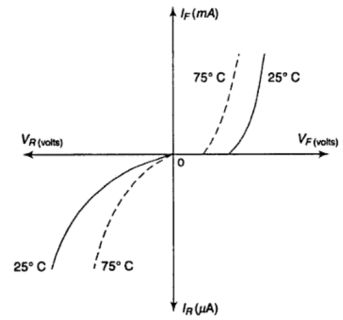
Temperature Effects on Diode Characteristics
Family of diode I-V curves at increasing temperatures T1, T2, T3 showing the characteristic shifts left as temperature rises
Fig. 6.1 — Effect of temperature on the diode \(I\)–\(V\) characteristic
  • \(T\uparrow \;\Rightarrow\;\) generation of electron–hole pairs increases, which increases the conductivities.
  • If \(T\uparrow\) at fixed \(V \;\Rightarrow\; I\) increases.
  • To bring \(I\) to normal \(\;\Rightarrow\; V\downarrow\).
SECTION 07

Load Lines

Load Line Equation

Load Line (KVL)

\[I_D = \frac{V_S - V_D}{R_s}\]

Load line: a straight line on the \(I_D\)–\(V_D\) plane whose intersection with the diode characteristic defines the Q-point.
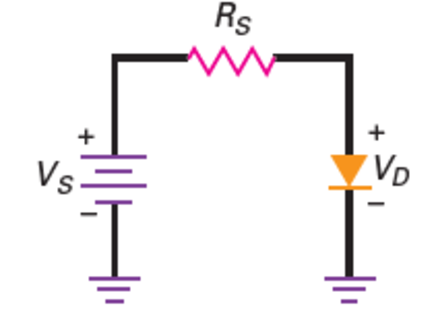
Load line drawn on the diode I-V plane: y-intercept at Vs/Rs and x-intercept at Vs
Fig. 7.1 — Load line on the diode \(I_D\)–\(V_D\) characteristic plane
Q-Point Determination
  • If \(V_s = 2~\mathrm{V}\), \(R = 100~\Omega\)

  • \(V_D = 0 \;\Rightarrow\; I_D = 20~\mathrm{mA}\)

  • \(I_D = 0 \;\Rightarrow\; V_D = V_s = 2~\mathrm{V}\)

  • The straight line is called the load line.

  • \(Q\) is an abbreviation for quiescent, which means "at rest."
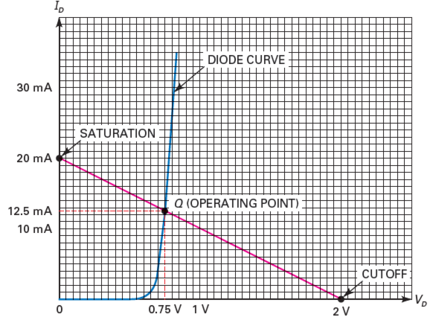
Diode I-V characteristic with the load line superimposed; their intersection is the Q-point (quiescent operating point)
Fig. 7.2 — Q-point: intersection of the load line and the diode \(I\)–\(V\) curve