Overview
-
Number Systems - Binary, decimal, octal, hexadecimal with conversion examples
-
Binary Arithmetic - Addition and subtraction with detailed examples
-
Complements - 1’s and 2’s complement methods with subtraction examples
-
Logic Gates - All 7 gates (AND, OR, NOT, NAND, NOR, XOR, XNOR) with truth tables
-
Boolean Algebra - All laws, theorems, and simplification techniques
-
Standard Forms - SOP/POS, minterms/maxterms with conversion methods
-
NAND/NOR Realization - Universal gate implementations
Number Systems
Number Systems - Overview
Common Number Systems
-
Binary (Base-2): Uses digits 0 and 1
-
Octal (Base-8): Uses digits 0 to 7
-
Decimal (Base-10): Uses digits 0 to 9
-
Hexadecimal (Base-16): Uses digits 0-9 and A-F
Why Study Number Systems?
Digital systems work exclusively with binary numbers. Understanding conversions between different bases is essential for digital design, computer programming, and hardware interfacing.
Key Concept
Any number in base \(r\) can be represented as: \[N = d_n \times r^n + d_{n-1} \times r^{n-1} + \ldots + d_1 \times r^1 + d_0 \times r^0\]
Decimal to Other Bases
Problem 1: Decimal to Binary Conversion
Problem Convert the decimal number \((156)_{10}\) to binary.
Solution
Method: Repeated division by 2| Division | Quotient | Remainder |
|---|---|---|
| \(156 \div 2\) | 78 | 0 (LSB) |
| \(78 \div 2\) | 39 | 0 |
| \(39 \div 2\) | 19 | 1 |
| \(19 \div 2\) | 9 | 1 |
| \(9 \div 2\) | 4 | 1 |
| \(4 \div 2\) | 2 | 0 |
| \(2 \div 2\) | 1 | 0 |
| \(1 \div 2\) | 0 | 1 (MSB) |
Answer: \((156)_{10} = (10011100)_2\)
Verification: \[\begin{aligned} &128 + 16 + 8 + 4 \\ &= 156 \checkmark \end{aligned}\]
Problem 2: Decimal to Octal Conversion
Problem Convert \((237)_{10}\) to octal.
Solution
Method: Repeated division by 8| Division | Quotient | Remainder |
|---|---|---|
| \(237 \div 8\) | 29 | 5 (LSD) |
| \(29 \div 8\) | 3 | 5 |
| \(3 \div 8\) | 0 | 3 (MSD) |
Reading remainders from bottom to top
Answer: \((237)_{10} = (355)_8\)
Verification: \[\begin{aligned} &3 \times 8^2 + 5 \times 8^1 + 5 \times 8^0 \\ &= 192 + 40 + 5 \\ &= 237 \checkmark \end{aligned}\]
Problem 3: Decimal to Hexadecimal Conversion
Problem Convert \((2890)_{10}\) to hexadecimal.
Solution
Method: Repeated division by 16| Division | Quotient | Remainder |
|---|---|---|
| \(2890 \div 16\) | 180 | 10 = A |
| \(180 \div 16\) | 11 | 4 |
| \(11 \div 16\) | 0 | 11 = B |
Answer: \((2890)_{10} = (B4A)_{16}\)
Verification: \[\begin{aligned} &11 \times 256 + 4 \times 16 + 10 \\ &= 2816 + 64 + 10 \\ &= 2890 \checkmark \end{aligned}\]
Other Bases to Decimal
Problem 4: Binary to Decimal Conversion
Problem Convert the binary number \((11010110)_2\) to decimal.
Solution
Method: Multiply each bit by its positional weight and sum\[\begin{aligned} (11010110)_2 &= 1 \times 2^7 + 1 \times 2^6 + 0 \times 2^5 + 1 \times 2^4 \\ &\quad + 0 \times 2^3 + 1 \times 2^2 + 1 \times 2^1 + 0 \times 2^0 \\ &= 128 + 64 + 0 + 16 + 0 + 4 + 2 + 0 \\ &= 214 \end{aligned}\]
Answer: \((11010110)_2 = (214)_{10}\)
Problem 5: Octal to Decimal Conversion
Problem Convert \((742)_8\) to decimal.
Solution
Method: Multiply each digit by its positional weight\[\begin{aligned} (742)_8 &= 7 \times 8^2 + 4 \times 8^1 + 2 \times 8^0 \\ &= 7 \times 64 + 4 \times 8 + 2 \times 1 \\ &= 448 + 32 + 2 \\ &= 482 \end{aligned}\]
Answer: \((742)_8 = (482)_{10}\)
Problem 6: Hexadecimal to Decimal Conversion
Problem Convert \((2A5F)_{16}\) to decimal.
Solution
Remember: A=10, B=11, C=12, D=13, E=14, F=15\[\begin{aligned} (2A5F)_{16} &= 2 \times 16^3 + 10 \times 16^2 + 5 \times 16^1 + 15 \times 16^0 \\ &= 2 \times 4096 + 10 \times 256 + 5 \times 16 + 15 \times 1 \\ &= 8192 + 2560 + 80 + 15 \\ &= 10847 \end{aligned}\]
Answer: \((2A5F)_{16} = (10847)_{10}\)
Direct Conversions Between Bases
Problem 7: Binary to Hexadecimal Conversion
Problem Convert \((10110111001101)_2\) to hexadecimal.
Solution
Method: Group bits in sets of 4 from right to left| Binary Group: | 10 | 1101 | 1100 | 1101 |
| Pad with 0s: | 0010 | 1101 | 1100 | 1101 |
| Hex Digit: | 2 | D | C | D |
Answer: \((10110111001101)_2 = (2DCD)_{16}\)
Quick Reference
Each hexadecimal digit represents exactly 4 binary digits.
Problem 8: Binary to Octal Conversion
Problem Convert \((101110111)_2\) to octal.
Solution
Method: Group bits in sets of 3 from right to left| Binary Group: | 101 | 110 | 111 |
| Octal Digit: | 5 | 6 | 7 |
Answer: \((101110111)_2 = (567)_8\)
Verification: Convert both to decimal
-
\((567)_8 = 5 \times 64 + 6 \times 8 + 7 = 375\)
-
\((101110111)_2 = 256 + 64 + 32 + 16 + 4 + 2 + 1 = 375\)
Problem 9: Hexadecimal to Binary Conversion
Problem Convert \((3AF)_{16}\) to binary.
Solution
Method: Replace each hex digit with 4 binary digits| Hex Digit: | 3 | A | F |
| Binary: | 0011 | 1010 | 1111 |
Answer: \((3AF)_{16} = (001110101111)_2 = (1110101111)_2\)
Verification:
-
\((3AF)_{16} = 3 \times 256 + 10 \times 16 + 15 = 943_{10}\)
-
\((1110101111)_2 = 512 + 256 + 128 + 32 + 8 + 4 + 2 + 1 = 943_{10}~\checkmark\)
Problem 10: Octal to Hexadecimal Conversion
Problem Convert \((725)_8\) to hexadecimal.
Solution
Method: Convert through binary as intermediate stepStep 1: Octal to Binary
(each octal digit \(\to\) 3 bits)
| Octal: | 7 | 2 | 5 |
| Binary: | 111 | 010 | 101 |
Result: \((111010101)_2\)
Step 2: Binary to Hexadecimal
(group 4 bits from right)
| Binary: | 0001 | 1101 | 0101 |
| Hex: | 1 | D | 5 |
Answer: \((725)_8 = (1D5)_{16}\)
Binary Arithmetic
Binary Addition
Binary Addition Rules
Basic Rules
| A | B | Sum | Carry |
|---|---|---|---|
| 0 | 0 | 0 | 0 |
| 0 | 1 | 1 | 0 |
| 1 | 0 | 1 | 0 |
| 1 | 1 | 0 | 1 |
With Carry When adding three bits (including carry):
-
\(1 + 1 + 0 = 10_2\) (sum = 0, carry = 1)
-
\(1 + 1 + 1 = 11_2\) (sum = 1, carry = 1)
Problem 11: Simple Binary Addition
Problem Add the binary numbers \((1011)_2\) and \((1110)_2\).
Solution
| 1 | 1 | 0 | (Carry) | ||
| 1 | 0 | 1 | 1 | ||
| + | 1 | 1 | 1 | 0 | |
| 1 | 1 | 0 | 0 | 1 |
Step-by-step:
-
Position 0: \(1 + 0 = 0\) (no carry)
-
Position 1: \(1 + 1 = 10\) (write 0, carry 1)
-
Position 2: \(0 + 1 + 1_{\text{carry}} = 10\) (write 0, carry 1)
-
Position 3: \(1 + 1 + 1_{\text{carry}} = 11\) (write 1, carry 1)
Answer: \((1011)_2 + (1110)_2 = (11001)_2\)
Verification: \(11 + 14 = 25~\checkmark\)
Problem 12: Multi-bit Binary Addition
Problem Add \((10110101)_2 + (11011011)_2\)
Solution
| 1 | 1 | 1 | 1 | 1 | 0 | 1 | (Carry) | ||
| 1 | 0 | 1 | 1 | 0 | 1 | 0 | 1 | ||
| + | 1 | 1 | 0 | 1 | 1 | 0 | 1 | 1 | |
| 1 | 1 | 0 | 0 | 1 | 0 | 0 | 0 | 0 |
Answer:
\((10110101)_2 + (11011011)_2 = (110010000)_2\)
Verification:
-
\((10110101)_2 = 181_{10}\)
-
\((11011011)_2 = 219_{10}\)
-
Sum = \(400_{10} = (110010000)_2~\checkmark\)
Binary Multiplication
Binary Multiplication Rules
Basic Rules Binary multiplication is simpler than decimal:
| A | B | A \(\times\) B |
|---|---|---|
| 0 | 0 | 0 |
| 0 | 1 | 0 |
| 1 | 0 | 0 |
| 1 | 1 | 1 |
Process
-
Multiply each bit of multiplicand by each bit of multiplier
-
Shift partial products appropriately
-
Add all partial products
Problem 13: Binary Multiplication
Problem Multiply \((1101)_2 \times (101)_2\)
Solution
| 1 | 1 | 0 | 1 | |||||
| \(\times\) | 1 | 0 | 1 | |||||
| 1 | 1 | 0 | 1 | (multiply by 1) | ||||
| 0 | 0 | 0 | 0 | (multiply by 0, shift) | ||||
| + | 1 | 1 | 0 | 1 | (multiply by 1, shift) | |||
| 1 | 0 | 0 | 0 | 0 | 0 | 1 |
Answer: \((1101)_2 \times (101)_2 = (1000001)_2\)
Verification: \(13 \times 5 = 65~\checkmark\)
Problem 14: Larger Binary Multiplication
Problem Multiply \((1110)_2 \times (1011)_2\)
Solution
| 1 | 1 | 1 | 0 | ||||||
| \(\times\) | 1 | 0 | 1 | 1 | |||||
| 1 | 1 | 1 | 0 | ||||||
| 1 | 1 | 1 | 0 | ||||||
| 0 | 0 | 0 | 0 | ||||||
| + | 1 | 1 | 1 | 0 | |||||
| 1 | 0 | 0 | 1 | 1 | 0 | 1 | 0 |
Answer: \((1110)_2 \times (1011)_2 = (10011010)_2\)
Verification: \(14 \times 11 = 154 = (10011010)_2~\checkmark\)
Complements and Binary Subtraction
Complements - Overview
Why Complements?
-
Simplify subtraction by converting it to addition
-
Essential for computer arithmetic circuits
-
Efficient representation of negative numbers
Two Types of Complements For base \(r\), there are two types:
-
\((r-1)\)’s Complement: For binary: 1’s complement
-
\(r\)’s Complement: For binary: 2’s complement
Key Concepts
-
1’s Complement: Flip all bits (\(0 \leftrightarrow 1\))
-
2’s Complement: 1’s complement + 1
Finding Complements
Example: Complements of \((1010)_2\)
1’s Complement:
-
Original: 1010
-
Flip all bits: 0101
-
Answer: \((0101)_2\)
2’s Complement:
-
1’s complement: 0101
-
Add 1: \(0101 + 1 = 0110\)
-
Answer: \((0110)_2\)
Alternative Method for 2’s Complement
-
Scan from right to left
-
Copy bits until first 1 (including it)
-
Then flip remaining bits
-
Example: \(1010 \rightarrow 0110\)
-
(copy 10, flip 10)
Problem 15: Subtraction using 1’s Complement
Problem Subtract \((1010)_2 - (0110)_2\) using 1’s complement.
Solution
Step 1: Find 1’s complement of subtrahend (0110) \[\text{1's complement of } 0110 = 1001\]Step 2: Add minuend and 1’s complement
| 1 | 0 | 1 | 0 | ||
| + | 1 | 0 | 0 | 1 | |
| 1 | 0 | 0 | 1 | 1 |
Step 3: Add end-around carry to result \[0011 + 1_{\text{carry}} = 0100\] Answer: \((1010)_2 - (0110)_2 = (0100)_2 = 4_{10}\)
Verification: \(10 - 6 = 4~ \checkmark\)
Problem 16: Subtraction using 2’s Complement (Positive Result)
Problem Subtract \((10110)_2 - (01101)_2\) using 2’s complement.
Solution
Step 1: Find 2’s complement of subtrahend (01101)-
1’s complement: 10010
-
2’s complement: \(10010 + 1 = 10011\)
Step 2: Add minuend and 2’s complement
| 1 | 0 | 1 | 1 | 0 | ||
| + | 1 | 0 | 0 | 1 | 1 | |
| 1 | 0 | 1 | 0 | 0 | 1 |
Step 3: Discard the carry (indicates positive result) Answer: \[\begin{aligned} (10110)_2 - (01101)_2 & = (01001)_2 \\ &= 9_{10} \end{aligned}\]
Verification: \(22 - 13 = 9~\checkmark\)
Problem 17: Subtraction using 2’s Complement (Negative Result)
Problem Subtract \((0110)_2 - (1010)_2\) using 2’s complement.
Solution
Step 1:
Find 2’s complement of subtrahend (1010)
-
1’s complement: 0101
-
2’s complement: \(0101 + 1 = 0110\)
Step 2: Add minuend and 2’s complement
| 0 | 1 | 1 | 0 | |
| + | 0 | 1 | 1 | 0 |
| 1 | 1 | 0 | 0 |
Step 3: No carry! Result is negative. Find 2’s complement of result:
-
1’s complement of 1100: 0011
-
2’s complement: \(0011 + 1 = 0100\)
Answer: \[\begin{aligned} (0110)_2 - (1010)_2 & = -(0100)_2 \\ &= -4_{10} \end{aligned}\]
Verification: \(6 - 10 = -4\) \(\checkmark\)
Problem 18: Subtraction using 1’s Complement (Negative Result)
Problem Subtract \((0011)_2 - (1001)_2\) using 1’s complement.
Solution
Step 1: Find 1’s complement of 1001 \[\text{1's complement: } 0110\]Step 2: Add
| 0 | 0 | 1 | 1 | |
| + | 0 | 1 | 1 | 0 |
| 1 | 0 | 0 | 1 |
Step 3: No end-around carry! Result is negative.
Take 1’s complement of result: \(\overline{1001} = 0110\)
Answer: \[\begin{aligned} (0011)_2 - (1001)_2 &= -(0110)_2 \\ &= -6_{10} \end{aligned}\]
Verification: \(3 - 9 = -6\) \(\checkmark\)
Logic Gates
Logic Gates - Overview
What are Logic Gates?
Logic gates are the basic building blocks of digital circuits that perform logical operations on one or more binary inputs to produce a single binary output.
Classification
-
Basic Gates: AND, OR, NOT
-
Universal Gates: NAND, NOR
-
Special Purpose Gates: XOR, XNOR
Why Universal Gates?
NAND and NOR gates are called universal because any Boolean function can be implemented using only NAND gates or only NOR gates.
Basic Logic Gates
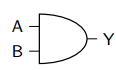
Problem 19: AND Gate
Definition
AND gate produces output 1 only when ALL inputs are 1.
Boolean Expression:
\(Y = A \cdot B\) or \(Y = AB\)
Truth Table
| A | B | Y = A·B |
|---|---|---|
| 0 | 0 | 0 |
| 0 | 1 | 0 |
| 1 | 0 | 0 |
| 1 | 1 | 1 |
Applications
-
Enable/Disable circuits
-
Masking operations
-
Multiplication in arithmetic circuits
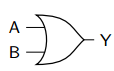
Problem 20: OR Gate
Definition OR gate produces output 1 when ANY input is 1.
Boolean Expression: \(Y = A + B\)
Truth Table
| A | B | Y = A+B |
|---|---|---|
| 0 | 0 | 0 |
| 0 | 1 | 1 |
| 1 | 0 | 1 |
| 1 | 1 | 1 |
Applications
-
Multiple input selection
-
Addition in arithmetic circuits
-
Alarm systems
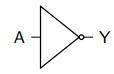
Problem 21: NOT Gate (Inverter)
Definition NOT gate inverts the input signal.
Boolean Expression: \(Y = \overline{A}\) or \(Y = A'\)
Truth Table
| A | Y = \(\overline{A}\) |
|---|---|
| 0 | 1 |
| 1 | 0 |
Key Properties
-
Single input gate
-
Also called inverter
-
Double inversion: \(\overline{\overline{A}} = A\)
Universal Gates
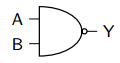
Problem 22: NAND Gate
Definition
-
NAND = NOT-AND (inverted AND)
-
Output is 0 only when ALL inputs are 1.
-
Boolean: \(Y = \overline{A \cdot B}\)
Truth Table
| A | B | Y = \(\overline{AB}\) |
|---|---|---|
| 0 | 0 | 1 |
| 0 | 1 | 1 |
| 1 | 0 | 1 |
| 1 | 1 | 0 |
Universal Gate Can implement:
-
NOT: Connect inputs together
-
AND: NAND + NOT
-
OR: NOT inputs + NAND
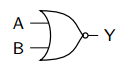
Problem 23: NOR Gate
Definition
-
NOR = NOT-OR (inverted OR)
-
Output is 1 only when ALL inputs are 0.
-
Boolean: \(Y = \overline{A + B}\)
Truth Table
| A | B | Y = \(\overline{A+B}\) |
|---|---|---|
| 0 | 0 | 1 |
| 0 | 1 | 0 |
| 1 | 0 | 0 |
| 1 | 1 | 0 |
Universal Gate Can implement:
-
NOT: Connect inputs together
-
OR: NOR + NOT
-
AND: NOT inputs + NOR
Special Purpose Gates
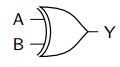
Problem 24: XOR Gate (Exclusive-OR)
Definition
-
XOR outputs 1 when inputs are DIFFERENT.
-
Boolean: \(Y = A \oplus B = A\overline{B} + \overline{A}B\)
Truth Table
| A | B | \(Y = A \oplus B\) |
|---|---|---|
| 0 | 0 | 0 |
| 0 | 1 | 1 |
| 1 | 0 | 1 |
| 1 | 1 | 0 |
Applications
-
Adder circuits (sum bit)
-
Parity checkers
-
Comparators
-
Encryption circuits
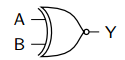
Problem 25: XNOR Gate (Exclusive-NOR)
Definition
-
XNOR outputs 1 when inputs are SAME.
-
Boolean: \(Y = \overline{A \oplus B} = AB + \overline{A}\,\overline{B}\)
Truth Table
| A | B | Y = \(\overline{A \oplus B}\) |
|---|---|---|
| 0 | 0 | 1 |
| 0 | 1 | 0 |
| 1 | 0 | 0 |
| 1 | 1 | 1 |
Applications
-
Equality detector
-
Parity generators
-
Coincidence detector
-
Controlled inverter
Boolean Algebra
Boolean Algebra - Fundamental Laws
Identity Laws \[\begin{aligned} A + 0 &= A \\ A \cdot 1 &= A \end{aligned}\]
Null (Dominance) Laws \[\begin{aligned} A + 1 &= 1 \\ A \cdot 0 &= 0 \end{aligned}\]
Idempotent Laws \[\begin{aligned} A + A &= A \\ A \cdot A &= A \end{aligned}\]
Complement Laws \[\begin{aligned} A + \overline{A} &= 1 \\ A \cdot \overline{A} &= 0 \\ \overline{\overline{A}} &= A \end{aligned}\]
Commutative Laws \[\begin{aligned} A + B &= B + A \\ A \cdot B &= B \cdot A \end{aligned}\]
Boolean Algebra - More Laws
Associative Laws \[\begin{aligned} A + (B + C) &= (A + B) + C \\ A \cdot (B \cdot C) &= (A \cdot B) \cdot C \end{aligned}\]
Distributive Laws \[\begin{aligned} A(B + C) &= AB + AC \\ A + BC &= (A + B)(A + C) \end{aligned}\]
Absorption Laws \[\begin{aligned} A + AB &= A \\ A(A + B) &= A \\ A + \overline{A}B &= A + B \\ A(\overline{A} + B) &= AB \end{aligned}\]
De Morgan’s Theorems
First Theorem \(\overline{A + B} = \overline{A} \cdot \overline{B}\)
The complement of a sum equals the product of complements.
Second Theorem \(\overline{A \cdot B} = \overline{A} + \overline{B}\)
The complement of a product equals the sum of complements.
Extended Forms For multiple variables: \[\begin{aligned} \overline{A + B + C} &= \overline{A} \cdot \overline{B} \cdot \overline{C} \\ \overline{ABC} &= \overline{A} + \overline{B} + \overline{C} \end{aligned}\]
Key Point Break the bar, change the operation (AND \(\longleftrightarrow\) OR)
Problem 26: Truth Table Construction
Problem Construct the truth table for \(F = AB + \overline{A}C\)
Solution
| A | B | C | \(AB\) | \(\overline{A}C\) | \(F = AB + \overline{A}C\) |
|---|---|---|---|---|---|
| 0 | 0 | 0 | 0 | 0 | 0 |
| 0 | 0 | 1 | 0 | 1 | 1 |
| 0 | 1 | 0 | 0 | 0 | 0 |
| 0 | 1 | 1 | 0 | 1 | 1 |
| 1 | 0 | 0 | 0 | 0 | 0 |
| 1 | 0 | 1 | 0 | 0 | 0 |
| 1 | 1 | 0 | 1 | 0 | 1 |
| 1 | 1 | 1 | 1 | 0 | 1 |
-
Answer: Function outputs 1 for rows 1, 3, 6, and 7
-
In minterm notation: \(F(A,B,C) = \sum m(1, 3, 6, 7)\)
Problem 27: Boolean Simplification Using Laws
Problem Simplify: \(F = A\overline{B}C + ABC + A\overline{B}\,\overline{C}\)
Solution
\[\begin{aligned} F &= A\overline{B}C + ABC + A\overline{B}\,\overline{C} \\ &= A\overline{B}(C + \overline{C}) + ABC \quad \text{(Factor } A\overline{B}\text{)} \\ &= A\overline{B}(1) + ABC \quad \text{(Complement law)} \\ &= A\overline{B} + ABC \\ &= A(\overline{B} + BC) \quad \text{(Factor } A\text{)} \\ &= A(\overline{B} + C) \quad \text{(Absorption: } \overline{B} + BC = \overline{B} + C\text{)} \end{aligned}\]
-
Answer:
\[F = A(\overline{B} + C) = A\overline{B} + AC\]
-
Gate Reduction: Original requires 7 gates, simplified requires 4 gates!
Problem 28: Simplification Using Consensus Theorem
Problem Simplify: \(F = AB + \overline{A}C + BC\)
Solution
-
Consensus Theorem:
\[XY + \overline{X}Z + YZ = XY + \overline{X}Z\]
-
The term \(BC\) is the consensus term and can be eliminated.
\[\begin{aligned} F &= AB + \overline{A}C + BC \\ &= AB + \overline{A}C \quad \text{(Apply consensus theorem)} \end{aligned}\]
-
Verification by expansion: \[\begin{aligned} BC &= BC(A + \overline{A}) \\ &= ABC + \overline{A}BC \\ &= ABC + \overline{A}BC \subseteq AB + \overline{A}C \end{aligned}\]
-
Answer: \(F = AB + \overline{A}C\)
Problem 29: De Morgan’s Theorem Application
Problem Apply De Morgan’s theorem: \(\overline{(A + B)(C + D)}\)
Solution
-
Step 1: Apply De Morgan’s first law (break outer bar) \[\overline{(A + B)(C + D)} = \overline{(A + B)} + \overline{(C + D)}\]
-
Step 2: Apply De Morgan’s to each term \(= (\overline{A} \cdot \overline{B}) + (\overline{C} \cdot \overline{D})\)
-
Answer: \(\overline{(A + B)(C + D)} = \overline{A}\,\overline{B} + \overline{C}\,\overline{D}\)
Verification Can verify by constructing truth tables for both expressions.
Problem 30: Complex Simplification
Problem Simplify: \(F = \overline{A}BC + A\overline{B}C + AB\overline{C} + ABC\)
Solution
\[\begin{aligned} F &= \overline{A}BC + A\overline{B}C + AB\overline{C} + ABC \\ &= \overline{A}BC + ABC + A\overline{B}C + AB\overline{C} \quad \text{(Rearrange)} \\ &= BC(\overline{A} + A) + A\overline{B}C + AB\overline{C} \quad \text{(Factor)} \\ &= BC + A\overline{B}C + AB\overline{C} \quad \text{(Complement law)} \\ &= BC + AC(\overline{B} + B) \quad \text{(Factor } AC\text{, note: } AB\overline{C} = A\overline{C}B\text{)} \\ &= BC + AC \end{aligned}\]
-
Alternative approach: \[\begin{aligned} F & = C(\overline{A}B + A\overline{B} + AB) + AB\overline{C}\\ & = C(A + B) + AB\overline{C}\\ &= AC + BC + AB\overline{C} \\ &= AC + BC \end{aligned}\]
-
Answer:
\(F = BC + AC = C(A + B)\)
Standard Forms of Boolean Functions
Standard Forms - Overview
Two Standard Forms
-
Sum of Products (SOP): Sum of minterms
-
Example: \(F = AB + \overline{A}C + BC\)
-
Two-level AND-OR implementation
-
-
Product of Sums (POS): Product of maxterms
-
Example: \(F = (A + B)(A + C)(\overline{B} + C)\)
-
Two-level OR-AND implementation
-
Canonical Forms
-
Canonical SOP: All variables appear in each product term (minterm)
-
Canonical POS: All variables appear in each sum term (maxterm)
Minterms and Maxterms for 3 Variables
Minterms
| Index | Minterm |
|---|---|
| \(m_0\) | \(\overline{A}\,\overline{B}\,\overline{C}\) |
| \(m_1\) | \(\overline{A}\,\overline{B}C\) |
| \(m_2\) | \(\overline{A}B\overline{C}\) |
| \(m_3\) | \(\overline{A}BC\) |
| \(m_4\) | \(A\overline{B}\,\overline{C}\) |
| \(m_5\) | \(A\overline{B}C\) |
| \(m_6\) | \(AB\overline{C}\) |
| \(m_7\) | \(ABC\) |
Maxterms
| Index | Maxterm |
|---|---|
| \(M_0\) | \(A + B + C\) |
| \(M_1\) | \(A + B + \overline{C}\) |
| \(M_2\) | \(A + \overline{B} + C\) |
| \(M_3\) | \(A + \overline{B} + \overline{C}\) |
| \(M_4\) | \(\overline{A} + B + C\) |
| \(M_5\) | \(\overline{A} + B + \overline{C}\) |
| \(M_6\) | \(\overline{A} + \overline{B} + C\) |
| \(M_7\) | \(\overline{A} + \overline{B} + \overline{C}\) |
Important Relationships
-
\(m_i = \overline{M_i}\) (Minterm is complement of corresponding maxterm)
-
Binary index matches the input combination
Problem 31: Convert to Canonical SOP
Problem Convert \(F = A + BC\) to canonical Sum of Products form.
Solution
Step 1: Expand term A (missing B and C) \[\begin{aligned} A &= A(B + \overline{B}) = AB + A\overline{B} \\ AB &= AB(C + \overline{C}) = ABC + AB\overline{C} \\ A\overline{B} &= A\overline{B}(C + \overline{C}) = A\overline{B}C + A\overline{B}\,\overline{C} \end{aligned}\]Step 2: Expand term BC (missing A) \(BC = BC(A + \overline{A}) = ABC + \overline{A}BC\)
Step 3: Combine and remove duplicates \(F = ABC + AB\overline{C} + A\overline{B}C + A\overline{B}\,\overline{C} + \overline{A}BC\) \(= m_3 + m_4 + m_5 + m_6 + m_7\)
Answer: \(F = \sum m(3, 4, 5, 6, 7)\)
Problem 32: SOP from Truth Table
Problem Write SOP expression from the truth table:
| A | B | C | F |
|---|---|---|---|
| 0 | 0 | 0 | 0 |
| 0 | 0 | 1 | 1 |
| 0 | 1 | 0 | 0 |
| 0 | 1 | 1 | 1 |
| 1 | 0 | 0 | 1 |
| 1 | 0 | 1 | 0 |
| 1 | 1 | 0 | 1 |
| 1 | 1 | 1 | 1 |
Solution
-
Method: Write minterm for each row where F = 1 \[\begin{aligned} F &= m_1 + m_3 + m_4 + m_6 + m_7 \\ &= \overline{A}\,\overline{B}C + \overline{A}BC + A\overline{B}\,\overline{C} + AB\overline{C} + ABC \end{aligned}\]
-
Answer: \(F(A,B,C) = \sum m(1, 3, 4, 6, 7)\)
-
Simplified form can be obtained using Boolean algebra
Problem 33: SOP to POS Conversion
Problem Given
\[F(A,B,C) = \sum m(1,3,5,7),\]
express in POS form.
-
Answer: \(F = \prod M(0, 2, 4, 6)\)
-
Observation: After simplification, \(F = C\)
Solution
Step 1: Identify missing minterms (where F = 0) \[F = 0 \text{ for } m_0, m_2, m_4, m_6\]Step 2: Convert to maxterms using relationship \[F = \prod M(0, 2, 4, 6)\]
Step 3: Write out maxterms \[\begin{aligned} F &= M_0 \cdot M_2 \cdot M_4 \cdot M_6 \\ &= (A + B + C)(A + \overline{B} + C)(\overline{A} + B + C)(\overline{A} + \overline{B} + C) \end{aligned}\]
Problem 34: POS from Truth Table
Problem Write POS expression for the function with F = 0 at rows 0, 2, 5:
Solution
-
Method: Write maxterm for each row where F = 0
-
For row 0 (A=0, B=0, C=0): \(M_0 = A + B + C\)
-
For row 2 (A=0, B=1, C=0): \(M_2 = A + \overline{B} + C\)
-
For row 5 (A=1, B=0, C=1): \(M_5 = \overline{A} + B + \overline{C}\)
\[\begin{aligned} F &= M_0 \cdot M_2 \cdot M_5 \\ &= (A + B + C)(A + \overline{B} + C)(\overline{A} + B + \overline{C}) \end{aligned}\]
Answer: \[F(A,B,C) = \prod M(0, 2, 5)\]
Alternative notation: \[F = \sum m(1, 3, 4, 6, 7)\]
Problem 35: Convert Non-Standard to Standard SOP
Problem Convert \(F = A(B + C)\) to standard SOP form.
Solution
Step 1: Distribute to get SOP \(F = AB + AC\)Step 2: Expand AB (missing C) \[AB = AB(C + \overline{C}) = ABC + AB\overline{C}\]
Step 3: Expand AC (missing B) \[AC = AC(B + \overline{B}) = ABC + A\overline{B}C\]
Step 4: Combine (ABC appears twice, write once) \[F = ABC + AB\overline{C} + A\overline{B}C\]
Answer:
\(F = \sum m(5, 6, 7)\)
where:
-
\(m_5 = A\overline{B}C\) (binary: 101)
-
\(m_6 = AB\overline{C}\) (binary: 110)
-
\(m_7 = ABC\) (binary: 111)
Problem 36: Conversion Between SOP and POS
Problem Given \(F(A,B,C) = \sum m(0,2,5,7)\), find:
-
Canonical SOP
-
Canonical POS
Solution
Canonical SOP \[\begin{aligned} F &= m_0 + m_2 + m_5 + m_7 \\ &= \overline{A}\,\overline{B}\,\overline{C} + \overline{A}B\overline{C} + A\overline{B}C + ABC \end{aligned}\]
Answer: Both forms represent the same function! Canonical POS
Missing minterms: 1, 3, 4, 6 \(\to\) Use maxterms: \(M_1, M_3, M_4, M_6\) \[\begin{aligned} F &= \prod M(1, 3, 4, 6) \\ &= (A+B+\overline{C})(A+\overline{B}+\overline{C})\\ &(\overline{A}+B+C)(\overline{A}+\overline{B}+C) \end{aligned}\]
NAND and NOR Gate Realization
Universal Gates - Why NAND and NOR?
Advantages of Universal Gates
-
Economic: Cheaper to manufacture single gate type
-
Simplicity: Easier IC design and production
-
Versatility: Can implement any Boolean function
-
Speed: Often faster than equivalent AND-OR circuits
Implementation Strategy
For NAND realization:
-
Express function in SOP form
-
Apply two-level NAND-NAND logic
For NOR realization:
-
Express function in POS form
-
Apply two-level NOR-NOR logic
Basic Gates Using NAND
NOT Using NAND Connect both inputs together: \[Y = \overline{A \cdot A} = \overline{A}\]
AND Using NAND NAND followed by NOT: \[Y = \overline{\overline{A \cdot B}} = A \cdot B\]
OR Using NAND NOT inputs, then NAND: \[Y = \overline{\overline{A} \cdot \overline{B}} = A + B\] (By De Morgan’s theorem)
Key Insight NAND with inverted inputs = OR gate
Basic Gates Using NOR
NOT Using NOR Connect both inputs together: \[Y = \overline{A + A} = \overline{A}\]
OR Using NOR NOR followed by NOT: \[Y = \overline{\overline{A + B}} = A + B\]
AND Using NOR NOT inputs, then NOR: \[Y = \overline{\overline{A} + \overline{B}} = A \cdot B\] (By De Morgan’s theorem)
Key Insight NOR with inverted inputs = AND gate
Problem 37: NAND Gate Realization - Simple
Problem Implement \(F = AB + CD\) using only NAND gates.
Solution
Step 1: Function is already in SOP formStep 2: Apply double negation (De Morgan’s) \[F = AB + CD = \overline{\overline{AB + CD}} = \overline{\overline{AB} \cdot \overline{CD}}\]
Step 3: NAND implementation structure
-
Level 1:
-
NAND gate 1: Inputs A, B \(\to\) Output \(\overline{AB}\)
-
NAND gate 2: Inputs C, D \(\to\) Output \(\overline{CD}\)
-
-
Level 2:
-
NAND gate 3: Inputs \(\overline{AB}\), \(\overline{CD}\) \(\to\) Output F
-
Answer
-
Total gates required = 3 NAND gates
-
Circuit: Two-level NAND-NAND implementation
Problem 38: NAND Realization - Three Terms
Problem Implement \(F = AB + \overline{A}C + BC\)
using only NAND gates.
Answer
Total = 1 NOT + 4 NAND
= 5 gates
Solution
Step 1: Apply double negation \[F = AB + \overline{A}C + BC = \overline{\overline{AB + \overline{A}C + BC}}\]Step 2: Apply De Morgan’s theorem \[F = \overline{\overline{AB} \cdot \overline{\overline{A}C} \cdot \overline{BC}}\]
Step 3: NAND implementation
-
Level 1: Generate product terms
-
NAND(A, B) \(\to\) \(\overline{AB}\)
-
NAND(\(\overline{A}\), C) \(\to\) \(\overline{\overline{A}C}\) (need NOT for A first)
-
NAND(B, C) \(\to\) \(\overline{BC}\)
-
-
Level 2: NAND of all outputs \(\to\) F
Problem 39: NOR Gate Realization - Simple
Problem Implement
\(F = (A + B)(C + D)\)
using only NOR gates.
Answer
-
Total gates required = 3 NOR gates
-
Circuit: Two-level NOR-NOR implementation
Solution
Step 1: Function is already in POS formStep 2: Apply double negation (De Morgan’s) \[F = (A + B)(C + D) = \overline{\overline{(A + B)(C + D)}}\] \[= \overline{\overline{(A + B)} + \overline{(C + D)}}\]
Step 3: NOR implementation structure
-
Level 1:
-
NOR gate 1: Inputs A, B \(\to\) Output \(\overline{(A + B)}\)
-
NOR gate 2: Inputs C, D \(\to\) Output \(\overline{(C + D)}\)
-
-
Level 2:
-
NOR gate 3: Inputs from gates 1 and 2 \(\to\) Output F
-
Problem 40: NOR Realization - Multiple Terms
Problem Implement \(F = (A + B)(A + C)(\overline{B} + C)\)
using only NOR gates.
Answer Total = 1 NOT + 4 NOR = 5 gates
Solution
Step 1: Apply double negation \[F = (A + B)(A + C)(\overline{B} + C) = \overline{\overline{(A+B)(A+C)(\overline{B}+C)}}\]Step 2: Apply De Morgan’s \[F = \overline{\overline{(A+B)} + \overline{(A+C)} + \overline{(\overline{B}+C)}}\]
Step 3: NOR implementation
-
Level 1: Generate sum terms
-
NOR(A, B) \(\to\) \(\overline{(A + B)}\)
-
NOR(A, C) \(\to\) \(\overline{(A + C)}\)
-
NOR(\(\overline{B}\), C) \(\to\) \(\overline{(\overline{B} + C)}\) (need NOT for B)
-
-
Level 2: 3-input NOR of outputs \(\to\) F
Problem 41: NAND Implementation of XOR
Problem Implement XOR function \(F = A \oplus B = A\overline{B} + \overline{A}B\) using NAND gates only.
Solution
Method 1: Direct from SOP \[\begin{aligned} F &= A\overline{B} + \overline{A}B \\ &= \overline{\overline{A\overline{B}} \cdot \overline{\overline{A}B}} \end{aligned}\] Implementation:
-
NOT gates: \(\overline{A}\), \(\overline{B}\) (2 NAND gates with tied inputs)
-
Term 1: NAND(A, \(\overline{B}\)) \(\to\) \(\overline{A\overline{B}}\)
-
Term 2: NAND(\(\overline{A}\), B) \(\to\) \(\overline{\overline{A}B}\)
-
Final: NAND of above two outputs \(\to\) F
Method 2: Efficient 4-NAND implementation
-
Gate 1: NAND(A, B) \(\to\) \(X = \overline{AB}\)
-
Gate 2: NAND(A, X) \(\to\) \(Y = \overline{A\overline{AB}} = \overline{A} + B\)
-
Gate 3: NAND(B, X) \(\to\) \(Z = \overline{B\overline{AB}} = A + \overline{B}\)
-
Gate 4: NAND(Y, Z) \(\to\) \(F = A \oplus B\)
Answer Minimum = 4 NAND gates
Problem 42: Converting AND-OR to NAND-NAND
Problem Convert the following AND-OR circuit to NAND-NAND: \(F = ABC + \overline{A}BC + A\overline{B}C\)
Solution
Step 1: Simplify first if possible \[\begin{aligned} F &= ABC + \overline{A}BC + A\overline{B}C \\ &= BC(A + \overline{A}) + A\overline{B}C \\ &= BC + A\overline{B}C \\ &= C(B + A\overline{B}) \\ &= C(A + B) \end{aligned}\] Step 2: Express in NAND form \[F = C(A + B) = \overline{\overline{C(A+B)}} = \overline{\overline{C} + \overline{(A+B)}}\]
Step 3: NAND implementation
-
Gate 1: NAND(A, B) with both inverted = OR
-
Gate 2: NAND(C, output of gate 1) = Final output
Answer: 3 NAND gates (2 for OR, 1 for AND)
Problem 43: Multilevel NAND Implementation
Problem Implement \(F = ((AB)C + D)E\) using only NAND gates.
Solution
Analysis: This is a multilevel function
Step 1: Identify levels
-
Level 1: \(AB\)
-
Level 2: \((AB)C\)
-
Level 3: \((AB)C + D\)
-
Level 4: \(((AB)C + D)E\)
Step 2: Convert each level to NAND
-
\(AB\) \(\to\) NAND(A,B) followed by NOT \(\to\) 2 NAND gates
-
\((AB)C\) \(\to\) NAND of previous with C, then NOT \(\to\) 2 NAND gates
-
\((AB)C + D\) \(\to\) Requires OR, implement with NAND
-
Final AND with E \(\to\) NAND then NOT
Answer: Requires 7 NAND gates
Note: Direct NAND-NAND conversion works best for 2-level circuits
Problem 44: NOR Implementation from Truth Table
Problem Implement using NOR gates: \(F(A,B,C) = \prod M(0,2,4,6)\)
Solution
Step 1: Write maxterms \[\begin{aligned} M_0 &= A + B + C \\ M_2 &= A + \overline{B} + C \\ M_4 &= \overline{A} + B + C \\ M_6 &= \overline{A} + \overline{B} + C \end{aligned}\]
Step 2: Product of sums \[\begin{aligned} F &= (A+B+C)(A+\overline{B}+C)\\ &~~(\overline{A}+B+C)(\overline{A}+\overline{B}+C) \end{aligned}\] Step 3: Apply De Morgan’s for NOR-NOR \[F = \overline{\overline{(A+B+C)} + \overline{(A+\overline{B}+C)} + \overline{(\overline{A}+B+C)} + \overline{(\overline{A}+\overline{B}+C)}}\]
Step 4: Implementation
-
Level 1: 4 NOR gates (one for each maxterm)
-
Level 2: 1 four-input NOR gate for final output
Answer: Total = 2 NOT + 5 NOR = 7 gates
After simplification, \(F = C\), needs only inverters!
Summary and Key Points
Summary - Number Systems
Key Concepts Covered
-
Binary, Octal, Decimal, Hexadecimal systems
-
Conversion methods between all bases
-
Direct conversions (Binary \(\longleftrightarrow\) Octal \(\longleftrightarrow\) Hex)
Quick Conversion Tips
-
Binary to Octal: Group 3 bits
-
Binary to Hex: Group 4 bits
-
Any to Decimal: Positional weights
-
Decimal to Any: Repeated division
Summary - Binary Arithmetic & Complements
Binary Arithmetic
-
Addition: Simple carry propagation
-
Multiplication: Shift and add method
-
Subtraction: Use complement methods
Complements
-
1’s Complement: Flip all bits, end-around carry
-
2’s Complement: 1’s complement + 1, most used in computers
-
No carry in result = negative answer
Summary - Logic Gates
Seven Basic Gates
| Gate | Operation | Symbol |
|---|---|---|
| AND | \(Y = AB\) | All 1 \(\to\) 1 |
| OR | \(Y = A + B\) | Any 1 \(\to\) 1 |
| NOT | \(Y = \overline{A}\) | Invert |
| NAND | \(Y = \overline{AB}\) | All 1 \(\to\) 0 |
| NOR | \(Y = \overline{A+B}\) | All 0 \(\to\) 1 |
| XOR | \(Y = A \oplus B\) | Different \(\to\) 1 |
| XNOR | \(Y = \overline{A \oplus B}\) | Same \(\to\) 1 |
Remember NAND and NOR are universal gates!
Summary - Boolean Algebra
Essential Laws
-
Identity Laws
-
Null Laws
-
Idempotent Laws
-
Complement Laws
-
Commutative Laws
-
Associative Laws
-
Distributive Laws
-
Absorption Laws
-
De Morgan’s Theorems
-
Consensus Theorem
De Morgan’s - Most Important \[\overline{A + B} = \overline{A} \cdot \overline{B}\] \[\overline{A \cdot B} = \overline{A} + \overline{B}\] Break the bar, change the operation!
Summary - Standard Forms
SOP and POS
-
Sum of Products (SOP):
-
OR of AND terms
-
Use minterms where F = 1
-
Two-level AND-OR circuit
-
-
Product of Sums (POS):
-
AND of OR terms
-
Use maxterms where F = 0
-
Two-level OR-AND circuit
-
Relationship \(F = \sum m(a,b,c,...)\) and \(F = \prod M(\text{remaining indices})\)
Summary - Universal Gate Implementation
NAND Realization
-
Best for SOP expressions
-
Two-level NAND-NAND structure
-
Apply: \(F = \overline{\overline{AB} \cdot \overline{CD} \cdot ...}\)
NOR Realization
-
Best for POS expressions
-
Two-level NOR-NOR structure
-
Apply: \(F = \overline{\overline{(A+B)} + \overline{(C+D)} + ...}\)
Strategy
-
Simplify Boolean expression first
-
Choose appropriate form (SOP for NAND, POS for NOR)
-
Apply double negation and De Morgan’s
Practice Tips
For Better Understanding
-
Always verify conversions by converting back
-
Draw truth tables for complex Boolean functions
-
Practice simplification using multiple methods
-
Verify gate implementations with truth tables
-
Master De Morgan’s theorems - they’re everywhere!
Common Mistakes to Avoid
-
Forgetting end-around carry in 1’s complement
-
Incorrect grouping in binary-octal-hex conversions
-
Misapplying De Morgan’s theorems
-
Not simplifying before gate implementation
-
Confusing minterms and maxterms