Demonstrative Video
Losses in a Transformer
-
Types of losses in a transformer:
-
Iron or core loss
-
Copper loss
-
-
Iron loss:
-
Due to the reversal of flux in the core
-
Practically constant at all loads (no load to full load)
-
Subdivided into two losses:
-
Hysteresis loss
-
Eddy-current loss
-
-
-
Hysteresis loss:
-
Occurs due to the alternating flux in the core
-
Depends on factors such as hysteresis loop area, core volume, and frequency of flux reversal
-
-
Eddy-current loss:
-
Occurs due to the flow of eddy currents in the core
-
Depends on factors such as lamination thickness, frequency of flux reversal, maximum flux density, core volume, and quality of magnetic material
-
Eddy-current losses can be reduced by decreasing lamination thickness and adding silicon to steel.
-
-
Copper loss:
-
due to the resistances of primary and secondary windings
-
depends upon the load on the transformer
-
proportional to square of load current of kVA rating
-
Ideal and Practical Transformers
-
For an ideal transformer:
-
No core loss and copper loss.
-
Winding resistance and leakage flux are zero.
-
-
In a practical transformer:
-
The windings have some resistance.
-
There is always some leakage flux.
-
-
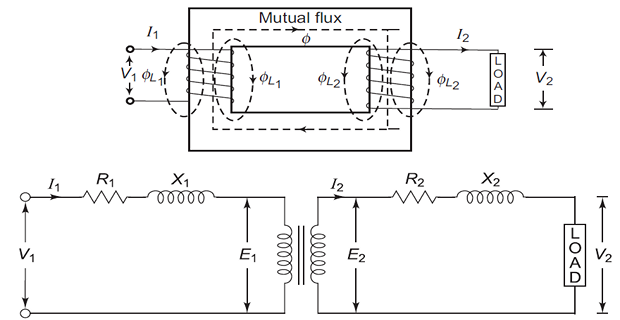
In an ideal transformer, it is assumed that all the flux produced by the primary winding links both the primary and secondary windings. However, in practice, this condition cannot be realized.
-
The flux \(\phi_{L1}\) represents the primary leakage flux, which links only to the primary winding and does not link to the secondary winding.
-
Similarly, \(\phi_{L2}\) is secondary leakage flux, which links only to the secondary winding and does not link to the primary winding.
-
The mutual flux, \(\phi\) , links both the primary and secondary windings.
-
\(\phi_{L1}\) is in phase with \(I_1\) and produces a self-induced emf \(E_{L1}\) in the primary winding.
-
\(\phi_{L2}\) is in phase with \(I_2\) and produces \(E_{L2}\) in the secondary winding.
-
The induced voltages \(E_{L1}\) and \(E_{L2}\) caused by \(\phi_{L1}\) and \(\phi_{L2}\) differ from the induced voltages \(E_1\) and \(E_2\) caused by the main or mutual flux \(\phi\) .
-
Leakage fluxes generate self-induced emfs in their respective windings.
-
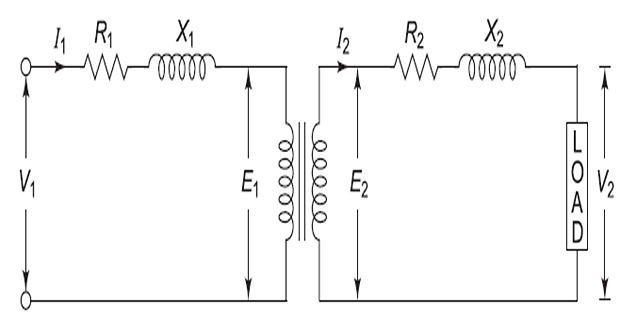
Consequently, the leakage fluxes are equivalent to inductive coils connected in series with their respective windings.
-
The voltage drop in each series coil is equal to the voltage produced by the leakage flux.\[E_{L_1}=I_1X_1~~\text{and}~~E_{L_2}=I_2X_2\]
Phasor Diagram at No Load
-
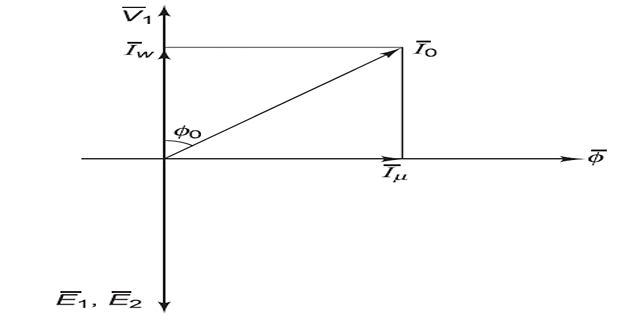
No Load \(\Rightarrow\) core loss and Cu loss in primary winding
-
\(I_0\) supply core loss and very small Cu loss in primary
-
\(I_0\) has two components:
-
\(I_\mu~\Rightarrow\) magnetising or reactive component
-
\(I_w~\Rightarrow\) power or active component
-
-
\(I_\mu\) sets flux ( \(\phi\) ) in the core and is in phase with \(\phi\)
-
\(I_w\) responsible for power loss and phase with \(V_1\)
-
\(I_0\) is very small as compared to \(I_1\)
-
copper loss negligible and\[\boxed{W_0=W_i = V_1I_0\cos\phi_0}\]
Phasor Diagram on Load
-
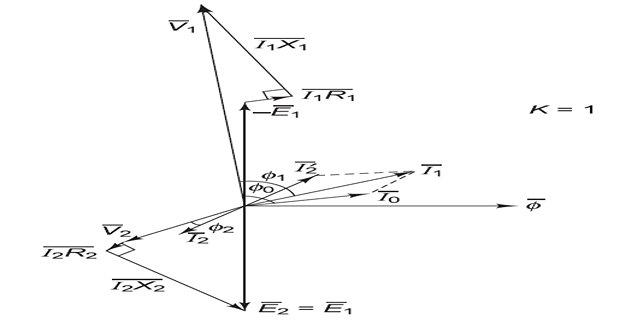
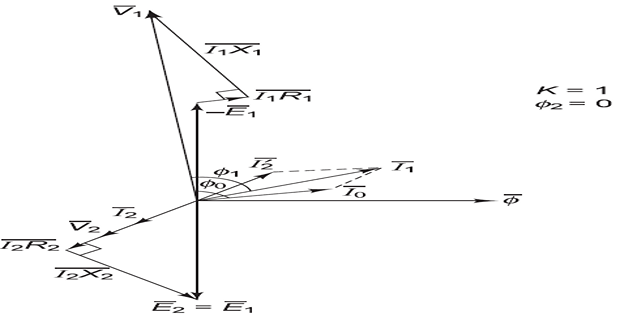
Load \(\Rightarrow~I_2~\Rightarrow~\phi_2~\Rightarrow~\phi \downarrow~\Rightarrow~I_1 \uparrow ~\Rightarrow~\phi \uparrow ~\Rightarrow\) constant \(\phi\)
-
\(I^{\prime}_2\) ( additional \(I_1\) is anti-phase with \(I_2\) ) sets \(\phi^{\prime}_2\) cancel \(\phi_2\) due to \(I_2\)
Resistive
load
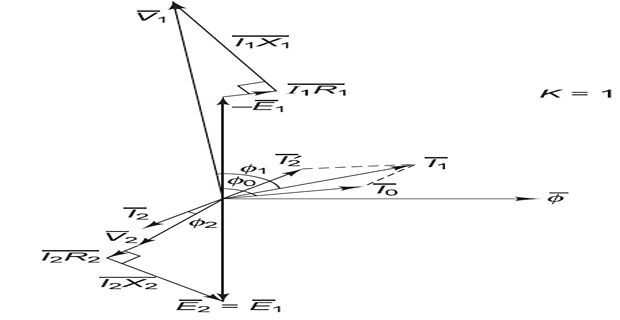
Capacitive load