Set 34 — Winding Factors and Coil Span
Set 33 used \(k_p\) and \(k_d\) as given numbers. This set works out where they come from and what they are for. Both are ratios of a phasor sum to an arithmetic sum: the pitch factor because the two sides of a chorded coil are not exactly opposed, the distribution factor because the coils of a phase belt sit in different slots and therefore generate at different instants.
The reason the topic matters is that neither factor is chosen to make the fundamental as large as possible. A full-pitch, concentrated winding would do that, and it would also generate a badly distorted wave. The coil span is set instead to null a named harmonic, and the phase belt is spread to smooth what is left. The last two problems make that explicit: one selects a span that removes the fifth harmonic exactly, the other handles a fractional-slot winding by reducing it to an equivalent integral-slot one.
Everything starts from the slot angle. Adjacent slots are separated by \(\beta\) electrical degrees:
\[ \beta = \frac{180^\circ P}{S} = \frac{180^\circ}{\text{slots per pole}} \]One pole pitch is \(180^\circ\) electrical however many slots it contains, and one revolution is \(180^\circ P\).
The pitch factor measures the loss from a coil whose two sides are not exactly a pole pitch apart. If the coil falls short by \(\alpha\) electrical degrees, the two side e.m.f.s subtract at an angle instead of head-on:
\[ k_p = \cos\frac{\alpha}{2}, \qquad k_{pn} = \cos\frac{n\alpha}{2} \]The distribution factor measures the loss from spreading a phase belt over \(m\) slots. It is the ratio of the phasor sum of \(m\) equal e.m.f.s \(\beta\) apart to their arithmetic sum:
\[ k_d = \frac{\sin(m\beta/2)}{m\sin(\beta/2)}, \qquad k_{dn} = \frac{\sin(nm\beta/2)}{m\sin(n\beta/2)} \]Angles in degrees. For a normal three-phase 60° belt \(m\beta = 60^\circ\) and \(k_d\) lies between 0.955 and 0.966 whatever \(m\) is.
The winding factor is simply their product, and it is the only place the winding geometry enters the e.m.f. equation:
\[ k_w = k_p k_d, \qquad E_{ph} = 4.44\,k_w f \Phi T_{ph} \]Chording is chosen to kill a harmonic, not to raise the fundamental. Setting \(k_{pn} = 0\) requires
\[ \frac{n\alpha}{2} = 90^\circ \;\Longrightarrow\; \alpha = \frac{180^\circ}{n}, \qquad \text{coil span} = \left(1 - \frac{1}{n}\right)\times\text{pole pitch} \]The fundamental then survives with \(k_{p1} = \cos(90^\circ/n)\) — a loss of only 4.9 % for \(n = 5\).
Fractional-slot windings have \(q = S/3P\) non-integral. Write \(q = N/D\) in lowest terms; the winding then behaves exactly like an integral-slot one with
\[ q' = N \ \text{slots per pole per phase}, \qquad \beta' = \frac{\beta}{D} \]The spread is preserved: \(q'\beta' = q\beta = 60^\circ\). That identity is the check that the reduction was done correctly.
Coil span in slots, angle in degrees. A coil laid from slot 1 to slot \(1+s\) spans \(s\) slot pitches, i.e. \(s\beta\) electrical degrees; the shortfall is \(\alpha = 180^\circ - s\beta\). Nearly every error in this set is a confusion between these two units.
Calculate the pitch factor for the following windings:
- 36 stator slots, 4 poles, coil span 1 to 8;
- 72 stator slots, 6 poles, coil span 1 to 10;
- 96 stator slots, 6 poles, coil span 1 to 12.
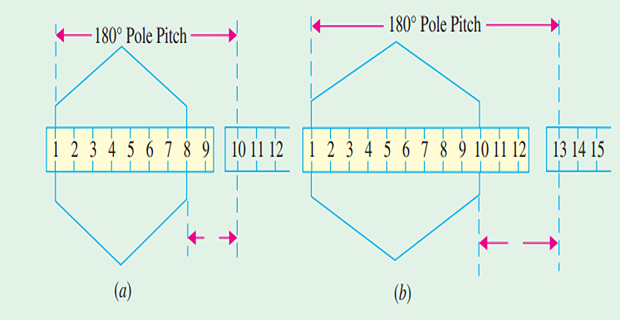
Fix the method once. A coil laid from slot 1 to slot \(1+s\) spans \(s\) slot pitches. A full pitch is one pole pitch, which is \(S/P\) slots and \(180^\circ\) electrical whatever that count happens to be. So the shortfall, expressed as a fraction of a pole pitch, is
(a) 36 slots, 4 poles, span 1 to 8. Nine slots per pole; the coil spans 7 slots, so it is 2 slots short:
(b) 72 slots, 6 poles, span 1 to 10. Twelve slots per pole; the coil spans 9 slots, 3 short:
(c) 96 slots, 6 poles, span 1 to 12. Sixteen slots per pole; the coil spans 11 slots, 5 short:
A shortfall of five sixteenths of a pole pitch is severe chording, and it costs nearly 12 % of the fundamental — more than any designer would accept unless a particular harmonic had to be destroyed.
Read the trend. The three cases chord by \(2/9\), \(3/12\) and \(5/16\) of a pole pitch, and \(k_p\) falls monotonically with the shortfall:
| Case | Slots/pole | Span (slots) | Shortfall | \(\alpha\) | \(k_p\) |
|---|---|---|---|---|---|
| (a) | 9 | 7 | 2 slots | 40° | 0.940 |
| (b) | 12 | 9 | 3 slots | 45° | 0.924 |
| (c) | 16 | 11 | 5 slots | 56°15′ | 0.882 |
Note that the pole number never enters directly — only through \(S/P\), the slots per pole, which converts a span in slots into an angle.
Determine \(k_d\) for an alternator with 9 slots per pole for the following cases:
- one winding occupying all the slots;
- one winding using only the first \(2/3\) of the slots per pole;
- three equal windings placed sequentially, each occupying a 60° group.
The slot angle is common to all three cases. Nine slots share one pole pitch of 180° electrical:
Only \(m\), the number of slots in one belt, changes from case to case: 9, 6 and 3 respectively.
(i) All nine slots in one belt. The belt then spans \(m\beta = 180^\circ\) — a whole pole pitch:
Spreading a phase over a full pole pitch throws away 36 % of the e.m.f. The last coil of the belt is in direct opposition to the first, so their contributions very nearly cancel.
(ii) Six slots — a 120° belt.
(iii) Three slots — the standard 60° belt. Three windings of three slots each fill the nine slots of a pole and give the usual three-phase arrangement:
What the three numbers say. The same nine slots and the same conductors give very different outputs depending on how the phase belts are grouped:
| Case | \(m\) | Belt spread \(m\beta\) | \(k_d\) |
|---|---|---|---|
| (i) all slots, one winding | 9 | 180° | 0.640 |
| (ii) first two thirds | 6 | 120° | 0.831 |
| (iii) three 60° groups | 3 | 60° | 0.960 |
In the limit of very many slots, \(k_d \to \sin(\sigma/2)/(\sigma/2)\) with \(\sigma\) the spread in radians: 0.637 for 180°, 0.827 for 120°, 0.955 for 60°. The three answers above sit just above those limits, as they must for a finite number of slots.
A part of an alternator winding consists of six coils in series, each coil having an e.m.f. of 10 V r.m.s. induced in it. The coils lie in successive slots, and between one slot and the next there is an electrical phase displacement of 30°. Find the resultant e.m.f. of the six coils in series.
Identify the two quantities the formula needs. The coils are the belt, and the slot displacement is the slot angle:
The distribution factor is exactly the ratio the question asks for — phasor sum over arithmetic sum:
The arithmetic sum is what a series connection would give if every coil e.m.f. were in phase:
The phasor sum is the actual terminal e.m.f. of the group:
A 36 % shortfall — and no wonder: \(m\beta = 6\times 30^\circ = 180^\circ\), so this belt spans a whole pole pitch and the sixth coil opposes the first. It is the same geometry as case (i) of Problem 2, with 6 coils instead of 9.
The contrast worth drawing. If the same 60 V of coil e.m.f. were arranged as a 60° belt — two coils of a three-phase winding at \(\beta = 30^\circ\) — then \(k_d = \sin 30^\circ/(2\sin 15^\circ) = 0.966\). The loss would be 3.4 % instead of 36 %.
A 3-phase, 50 Hz alternator running at 600 rpm has a two-layer winding with 12 turns per coil, 4 slots per pole per phase and a coil pitch of 10 slots. Determine
- the number of poles and the total number of slots;
- the slot angle and the distribution factor;
- the pole pitch in slots and the pitch factor;
- the series turns per phase;
- the induced e.m.f. per phase, the flux per pole being 0.035 Wb.
(a) Poles first — the whole geometry hangs on it. The speed and frequency are given, so
(b) Slot angle and distribution factor. With 120 slots over 10 poles there are 12 slots per pole:
Spread check: \(m\beta = 4\times 15^\circ = 60^\circ\), the standard phase belt.
(c) Pole pitch and pitch factor. The pole pitch is the total slots divided by the poles:
(d) Series turns per phase. A two-layer winding has one coil per slot, so there are 120 coils of 12 turns:
The data counts turns, not conductors, so there is no further halving here.
(e) The e.m.f. per phase:
A 10-pole, 600 rpm, 3.45 kV-per-phase machine — about 6 kV between lines in star, which is a standard medium-voltage rating.
A 3-phase, 4-pole alternator has 60 stator slots.
- Find the slot angle.
- Choose a coil span, in slots, that eliminates the fifth harmonic from the phase e.m.f., and state that span in electrical degrees.
- With that span, evaluate the pitch factor for the fundamental and for the 3rd, 5th and 7th harmonics.
- What fraction of the fundamental e.m.f. is sacrificed?
- Evaluate the distribution factor for the fundamental and the fifth harmonic, and hence the fifth-harmonic winding factor.
(a) Slot angle. Sixty slots over four poles is fifteen slots per pole:
(b) The chording condition. The \(n\)th harmonic vanishes from a coil when its two sides are exactly in phase for that harmonic, i.e. when the pitch factor is zero:
So the coil must be chorded by 3 slots out of the 15-slot pole pitch:
Equivalently the span is \(1 - 1/5 = 4/5\) of a pole pitch — the general rule for eliminating the \(n\)th harmonic by chording.
(c) Pitch factors with \(\alpha = 36^\circ\):
The negative sign on the seventh means only that the harmonic is reversed in phase; the magnitude 0.588 is what matters, and it has been cut by 41 % as a free by-product.
(d) The price of the fundamental.
Five per cent of the output buys the complete removal of the fifth harmonic and a large reduction of the seventh. No designer refuses that trade.
(e) Distribution factors. With \(m = 60/(4\times3) = 5\) slots per pole per phase:
Distribution alone had already reduced the fifth harmonic to a fifth of its coil value; chording then removes it entirely. Even without the chording, the fifth-harmonic winding factor would have been only 0.2.
A 3-phase, 8-pole alternator has 54 stator slots, so that the number of slots per pole per phase is not a whole number. Each coil spans 6 slots. Determine
- the slots per pole per phase and the slot angle;
- the distribution factor;
- the pitch factor;
- the resultant winding factor.
(a) The winding is fractional-slot.
No phase belt can contain 2.25 slots. What actually happens is that the pattern of belts differs from pole to pole and repeats only after \(D = 4\) poles — the denominator of the fraction.
The reduction to an equivalent integral-slot winding. Over one repeat of the pattern the phase collects \(N = 9\) coil groups whose e.m.f.s are uniformly spaced at \(\beta/D\). So the winding behaves exactly as an integral-slot winding with
Check the spread before using it: \(q'\beta' = 9 \times 6.667^\circ = 60^\circ\), exactly the original \(q\beta = 2.25 \times 26.67^\circ = 60^\circ\). If the two do not agree, the fraction was not reduced to lowest terms.
(b) Distribution factor from the equivalent winding:
Compare with the limiting value for a uniformly filled 60° belt, \(\sin 30^\circ/(\pi/6) = 0.9549\). Nine sub-groups is effectively a continuous distribution, and the answer sits just above the limit as it must.
(c) Pitch factor. The pole pitch is fractional too:
The coil must span a whole number of slots even though the pole pitch does not, so a fractional-slot machine is always slightly chorded whether the designer intends it or not.
(d) The winding factor:
Indistinguishable in value from an ordinary integral-slot winding — which is the point. The fraction is chosen for what it does to the harmonics and to the tooth-ripple, not for what it does to the fundamental.
Key Formulas
| Quantity | Relation | Notes |
|---|---|---|
| Slot angle | \(\beta = 180^\circ P/S\) | Electrical degrees — every problem |
| Slots per pole per phase | \(q = m = S/3P\) | May be fractional — Problem 6 |
| Pole pitch | \(S/P\) slots \(= 180^\circ\) electrical | Problems 1, 4, 6 |
| Coil span in degrees | \(s\beta\) for a span of \(s\) slots | "1 to 8" spans 7 slots — Problem 1 |
| Chording angle | \(\alpha = 180^\circ - s\beta\) | The shortfall, not the span |
| Pitch factor | \(k_p = \cos(\alpha/2)\) | Problems 1, 4, 5, 6 |
| Harmonic pitch factor | \(k_{pn} = \cos(n\alpha/2)\) | Problem 5 |
| Distribution factor | \(k_d = \dfrac{\sin(m\beta/2)}{m\sin(\beta/2)}\) | Phasor sum / arithmetic sum — Problem 3 |
| Harmonic distribution factor | \(k_{dn} = \dfrac{\sin(nm\beta/2)}{m\sin(n\beta/2)}\) | Problem 5 |
| Large-\(m\) limit | \(k_d \to \dfrac{\sin(\sigma/2)}{\sigma/2}\), \(\sigma\) = spread in radians | 0.955 for a 60° belt — Problems 2, 6 |
| Winding factor | \(k_w = k_p k_d\) | The only geometry in the e.m.f. equation |
| Harmonic elimination | \(\alpha = 180^\circ/n\), span \(= (1-1/n)\) pole pitch | \(k_{p1} = \cos(90^\circ/n)\) survives — Problem 5 |
| Fractional-slot reduction | \(q = N/D \Rightarrow (q',\beta') = (N, \beta/D)\) | Check \(q'\beta' = 60^\circ\) — Problem 6 |
| Turns per phase, coil data | \(T_{ph} = S \times (\text{turns/coil})/3\) | Two-layer: coils = slots — Problem 4 |
| E.m.f. per phase | \(E_{ph} = 4.44\,k_w f \Phi T_{ph}\) | Where the factors are finally spent — Problem 4 |
Common Mistakes
Reading "coil span 1 to 8" as eight slot pitches. It is seven, and the error shifts \(\alpha\) by one full slot angle — Problem 1.
Putting the coil span into \(k_p = \cos(\alpha/2)\) instead of the shortfall. \(\alpha\) is the angle by which the coil falls short of 180° — Problems 1 and 5.
Dividing the total slots by the coil pitch to get the pole pitch. The pole pitch is \(S/P\); the coil pitch has nothing to do with it — Problem 4.
Using the mechanical slot pitch as \(\beta\). The electrical angle is \(P/2\) times larger; only for a 2-pole machine are they equal — Problem 4.
Leaving the calculator in radian mode for \(k_d\). \(\sin(m\beta/2)\) with \(\beta\) in degrees is the only correct reading, and a radian slip gives an absurd answer — Problems 2 and 6.
Assuming a wider phase belt gives more output. Widening the belt from 60° to 180° drops \(k_d\) from 0.96 to 0.64 — Problems 2 and 3.
Applying the fundamental formula to a harmonic. Every angle must be multiplied by \(n\) in both factors before evaluating — Problem 5.
Chording to maximise the fundamental. Full pitch maximises the fundamental; chording is chosen to null a harmonic, and the 5 % cost is deliberate — Problem 5.
Using the fractional \(q\) directly in the \(k_d\) formula. Reduce \(q = N/D\) and use \((N, \beta/D)\), then verify the 60° spread — Problem 6.
Halving turns that were given per coil. A two-layer winding has one coil per slot; \(T_{ph} = S \times (\text{turns/coil})/3\) with no further division — Problem 4.
The two winding factors turn out to be small numbers with a large purpose. Distribution costs about four per cent of the fundamental and buys a smooth wave; chording costs another few per cent and buys the removal of a chosen harmonic outright. Together they are the only place in the e.m.f. equation where the designer's choices about slots and coil span appear, and the whole of Sets 33 and 34 has been about computing them honestly.
All of that describes a machine on open circuit. Close the switch and the stator carries current, that current produces a rotating m.m.f. of its own, and the flux the field winding worked to establish is no longer the flux the conductors actually see. The generated e.m.f. and the terminal voltage part company.
Next: Set 35 — Armature Reaction and Synchronous Impedance, where the stator's own field is added to the picture and lumped into a single reactance \(X_s\).