By the end of this chapter you should be able to:
Derive the EMF of an \(N\)-turn coil rotating in a uniform magnetic field.
Express the result as \(e = E_m\sin\omega t\) with \(E_m = NBA\omega\).
Relate the coil position to the instantaneous EMF.
Demonstrative Video
Derivation
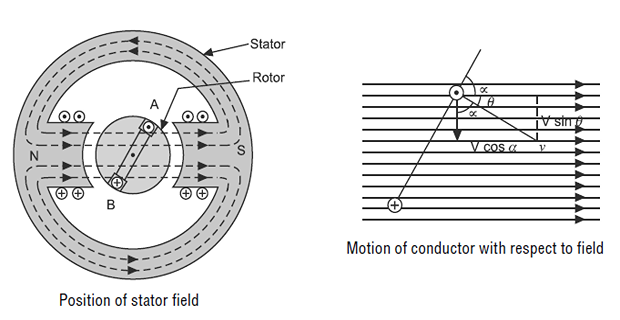
A rectangular coil of active length \(l\) and radius \(r\) (half its width) rotates clockwise at a constant angular velocity \(\omega\) rad/s in a uniform field \(B\). Each coil side moves at \(v = \omega r\). When the coil plane has turned through \(\theta = \omega t\) from the neutral position, the velocity component perpendicular to the field is
EMF in one conductor: \(e = Blv\sin\theta\).
The two sides of a turn are under opposite poles, so their EMFs add: \(e = 2Blv\sin\theta\).
For \(N\) turns: \(e = 2NBlv\sin\theta\).
Substituting \(v = \omega r\) and the coil area \(A = 2rl\):
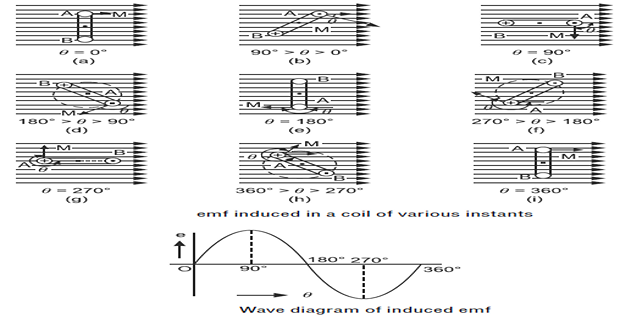
Equivalently, the flux linkage is \(\lambda = NBA\cos\omega t\), and \(e = -d\lambda/dt = NBA\omega\sin\omega t\).
Problem. A 100-turn coil of area 0.02 m² rotates at 3000 rpm in a uniform field of 0.5 T. Find the peak EMF, the RMS EMF and the frequency.
Summary
A coil rotating at constant speed in a uniform field generates a sinusoidal EMF.
\(E_m = NBA\omega\) and \(E_{rms} = E_m/\sqrt2 = 4.44fNBA\).
The frequency equals the revolutions per second for a two-pole field.
Chapter Review
MCQ 1. Doubling the speed of a rotating coil
(a) doubles the EMF and frequency (b) doubles only the frequency (c) quadruples the EMF (d) leaves the EMF unchangedShow answer
(a).MCQ 2. The EMF is zero when the coil plane is
(a) parallel to the field (b) perpendicular to the field (c) at 45° (d) neverShow answer
(b) perpendicular to the field, where the flux linkage is maximum.
Why is the EMF zero at the instant of maximum flux linkage?
How would the waveform change if the field were not uniform?