By the end of this chapter you should be able to:
Name the three characteristics and say which are electrical and which mechanical.
Derive and sketch the series motor curves, before and after saturation.
Explain why a series motor must never be started unloaded.
Derive and sketch the shunt motor curves and justify "constant speed".
Explain why a shunt motor should not be started on heavy load.
Describe the cumulative compound motor and what it borrows from each parent.
Explain why differential compound motors are unstable and rarely used.
Select a motor type for a stated duty.
The Three Characteristics
Everything in this chapter follows from the two results of Chapter 34:
| Plot | Name | Tells you |
|---|---|---|
| \(T_a/I_a\) | Electrical characteristic | How much torque for a given current |
| \(N/I_a\) | Speed characteristic | How the speed varies with current drawn |
| \(N/T_a\) | Mechanical characteristic | How the speed varies with the load |
Series Motor — Torque and Current
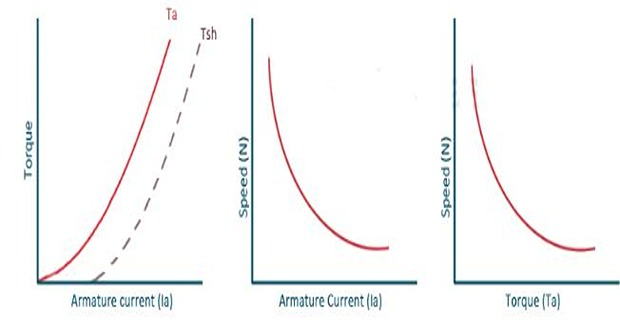
Before magnetic saturation: \(T_a \propto I_a^{2}\) — a parabola.
After magnetic saturation: the flux is fixed, so \(T_a \propto I_a\) — a straight line.
\(T_{sh} \lt T_a\) because of the stray and mechanical losses of Chapter 33.
Series motors are used where a high starting torque \(T_{st}\) is required.
Problem. A series motor develops 40 N·m at 20 A. Estimate the torque at 40 A (a) if the machine is still unsaturated, and (b) if it is fully saturated.
(a) Unsaturated. Here \(\Phi \propto I_a\), so \(T_a \propto I_a^{2}\):
(b) Saturated. The flux is fixed, so \(T_a \propto I_a\):
Comment. A factor of two between the two answers, from the same current. Saturation is not a small correction here but a change of law, and a problem that does not say which regime applies cannot be answered.
In practice a real machine passes gradually from one to the other, so the true answer lies between 80 and 160 N·m — nearer the parabola at light load and nearer the straight line at heavy load. The square law is the useful approximation for starting torque, where the current is high but the design allows for it.
Series Motor — Speed and Current
At small load the current is small, so the drop \(I_a\left(R_a + R_{se}\right)\) is small and may be neglected. Then
and therefore
a rectangular hyperbola. As \(I_a\downarrow\downarrow\) the speed \(N\uparrow\uparrow\) without limit.
With no load the current falls towards the value needed only for friction and windage. The flux falls with it, and since \(N \propto 1/\Phi\) the speed rises towards a value limited only by the point at which the armature bursts.
This is why series motors are always coupled directly to their load — geared or bolted, never belted. A belt that slips off leaves the motor unloaded and it destroys itself in seconds.
Note carefully what is "small and neglected". It is the voltage drop, not the back EMF. At light load \(E_b\) is at its largest, very nearly equal to \(V\) — which is exactly what makes it constant enough to be treated as such. Chapter 34's Section 34-3 made the same point for the shunt motor.
Problem. A 250 V series motor with \(R_a + R_{se} = 0.30~\Omega\) runs at 800 rev/min taking 50 A. Assuming the machine stays unsaturated so that \(\Phi \propto I_a\), find the speed at 25 A and at 5 A.
Back EMF at the reference condition.
Using the ratio method with \(\Phi \propto I_a\):
At 25 A.
At 5 A.
Comment. Halving the current roughly doubles the speed; reducing it to a tenth raises the speed more than tenfold. At 8460 rev/min the armature of any ordinary machine would disintegrate — and 5 A is still not "no load", merely light load.
Note where the two factors come from. The \(E_b\) ratio contributes only 5.7 % at the extreme; the flux ratio contributes the factor of ten. The runaway is entirely a flux effect, which is why it does not threaten a shunt motor whose flux is fixed.
Series Motor — Speed and Torque
Eliminating \(I_a\) between the other two characteristics gives the mechanical characteristic. Below saturation \(T_a \propto I_a^{2}\) and \(N \propto 1/I_a\), so
The speed therefore falls steeply as the load is applied and rises steeply as it is removed. As \(N\uparrow\), \(T_a\downarrow\) — the two are inversely related, which is exactly what a traction drive wants: high torque at low speed to accelerate the train, and low torque at high speed to hold it there.
Shunt Motor — Torque and Current
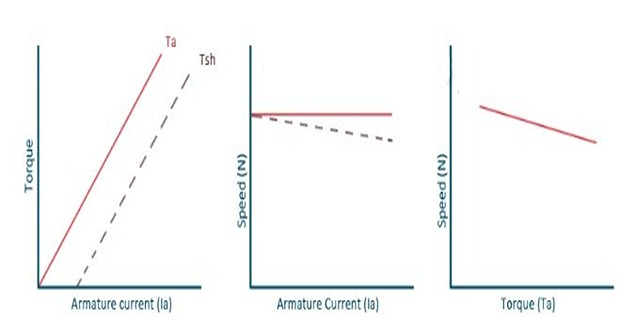
\(\Phi\) is constant. At heavy load it falls slightly, because of the armature reaction of Chapter 30.
\(T_a \propto I_a\), giving a straight line through the origin.
Since a heavy starting load would need \(I_{st}\uparrow\uparrow\), shunt motors should never be started on heavy load.
It is worth putting the two side by side, because students often confuse them.
Must not be started without load — it runs away.
Must not be started on heavy load — it draws excessive current.
The reason for the second is the linear torque law. To get three times the torque a shunt motor must draw three times the current, whereas a series motor needs only \(\sqrt{3}\) times — as Example 35.4 shows.
Shunt Motor — Speed Characteristics
\(N \propto E_b/\Phi \propto E_b\), so \(N\) is essentially constant, since \(E_b\) changes little.
With load, \(E_b\) falls slightly more than \(\Phi\) does, so \(N\) falls slightly.
Therefore shunt motors are constant-speed motors.
Because \(I_aR_a\) is only a few percent of \(V\), even a large change of load moves \(E_b\) — and hence \(N\) — by very little. This is the speed regulation of 2–8 % quoted in Chapter 34.
Armature reaction works slightly against the droop: as it weakens the flux at heavy load, \(N \propto 1/\Phi\) tends to raise the speed. In some machines the two effects nearly cancel, giving a remarkably flat characteristic; in others the flux weakening wins and the speed actually rises with load, which is undesirable and is why a few stabilising series turns are sometimes fitted.
Problem. A 220 V shunt motor has \(R_a = 0.25~\Omega\) and runs at 1000 rev/min with an armature current of 10 A. Find the speed and the torque ratio at 50 A, taking the flux as constant.
Back EMFs.
Speed.
Speed change.
Torque. With \(\Phi\) constant, \(T_a \propto I_a\):
Comment. The torque has risen fivefold and the speed has fallen 4.8 %. Compare Example 35.2, where a series motor changed speed by a factor of two for a halving of current. The contrast is the whole distinction between the two machines.
The reason is arithmetical. In the shunt motor only \(E_b\) changes, and it changes from 217.5 to 207.5 V — under 5 %. In the series motor the flux changes too, and it changes in the same proportion as the current.
Problem. A shunt motor and a series motor each develop 100 N·m at their rated 40 A. Find the torque each develops at 120 A, and the current each needs to develop 300 N·m. Take the series motor as unsaturated.
Torque at 120 A.
The series motor gives three times the torque for the same current.
Current for 300 N·m.
Comment. To triple its torque the shunt motor must triple its current; the series motor needs only \(\sqrt{3} = 1.73\) times. Since heating goes as \(I^{2}\), the shunt motor suffers nine times its rated armature loss and the series motor only three times.
This is the quantitative case for series motors in traction, hoists and cranes — and equally the reason a shunt motor should not be started against a heavy load. Both warnings of Section 35-5 come from this one comparison.
Cumulative Compound Motor
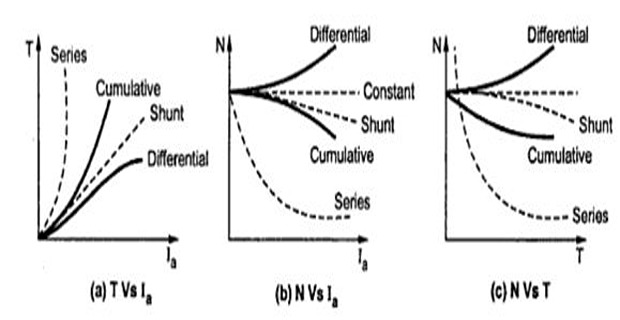
Develops a large torque at low speed, just like a series motor.
Has none of the disadvantages of the series motor at light or no load.
\(\Phi_{se}\) helps \(\Phi_{sh}\) to increase the total flux \(\Phi_T\), so the machine runs at a reasonable speed.
On no load the series flux vanishes but \(\Phi_{sh}\) remains, so the speed settles at a definite finite value — the series motor's fatal defect is removed.
On heavy load the series flux adds, so the torque rises faster than linearly and the speed droops usefully. The motor slows down when heavily loaded, which lets a flywheel give up its energy to help.
That last point is the reason for the applications in Chapter 26's table — presses, shears, punches and rolling mills. A machine that slows under a peak load draws on the kinetic energy stored in its flywheel, so the supply sees a much smaller peak than the load demands.
Differential Compound Motor
As the two fluxes oppose, the resultant flux falls as the load increases.
The machine therefore runs at a higher speed with increase in load.
It tries to run at dangerously high speed at full load.
Generally not used in practice.
Suppose the load increases slightly. The motor speeds up, which — for most loads, whose torque demand rises with speed — increases the load torque further, which speeds it up again.
The response reinforces the disturbance rather than opposing it. This is the same instability that Chapter 32 found in paralleled compound generators, and for the same structural reason: a characteristic with the wrong slope turns negative feedback into positive.
There is a second hazard. As the flux falls the torque per ampere falls too, so the motor must draw yet more current — which weakens the flux further. Under a heavy enough load the machine can lose its flux entirely and stall or reverse.
Problem. A 240 V compound motor has \(R_a + R_{se} = 0.20~\Omega\) and runs at 1000 rev/min at \(I_a = 10\) A. The series field changes the flux by 0.4 % per ampere of armature current. Find the speed and torque ratio at 50 A for cumulative and differential connection, and compare with a shunt motor.
Back EMFs. The same for all three:
Fluxes. With \(\Phi = \Phi_{sh}\left(1 \pm 0.004I_a\right)\):
Cumulative.
Differential.
Shunt, for comparison. Flux constant, so
| Connection | Speed at 50 A | Speed change | Torque ratio |
|---|---|---|---|
| Cumulative compound | 837.5 rev/min | −16.2 % | 5.77 |
| Shunt | 966.4 rev/min | −3.4 % | 5.00 |
| Differential compound | 1160 rev/min | +16.0 % | 4.17 |
Comment. Read the table as a trade. The cumulative machine buys 15.4 % extra torque with 16 % of speed droop; the differential machine gives up 17 % of its torque and gets a rising speed curve in exchange — a worse result on both counts.
That is the whole case against differential compounding for motors, and it is why the connection survives only in a few special applications. Note that the same connection was genuinely useful for a generator in Chapter 29, where a steeply drooping voltage is what arc welding needs.
Comparison and Selection
| Series | Shunt | Cumulative compound | |
|---|---|---|---|
| \(T_a\) vs \(I_a\) | \(\propto I_a^{2}\) then \(\propto I_a\) | \(\propto I_a\) | between the two |
| \(N\) vs \(I_a\) | \(\propto 1/I_a\) | nearly constant | droops moderately |
| No-load speed | infinite | definite | definite |
| Starting torque | very high | moderate | high |
| Speed regulation | very poor | 2–8 % | 10–25 % |
| Must not be | run unloaded | started on heavy load | — |
| Applications | Traction, cranes, hoists, trolleys, winches | Lathes, fans, pumps, conveyors, machine tools | Presses, shears, punches, rolling mills, lifts |
Summary and Key Formulas
Three characteristics: \(T_a/I_a\) (electrical), \(N/I_a\), and \(N/T_a\) (mechanical — the one that matters in practice).
Series motor torque: \(T_a \propto I_a^{2}\) before saturation (a parabola), \(T_a \propto I_a\) after (a straight line). \(T_{sh} \lt T_a\) because of stray losses.
Series motor speed: at light load the drop \(I_a(R_a + R_{se})\) is small, so \(E_b \approx V\) and \(N \propto 1/\Phi \propto 1/I_a\) — a hyperbola.
A series motor must never be started without mechanical load. It has no finite no-load speed.
Series mechanical characteristic: \(N \propto 1/\sqrt{T_a}\) below saturation.
Shunt motor: \(\Phi\) constant, so \(T_a \propto I_a\) (a straight line) and \(N \propto E_b\) — nearly constant. Never start on heavy load, since torque needs current in direct proportion.
Cumulative compound: \(\Phi_T = \Phi_{sh} + \Phi_{se}\). Large torque at low speed like a series motor, but with a definite no-load speed because \(\Phi_{sh}\) survives when the load goes.
Differential compound: the fluxes oppose, so \(\Phi\) falls with load and the speed rises. Unstable and generally not used.
| Quantity | Relation | Notes |
|---|---|---|
| Governing pair | \(T_a \propto \Phi I_a\), \(N \propto E_b/\Phi\) | everything follows |
| Series torque, unsaturated | \(T_a \propto I_a^{2}\) | parabola |
| Series torque, saturated | \(T_a \propto I_a\) | straight line |
| Series speed | \(N \propto 1/I_a\) | hyperbola; \(E_b \approx V\) |
| Series mechanical | \(N \propto 1/\sqrt{T_a}\) | no finite no-load speed |
| Shunt torque | \(T_a \propto I_a\) | straight line |
| Shunt speed | \(N_2/N_1 = E_{b2}/E_{b1}\) | 2–8 % regulation |
| Speed ratio, general | \(\dfrac{N_2}{N_1} = \dfrac{E_{b2}}{E_{b1}}\dfrac{\Phi_1}{\Phi_2}\) | use for every type |
| Series flux ratio | \(\Phi_2/\Phi_1 = I_2/I_1\) | unsaturated only |
| Compound flux | \(\Phi_T = \Phi_{sh} \pm \Phi_{se}\) | + cumulative, − differential |
Common Mistakes
Saying the back EMF is small at light load. It is at its largest. What is small and neglected is the \(I_aR\) drop.
Applying \(T_a \propto I_a^{2}\) to a saturated series motor. Past the knee the flux is fixed and the law is linear.
Forgetting the flux ratio for a series motor. \(N_2/N_1\) needs \(\Phi_1/\Phi_2 = I_1/I_2\) as well as the \(E_b\) ratio.
Confusing the two starting warnings. Series: never without load. Shunt: never on heavy load.
Belt-driving a series motor. A slipped belt removes the load and the motor runs away.
Thinking a shunt motor's speed is exactly constant. It droops a few percent, and armature reaction partly offsets even that.
Expecting a compound motor to have a series motor's starting torque. It is high, but not as high — the shunt flux is present throughout.
Assuming differential compounding is merely a poor choice. Its rising speed curve is genuinely unstable.
Carrying over the generator conclusion. Differential compounding is useful for a welding generator and bad for a motor.
Reading the \(N/I_a\) curve as though the load set the current. The load sets the torque; the current follows.
Chapter Review
For a series motor remember both ratios — \(E_b\) and flux. For a shunt motor only \(E_b\) changes.
P35.1 A series motor develops 25 N·m at 15 A. Find the torque at 45 A if unsaturated, and if fully saturated.
Show answer
\[\text{unsaturated: } 25\left(\frac{45}{15}\right)^{2} = (25)(9) = 225~\mathrm{N\,m}\]\[\text{saturated: } 25\left(\frac{45}{15}\right) = 75~\mathrm{N\,m}\]P35.2 A 200 V series motor with \(R_a + R_{se} = 0.40~\Omega\) runs at 600 rev/min at 40 A. Find the speed at 20 A, unsaturated.
Show answer
\[E_{b1} = 200 - 16 = 184~\mathrm{V}, \qquad E_{b2} = 200 - 8 = 192~\mathrm{V}\]\[N_2 = 600\left(\frac{192}{184}\right)\left(\frac{40}{20}\right) = (600)(1.0435)(2) = 1252~\mathrm{rev/min}\]P35.3 For P35.2, find the speed at 8 A and comment.
Show answer
\[E_{b2} = 200 - 3.2 = 196.8~\mathrm{V}\]Over five times the rated speed at a fifth of the current — and 8 A is still not "no load". The machine would fly apart before the current reached zero.\[N_2 = 600\left(\frac{196.8}{184}\right)\left(\frac{40}{8}\right) = (600)(1.0696)(5) = 3209~\mathrm{rev/min}\]P35.4 A 250 V shunt motor with \(R_a = 0.20~\Omega\) runs at 1200 rev/min at 15 A. Find the speed and torque ratio at 60 A.
Show answer
\[E_{b1} = 250 - 3 = 247~\mathrm{V}, \qquad E_{b2} = 250 - 12 = 238~\mathrm{V}\]\[N_2 = 1200\left(\frac{238}{247}\right) = 1156.3~\mathrm{rev/min}\]Four times the torque for a 3.8 % speed drop.\[\frac{T_2}{T_1} = \frac{60}{15} = 4.00\]P35.5 Two motors each give 60 N·m at 30 A. What current does each need for 240 N·m?
Show answer
\[\text{shunt: } I = 30\left(\frac{240}{60}\right) = 120~\mathrm{A}\]The series motor needs half the current, so a quarter of the armature copper loss.\[\text{series: } I = 30\sqrt{\frac{240}{60}} = 30\sqrt{4} = 60~\mathrm{A}\]P35.6 A compound motor's flux changes by 0.5 % per ampere. It runs at 900 rev/min at 12 A with \(E_b = 230\) V. Find the speed at 48 A where \(E_b = 218\) V, cumulative.
Show answer
\[\Phi(12) = 1.060, \qquad \Phi(48) = 1.240 \quad\text{(relative to } \Phi_{sh})\]A drop of 19 %, far more than a shunt motor's.\[N_2 = 900\left(\frac{218}{230}\right)\left(\frac{1.060}{1.240}\right) = (900)(0.9478)(0.8548) = 729.2~\mathrm{rev/min}\]P35.7 Explain why a series motor must never be belt-driven.
Show answer
If the belt breaks or slips off, the motor is left unloaded. Its current falls towards the small value needed for friction and windage, and since \(\Phi \propto I_a\) the flux falls with it.Because \(N \propto E_b/\Phi\) and \(E_b\) stays close to \(V\), the speed rises towards infinity — limited only by the point at which the armature banding fails and the winding is thrown out of its slots.
Series motors are therefore always coupled directly or geared, so that the load cannot become disconnected.
P35.8 Why should a shunt motor not be started against a heavy load?
Show answer
Because its torque is directly proportional to armature current, \(T_a \propto I_a\). To develop three times the rated torque it must draw three times the rated current, and the armature copper loss goes as the square — nine times.At starting there is no back EMF to limit the current in any case (Chapter 34), so the combination is doubly severe.
A series motor needs only \(\sqrt{3}\) times the current for the same tripling of torque, which is why heavy starting duties go to series or compound machines.
P35.9 A press applies a heavy load for a fraction of a second every few seconds. Which motor, and why?
Show answer
A cumulative compound motor with a flywheel.The series field gives a high torque during the peak, and the machine's drooping speed characteristic lets it slow appreciably under that load. As it slows, the flywheel gives up kinetic energy, supplying much of the peak power mechanically.
The supply therefore sees a demand far smaller and smoother than the load itself. A shunt motor, holding its speed nearly constant, would extract almost nothing from the flywheel and would draw the full peak from the supply.
A series motor is unsuitable because the press must also run light between strokes, and a series motor has no safe no-load speed.
P35.10 Explain why a differential compound motor is unstable, and contrast with the differential compound generator of Chapter 29.
Show answer
Motor. The series field opposes the shunt field, so \(\Phi\) falls as the load rises, and \(N \propto 1/\Phi\) makes the speed rise with load. For most loads a rising speed increases the torque demand further, so the disturbance grows rather than settling.There is a second hazard: as \(\Phi\) falls the torque per ampere falls, so the motor draws more current, which weakens the flux further. Under a heavy load it can lose its flux entirely.
Generator. There the same connection gives a steeply drooping voltage characteristic, which is exactly what arc welding requires — the current self-limits when the electrode touches the work.
The same winding is useful in one machine and dangerous in the other, because a drooping output characteristic is stable and a rising one is not.
MCQ 1. The mechanical characteristic of a motor is:
(a) \(T_a/I_a\) (b) \(N/I_a\) (c) \(N/T_a\) (d) \(E_b/I_a\)Show answer
(c) \(N/T_a\). The \(T_a/I_a\) curve is the electrical characteristic.MCQ 2. Before saturation, a series motor's torque varies as:
(a) \(I_a\) (b) \(I_a^{2}\) (c) \(\sqrt{I_a}\) (d) \(1/I_a\)Show answer
(b) \(I_a^{2}\), a parabola, because \(\Phi \propto I_a\) as well.MCQ 3. The speed of a series motor varies approximately as:
(a) \(I_a\) (b) \(I_a^{2}\) (c) \(1/I_a\) (d) constantShow answer
(c) \(1/I_a\) — a rectangular hyperbola, since \(E_b \approx V\) and \(\Phi \propto I_a\).MCQ 4. A series motor must never be:
(a) started on load (b) run unloaded (c) reversed (d) gearedShow answer
(b) run unloaded — it has no finite no-load speed.MCQ 5. The mechanical characteristic of an unsaturated series motor is:
(a) \(N \propto T_a\) (b) \(N \propto 1/T_a\) (c) \(N \propto 1/\sqrt{T_a}\) (d) \(N \propto \sqrt{T_a}\)Show answer
(c) \(N \propto 1/\sqrt{T_a}\), from \(N \propto 1/I_a\) and \(T_a \propto I_a^{2}\).MCQ 6. A shunt motor's torque-current characteristic is:
(a) a parabola (b) a straight line (c) a hyperbola (d) horizontalShow answer
(b) a straight line through the origin, since \(\Phi\) is constant.MCQ 7. A shunt motor should not be started on heavy load because:
(a) it would run away (b) it would need excessive current (c) the flux would collapse (d) it would reverseShow answer
(b) it would need excessive current, since torque is only linear in current.MCQ 8. A cumulative compound motor has a no-load speed that is:
(a) infinite (b) definite (c) zero (d) negativeShow answer
(b) definite, because the shunt flux remains when the series flux vanishes.MCQ 9. In a differential compound motor, as load increases the speed:
(a) falls (b) rises (c) is constant (d) oscillatesShow answer
(b) rises, because the resultant flux falls — which is why the machine is unstable.MCQ 10. The motor best suited to a press with a flywheel is:
(a) series (b) shunt (c) cumulative compound (d) differential compoundShow answer
(c) cumulative compound — it slows under the peak load, letting the flywheel give up its energy.
Name the three characteristics and say which is of most practical importance and why.
Derive the torque-current characteristic of a series motor before and after saturation.
Derive the speed-current characteristic of a series motor, stating carefully what is neglected.
Explain why a series motor must never be run without mechanical load.
Justify calling the shunt motor a constant-speed machine, and state the role of armature reaction.
Explain why a shunt motor should not be started against a heavy load.
Describe the cumulative compound motor and say what it takes from each of its parents.
Explain the instability of the differential compound motor, and contrast with the generator case.
Both of this chapter's warnings concern starting, and Chapter 34 left a third unanswered: with \(E_b = 0\) at rest, the armature current would be twenty to thirty times rated. Chapter 36 deals with all three together. A starter inserts resistance in the armature circuit and cuts it out in steps as the back EMF builds, and the same device carries a no-volt release — which also protects against the field failure of Chapter 34 — and an overload release.
Chapter 37 then turns the same equations to a different purpose. The relation \(N \propto E_b/\Phi\) offers three handles on speed — the flux, the armature circuit resistance and the applied voltage — and each gives a distinct method with its own range and efficiency. Field control raises the speed above rated; armature control lowers it below.
Chapter 38 covers braking, where a motor is made to act as a generator to bring its load to rest, and Chapter 39 the testing methods — Swinburne, Hopkinson and retardation — that measure the losses of Chapter 33 without loading the machine fully.