Demonstrative Video
Hunting in Synchronous Machines
Oscillation of rotor about its equilibrium or steady state position
Because of hunting the synchronous motor is not self starting
Hunting means momentary fluctuations in rotor speed.
In synchronous machine magnetic locking take place between rotor and stator, known as Cogging
A suddenly change in load causes sudden change in torque or load angle
Rotor oscillates about steady state position because of moment of inertia
Produced large variation in currents.
Its produced mechanical stresses on rotor shaft.
Its lead to loss of synchronism.
When fault occur in system.
Suddenly Change in load.
Suddenly change in excitation.
Effect of hunting:
- Produced large variation in currents.
- Its produced mechanical stresses on rotor shaft.
- Its lead to loss of synchronism.
Causes of hunting:
- When fault occur in system.
- Suddenly Change in load.
- Suddenly change in excitation.
Method to remedies for hunting
- There are two methods :- By using flywheel:
- The prime mover is fitted with a flywheel.
- It increase the inertia and maintains the rotor speed constant.
- By using damper winding
Damper Winding
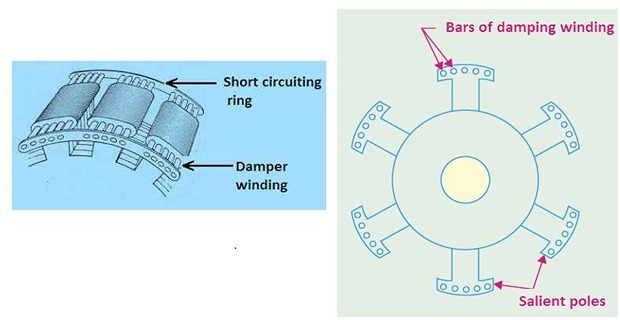
SM have their pole-shoes slotted for placing copper bars
Copper bars are placed in these slots and short-circuited at both ends by heavy copper rings (like squirrel cage rotor of IM’s)
This arrangement is known as damper winding, and performs two functions:
provides starting torque
prevents hunting
When rotor rotates at \(N_s\), then the relative velocity between the RMF and the rotor is zero
Hence induced EMF in the damper winding is zero
Thus, under normal running conditions, damper winding does not carry any current